Both stones are already in the ground here
Sint Maarten’s bedrock is volcanic. Andesite tuff and tuff breccia were intruded by hypabyssal basalt, quartz diorite and younger andesite, with limestone and marl deposited later on top of the eroded volcanics. So neither material is exotic on this island and neither needs selling as a novelty. What is imported is a processed product: units sawn to a set thickness, sorted into repeatable lots and given a named finish. Nor is this a contest between the two. A single property can reasonably carry both, and the useful question is which areas get which. The local rock has standing of its own here, too: a sample of the Point Blanc formation is held in the Sint Maarten Museum.
What exposure means on this island
Exposure on a small hilly island changes over a short distance. We are describing it by orientation and setting rather than quoting a local design figure, because Sint Maarten specific coefficients are not something we will state without a source.
- The eastern shore around Dawn Beach and Oyster Pond faces open Atlantic weather directly.
- Great Bay and Simpson Bay sit leeward, with a gentler wind and spray picture.
- Hillside plots across the Sint Maarten Hills and Cole Bay Hills bring falls, wind funneling and drainage runs into play.
- Enclosed courtyards and shaded terraces are a different microclimate again, whatever the coast is doing.
Where limestone earns its place
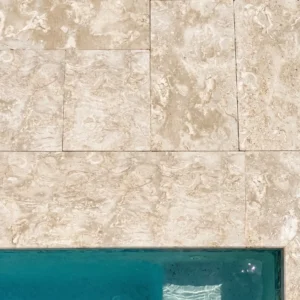
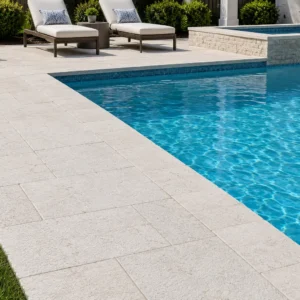
Pale limestone is the barefoot material. It reflects a larger share of solar energy than a dark surface, so it does not reach the same temperature under the same sun, and that decides pool decks, terraces and any route people use without shoes. Where the surface is walked rather than driven, the case for limestone paving here is usually the simpler one to make. The same logic carries indoors, since a floor continuing out to a terrace should be chosen for the exterior condition rather than the interior one.
- Pool surrounds, coping and the splash band around them.
- Terraces, roof decks and outdoor dining areas used through the afternoon.
- Interior floors that run out through a threshold without changing material.
- Stairs and paths people take barefoot between house, pool and garden.
Where basalt earns its place
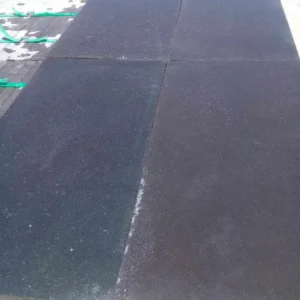
Basalt is dense and dark, and the format matters as much as the material. In heavier depths and smaller units it takes concentrated loads well, which is what suits it to the working parts of a property. Format matters more than most schedules admit: a smaller unit in a greater depth often serves better under wheels than a large slab.
- Drives, parking aprons and the areas where vehicle wheels turn and scrub.
- Service yards, bin stores and back-of-house routes at hospitality properties.
- Banding, thresholds and edge courses that frame a paler field.
- Areas where dark tone is wanted for design reasons and nobody walks barefoot.
Reading the two by exposure band
Exposure changes the emphasis rather than dictating the answer. On windward frontage, salt and wind-driven rain push the specification toward low absorption, adequate thickness and serious edge restraint, whichever stone you pick. On a leeward terrace, heat underfoot and glare rise up the list and tone matters more than salt. Under traffic, unit depth and format outrank both. So set out the areas first, note the exposure and duty of each, and only then assign materials; the drawing is a better arbiter than a showroom. Both materials sit in basalt paving in dimension-sawn formats and in the limestone ranges beside it.
What the test data should say
Whichever way the choice falls, the paperwork request is identical.
- Absorption and bulk density results for the actual lot, measured on the actual finish.
- Thickness tolerance, so the bedding can absorb variation without lipping.
- Wet slip resistance for the finish, wherever the area gets wet.
- Confirmation that the lot can be repeated if a later phase follows.
The commercial side is unusually simple
Landed cost here is not complicated by tariff. Customs Sint Maarten describes itself on the government website as mainly a law-enforcement agency rather than primarily an import-duty collecting organization, and states that the only tax it levies is on unleaded gasoline. The 5% turnover tax falls on a local seller’s revenue and is expressly not levied on imports, so it is not a border charge on a consignment. Clearance formalities still apply and a clearing agent still has a role. Construction here is routinely priced in US dollars, though the Caribbean guilder has been the official currency of the monetary union since 31 March 2025. Stone loads in the United States and discharges at Point Blanche, where the Captain David Cargo Quay works containerized and breakbulk cargo along a 540 m berth with 10.5 m alongside depth.
How to decide without guessing
Mark the plot into zones, note which are walked barefoot, which take vehicles and which face open weather. Send that with the areas and the exposure of each, since a windward frontage and an enclosed courtyard on the same plot are not the same brief. We will propose formats, thicknesses and finishes zone by zone, with test results attached and a crate count you can price. Phasing is worth stating out loud as well, so a crate ordered later matches the first. Using both materials across one property is a legitimate outcome rather than a compromise, and it is often the tidiest way to answer a mixed brief.
Let the exposure and the traffic choose the stone, and let taste choose the finish.