What Slope Means on a Flat Island
Anguilla is roughly sixteen miles long and three miles across at its widest, and Crocus Hill, at about 240 feet, is the highest ground there is. No mountain roads, no rivers. So when a contractor here talks about laying on a slope, he is describing the short, awkward level changes that come with building on a low limestone shelf, most of them made by an excavator rather than by nature.
- The rise from the public road up onto a villa platform at Meads Bay or Barnes Bay
- A terrace stepping down to a pool deck in three or four shallow falls
- Cliff-top ground above Little Bay, where the drop sits at the edge rather than under the paving
- Made ground over cut rock, where the fall is a design decision
- Ramped service access that still has to take a delivery truck
Why Small Units Cope With Uneven Ground
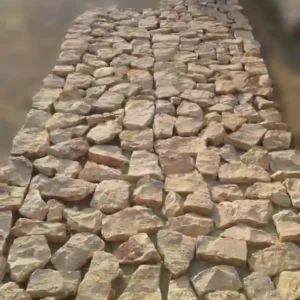
A large slab has to sit true across its whole face. Any twist in the ground beneath shows up as a rock underfoot or a lipped arris you can catch a sandal on. A sett is small enough that each piece takes its own bed and its own line, so the surface absorbs tolerance joint by joint instead of fighting it. A fall can be turned gradually through the coursing rather than announced in one abrupt step.
Reading the Subgrade of Thin Soil Over Rock
This is a coral limestone island from shore to shore, and the soil cover over that rock is thin and poor. A shallow dig often finds solid material almost at once. That is a sound bearing surface, but it produces a mixed one: rock under some panels, imported fill under others, and two different settlement rates meeting somewhere under your finished surface.
- Probe across the whole area before levels are fixed, not just at the corners
- Map where rock ends and fill begins, then keep that line off the main sight lines
- Build fill up in thin layers and compact each one rather than one deep lift
- Detail a movement joint where a rigid bed crosses from rock onto fill
Shedding a Short, Heavy Downpour
Anguilla receives the least rainfall in the Lesser Antilles, somewhere near thirty-five to forty inches a year, and it arrives unevenly. February and March can be bone dry; September and October can deliver a month of it in an afternoon. Because the island lives on rainwater catchment, wells and desalinated supply, every hard surface is a potential collector, so where the water goes is a supply question and not only a puddle question. That is the real reason setts that follow a fall are set out with the run-off plan open on the table.
- Fall the surface toward planting, a soakaway or a tank feed rather than at a threshold
- Keep the crossfall consistent so a burst does not pond in the low panel
- Allow for dry-season dust and grit washing into joints on the first heavy rain
- Check that a ramped apron does not deliver its whole catchment onto the road
Grip When a Dry Surface Suddenly Wets
The island is nowhere more than three miles wide, so the trade winds carry salt aerosol across all of it. There is no genuinely sheltered inland zone. After a long dry spell a surface carries fine salt dust, and the first minutes of rain turn that film slick before it washes clear. On a fall, those minutes are exactly when someone is walking down to the pool. Specify a texture that keeps its bite wet, and keep joints tight and full so the pattern itself gives the foot something to work against.
Restraint Is What Holds a Fall Together
Every sett surface on a gradient is trying, slowly, to walk downhill. What stops it is restraint at the perimeter and discipline in the coursing. Run courses across the fall rather than down it wherever the pattern allows, so each course braces the one below. Haunch the outer edge properly, use a cut edging or a curbstone at any free margin, and never rely on a soft planted edge to hold a laid field. On steeper ramps, a bound bed and a full jointing mortar are worth the extra day.
Bedding and Jointing Choices
Bedding decisions on falling ground are less about fashion than about what happens in year five. Loose bedding sand migrates downhill under wheel load and washing rain; on anything approaching a ramp it is the wrong choice. Full technical notes sit with our Anguilla project supply notes, but the short version is straightforward.
- Level terraces can take an unbound bed if the perimeter restraint is honest
- Ramps, aprons and vehicle routes want a bound bed on a concrete base
- Joint width should stay uniform, since a widening joint on a fall fills with grit
- Cut units at the head and foot of a ramp deserve full support, not a sliver of bed
Getting the Stone to Site
Road Bay at Sandy Ground handles the island’s commercial cargo, and freight from the US mainland commonly routes through a regional hub port before the short feeder run across the Anguilla Channel. That means your consignment is handled twice, so crate construction and banding matter more here than on a direct-call island. Commercial loads clear through Anguilla Customs on the ASYCUDA World system, normally through a registered broker, with duty assessed on CIF value and a nine percent Import Goods Tax applied on CIF since the first of August 2025. Order the stone for a sloping site early, because the fall is the part of the job you cannot rush.