The Apron Works Harder Than the Drive
Every driveway has one small area that takes far more abuse than the rest: the apron where the drive meets the road or the gate. That is where vehicles slow, turn, stop and start, where the wheels are loaded and steered at the same moment, and where the construction below is asked to resist twisting rather than simple pressure. On a Grenadian villa plot the apron usually sits on a grade change as well, because the road is rarely level with the parking. Build it like the rest of the drive and it will fail first. Build it properly and the rest of the drive tends to look after itself.
What a Turning Wheel Actually Does
A tire that turns while the vehicle is barely moving does something a rolling wheel never does. It scrubs. The contact patch pivots against the surface and drags the top layer sideways, and small units are exactly where that force finds its weakness.
- Loose bedding material creeps sideways, leaving units low and rocking within months.
- Joints open under repeated scrubbing, then fill with grit and lose whatever bond they had.
- Units migrate toward the outside of the turn, where the restraint has to take the load.
- Thin units crack across the middle long before the bed underneath ever fails.
Depth, Bedding and Base
Almost nothing about an apron is decided by appearance. It is decided by the vehicle, the turning radius and the ground underneath.
- Specify depth by duty: foot traffic, cars, or occasional delivery and service vehicles.
- Use a bound bed and a bound joint anywhere a vehicle turns while it is stationary.
- Compact the sub-base in layers rather than in one deep lift, and check that it drains.
- Keep base thickness generous on the line a truck or a service vehicle will cross.
- Allow for the construction phase itself, when heavy plant crosses the same ground before paving goes down.
The Layer Under Your Imported Stone
Here is a point worth stating plainly. Imported paving is a calibrated wearing surface, and it always sits on a base course. In Grenada that base course is very likely crushed basalt from the Telescope quarry in St Andrew, produced by the state-owned Gravel, Concrete and Emulsion Corporation, with a smaller gravel operation at Mon Rush. Grenadian basalt is the aggregate behind the island’s roads and concrete, and on a driveway it is doing the structural work beneath the surface you actually see. Imported dimension stone is a different product class doing a different job: the size-sorted, calibrated layer on top. The two are not competitors. They are two halves of one detail, and an apron built without a sound local base course will not last whatever is laid over it.
Driving on the Left and Wheel Tracks
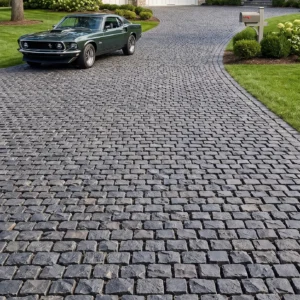
Grenada drives on the left, and that single fact decides where the wear lands. Vehicles swing in from the left-hand side of the road, so one side of the apron takes the tighter arc and the heavier scrub. On a narrow lane the swing is tighter again, and drivers cut the corner because there is no room to do anything else. Look at any older apron on the island and the worn arc is obvious from the gate. Build depth and restraint into that arc rather than spreading them evenly, and where the gate is narrow, extend the paved area a foot or two past the theoretical swept path, since the real path is always wider than the drawing. Choosing sett formats sized for vehicles at the outset avoids a rebuild in year three.
Holding the Edge
An apron fails at its edge long before it fails in the field. Every unit in the middle is held by its neighbors; the outer course is held by whatever you decided to put there.
- Set a continuous restraint on every free edge, haunched in concrete below finished level.
- Avoid narrow cut closers against the restraint, because a thin sliver breaks out under a wheel.
- Where the apron meets asphalt, detail that joint deliberately instead of butting stone to a soft edge.
- Keep the restraint at or below finished surface level so nothing catches a low bumper.
- Inspect the edge again after the first heavy season, since that is when any movement shows.
Cut stone does this job well, and edge restraint that stays put costs a great deal less than relaying an apron.
Gradient, Gates and Thresholds
Aprons on sloping plots carry a second problem: the transition. A vehicle crossing from a level road onto a rising drive will ground out if the change happens over a short distance, and the paving takes that impact every time. Ease the grade change over as long a run as the plot allows and keep the first stretch inside the gate as gentle as you can. Drainage matters here too. An apron that sheds toward the gate sends water straight into the road, and one that sheds toward the house sends it under the door. Fix the cross-fall and the collection point before levels are agreed, not after the setts are down.
Ordering for a Driveway
When you ask for a price on apron work, the useful information is short.
- The heaviest vehicle that will use it, and how often it comes.
- The gate width and the turning space available on each side of it.
- The grade difference between road level and the parking area.
- Whether the existing base is sound, or the job starts from dug ground.
An apron built for the turn rather than for the traffic count is the one detail that keeps a stone driveway looking new.