Wet grip comes first, not last
On a steep, wet, high-rainfall island, slip resistance is not something to settle after tone and format have been agreed. It is the first-order requirement and the rest of the scheme is arranged around it. Grenada’s wet season runs from June into December, the ground falls away sharply from most coastal plots, and a pool surround is wet by definition every day of the year. Any specification that treats grip as an afterthought gets corrected later by somebody with a grinder, at several times the cost and with a far worse result. Deciding texture early also costs nothing at the drawing stage, because the same stone is usually available in several worked finishes and the choice can be priced before anything is ordered.
What actually makes a surround slippery
Slips rarely have a single cause. Usually three or four small decisions stack up quietly until the margin disappears, and the individual choices all looked reasonable at the time.
- A polished or over-smooth face chosen from an indoor photograph.
- A flat surface with no fall, so a film of water sits rather than runs away.
- Algae or biofilm growing in shade through the seven-month wet season.
- Sunscreen and body oils building up on coping in heavy-use areas.
- Sand and grit tracked in from the beach acting like ball bearings on a smooth face.
The finishes that grip
Texture works by giving water somewhere to go and giving skin something to key against. There is a usable range between glassy and punishing, and most decks need more than one point on it.
- Bush-hammered: a strong mechanical texture, well suited to ramps and step treads.
- Brushed or antiqued: softened texture that keeps grip while staying comfortable barefoot.
- Sandblasted: a fine, even roughness carried across the whole face.
- Flamed on dense stone: an open, aggressive texture for the wettest zones.
- Split or riven faces: strong natural variation, best kept off routes walked barefoot at speed.
Grip versus barefoot comfort
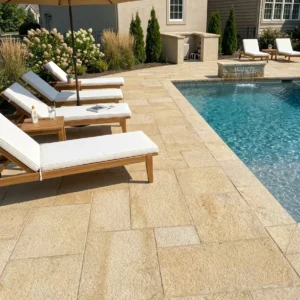
The two pull against each other, and balancing them is the whole craft of a pool surround. A texture aggressive enough to hold a wet shoe on a slope can be unpleasant under the soles of a swimmer who has just climbed out. The usual answer is to zone the deck: a softer texture on the immediate coping and lounging area where people move slowly and barefoot, and a firmer texture on steps, ramps and the routes carrying traffic in from the garden. Zoning also spends the texture budget where it does real work, which is how paving specified by wet grip tends to be planned on resort decks here.
Falls, joints and where the water goes
Finish alone will not rescue a badly drained deck. Highland rainfall in Grenada climbs toward 3,800 mm a year and even the coastal belts see around 1,500 mm, so the water needs a route designed for it rather than left to find its own.
- Design a consistent fall away from the pool and the building, never toward them.
- Size channels and outlets for the wet-season peak, not the annual average.
- Keep joints free-draining and maintainable rather than sealed hard.
- Never let a deck drain across a step nosing or a threshold.
Chlorine, salt water and rinse-down
Pool chemistry and sea spray both leave residue on stone. Chlorinated splash-out and salt-system water carry dissolved solids that remain behind once the water evaporates, and on the Atlantic-facing east coast the wind delivers considerably more. Lower absorption limits how far any of that travels into the unit, and a habit of rinsing with clean fresh water does most of the rest. On a resort deck the maintenance routine belongs in the handover pack, because the crew looking after it will change several times over the life of the paving. Write down the cleaning method, the frequency and what must never be used on the stone, and the surface will still be behaving properly in ten years.
Steps, coping and the edge detail
Most incidents happen at a change of level, which is where specification attention pays back fastest. Treat every step and every coping run as a separate small design problem with its own answer.
- Keep riser heights consistent across an entire flight, without exception.
- Give nosings a defined edge that still reads clearly when the tread is wet.
- Use a visible tone or texture change at the top and bottom of every flight.
- Set coping slightly proud with a clean drip edge so water leaves the surface.
- Restrain the outer edge properly so no unit can rock underfoot.
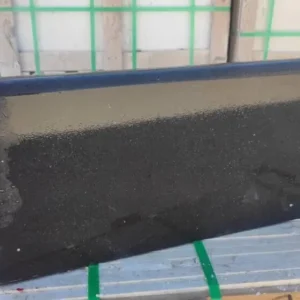
If you want to handle the finishes that bite underfoot in person, wet them before you decide anything.
Trial it wet before you buy
Slip data on paper is measured in a laboratory, on a clean dry sample, under controlled conditions. A Grenadian pool deck is none of those three things. Get a sample, wet it, tilt it, walk it barefoot and then walk it again in wet sandals. Repeat the exercise after the sample has sat outdoors for a few weeks and picked up real surface conditions, because a brand-new face and a weathered one do not always behave the same way. Do it with the finish you actually intend to order rather than whichever piece happens to be nearest, since two textures of one stone can give completely different answers. The sample you slip on during a test is the sample that saved you a claim.