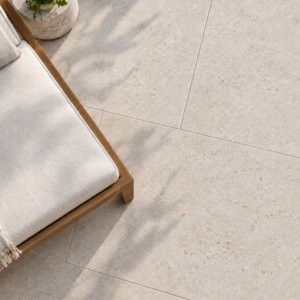
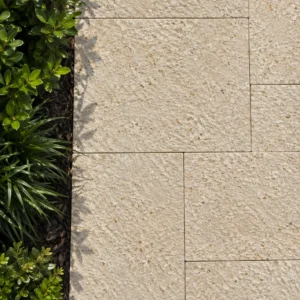
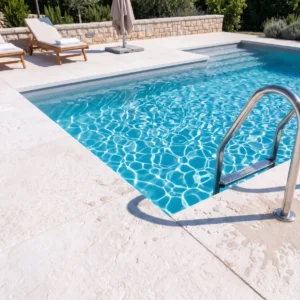
Absorption matters here; freeze-thaw does not
Most paving datasheets lead with freeze-thaw cycling. On a tropical volcanic island that number tells you almost nothing. The cycle that ages stone in Grenada is a different one: long saturation through the wet months, hard drying under high sun, then saturation again the following week. Absorption tells you how much water a unit takes on during that cycle. Density and compressive strength tell you whether it stays sound while carrying load in a saturated state. Read the three together and you have a specification you can defend.
What the rainfall actually does to a terrace
The dry season runs roughly January through May and the wet season June through December, with the heaviest monthly totals between June and November. The northern and southern coastal belts take around 1,500 mm a year, close to 60 inches. Move inland toward the central highlands and that climbs toward 3,800 mm, around 150 inches. A terrace at Grand Anse and a terrace on the approach to Grand Etang are not the same commission. Carriacou and Petite Martinique sit at the dry end of the national range and can face genuine drought in the first half of the year, which shifts the jointing conversation rather than ending it.
Reading an absorption figure without guessing
An absorption percentage is only useful when you know what was measured, on which unit, and by what method. Ask for the paperwork in writing before you ask for a price. A supplier who cannot produce it on request is quoting from a brochure rather than from a tested batch.
- The tested value for the exact stone type and finish you intend to buy, not a family average.
- Whether the figure is expressed by weight, and which saturation method produced it.
- Density or bulk specific gravity quoted alongside it, since the two move together.
- Compressive strength, tested in the wet condition wherever the producer can supply it.
- The production window or batch the numbers actually belong to.
Density, thickness and the load above
Density on its own does not carry a vehicle. Thickness, the bedding and the base course beneath do most of that work, and the stone has to be matched to them rather than asked to compensate for them. A villa terrace at Lance aux Epines can run thinner than a driveway apron taking a delivery truck twice a week, and paying for driveway thickness across a whole garden is money spent on nothing. Every line of stone with published absorption values that we hold for this market is quoted by thickness for exactly that reason.
- Pedestrian terraces and pool surrounds: thinner calibrated units on a well-drained bed.
- Shared courtyards with occasional light vehicles: increase thickness before you chase a harder stone.
- Driveways and turning areas: full vehicular thickness, tight joints and restrained edges.
- Steep approaches: smaller units, more joints, and falls sized for the runoff the slope collects.
Algae, moss and the staining question
Seven wet months grow things. Biological growth is the most common complaint on island paving, and it is a drainage and exposure problem long before it is a stone problem. A shaded terrace under mature trees will green over whatever the material. What the stone genuinely controls is how easily that growth lifts off the surface and whether it leaves a shadow behind once it does.
- Lower absorption usually means shallower staining and easier cleaning.
- Open, free-draining joints dry faster than sealed joints that hold water in place.
- Textured finishes trap more surface debris but shed water better on a fall.
- A small consistent gradient beats a dead-level slab in every season of the year.
- Trees, walls and roof overhangs decide shade, and shade decides growth.
Salt on the windward side
Specify by coast, not by island. The Atlantic-facing east, from Grenville down past La Sagesse and north toward Bathway and Levera, takes driven salt spray and steady wind. The sheltered Caribbean west, Grand Anse through the Carenage, is a far gentler environment for identical material. Salt crystallization inside a porous stone is the mechanism that replaces freeze-thaw here: salt travels in with water, the water leaves, the crystals stay and grow. Low absorption is the cheapest defense available, and it costs nothing at the specification stage.
Landing the material in St George’s
Material arrives through the Port of St George’s, where the main quay runs 335 meters with depth alongside of between 8.3 and 9.8 meters, backed by four transit sheds. Tropical Shipping sails from the Port of Palm Beach in Florida and King Ocean operates an Eastern Caribbean service. If you would rather handle freight and clearance as one conversation, that is the job our Grenada supply and clearance route was built to do.
- Grenville is not a container alternative: its single pier carries roughly 3.0 meters alongside at the head.
- An Atlantic-side project therefore clears in St George’s and trucks across the island.
- Carriacou and Petite Martinique need a separate cargo-boat leg; pallets of stone do not travel on the Osprey.
- Duty is assessed under the CARICOM Common External Tariff on CIF value, then VAT at the standard 15% applies to CIF plus duty.
- A Customs Service Charge applies as well; confirm the current rate with your broker rather than budgeting from a figure found online.
Test it before you commit
Paperwork narrows the field. A physical sample settles it. Wet a piece and stand on it barefoot, leave it outdoors through a run of rain, then scrub it and watch the surface. Samples are small, they travel easily, and one is a trivial expense beside the price of lifting a laid terrace. Ask for the absorption figure, ask for the sample, then order with confidence.