Frost Is Not the Test Here
Most paving literature ranks stone by freeze-thaw performance. In the Turks and Caicos Islands that figure is decoration, because it never freezes. The wear mechanism on a Provo terrace is salt. Spray and groundwater carry it into the stone, the surface dries hard in the sun, the salt crystallizes, and the growing crystals push outward from inside the pore. Repeat that cycle season after season and the face powders, spalls or sheds a thin layer at a time.
So the useful question is not whether a paver survives ice. It is how much salt-bearing water the stone takes in, how fast it gives that water back, and how strong the material is around each pore.
What Absorption Actually Measures
Absorption is the weight of water a dried sample takes on when soaked, expressed against its own dry weight. A low figure means less connected pore space. In practice that tells you three things at once: how much dissolved salt can travel inward, how long the surface stays dark after rain, and how exposed the face is to staining from sunscreen, drinks and grill grease on a working resort terrace.
Density is the companion number, and the two are only useful together. Two samples can share an absorption result while one is a tight-grained limestone and the other is an open, chalky material with a well-sealed skin. Ask for both figures, and ask for them on the batch you are buying rather than on a generic brochure page.
Density, Grain and the Salt Cycle
Salt does not stop at the beach line. These islands sit on a low, flat limestone platform, and spray carries much further inland than most owners expect.
- A dense, fine-grained stone slows the inward travel of salt solution and keeps crystal growth nearer the surface.
- Coarse, open-pored material lets solution move deep, then fails below the face where nothing warns you.
- Drying speed matters as much as intake, and TCI is arid to semi-arid, so surfaces dry hard between rain events.
- Thickness buys tolerance, because a heavier unit keeps sound material in reserve under any surface loss.
- Sheltered courtyards and open beach frontage on one property deserve different specifications.
Reading a Test Sheet Before You Order
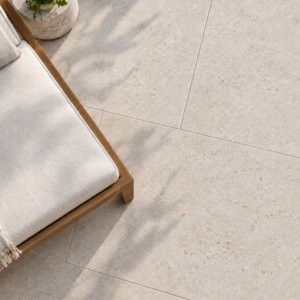
Freight to these islands is expensive enough that a wrong specification hurts twice, once at landed cost and again at replacement. Before committing, ask for documented absorption and density on the production run, then confirm finish, thickness and sorting standard. The tight-grained limestone units we stock are described by format and finish so comparisons stay like for like.
- Absorption and density from the same batch, not a range across a whole deposit.
- Finish named precisely, since a brushed face and a honed face behave differently in salt air.
- Thickness confirmed against the traffic the area will actually take.
- A small hand sample sent ahead so tone and texture are judged in island daylight.
Bedded and Bonded, Not Dry Laid
Specification alone does not save a terrace here. Storm surge and burst rainfall both move water under paving, and a dry-laid field on an exposed frontage can lift, migrate or wash out its jointing. Reinforced poured concrete is the structure of choice across TCI for good reason, and paving laid onto a properly drained bonded bed inherits that stability.
Where a permeable build-up is wanted, keep it back from the most exposed edges and give the perimeter a restrained, bonded margin. The principle behind the post-Ike code strengthening is simple: the more exposed the position, the more the paving should belong to the slab rather than sit loose on it.
The Fixings Fail Before the Stone
Salt-laden air corrodes standard metals quickly, and the first failure on many island terraces is not the paving at all.
- Use stainless fasteners for anything holding stone, trim or railings.
- Avoid cast zinc alloys entirely, because they do not last in this atmosphere.
- Keep ferrous banding and clips out of the build-up, including hidden restraint strips.
- Rinse hardware and stone with fresh water after storms to slow the salt load.
Rain Arrives All at Once
The islands take roughly forty-three inches of rain a year, and it does not arrive politely. It comes in heavy concentrated periods, which means falls, channels and outlets have to be sized for the burst rather than the annual average. On a flat limestone platform that drains poorly, standing water is the default unless the design fights it.
Falls away from buildings, generous joint drainage and outlets that can be cleared by hand all pay for themselves. Where ground is low-lying, keep lower levels for parking and plant rather than living space.
Landing Stone on Provo and Beyond
South Dock on Providenciales handles the great majority of national port traffic, and its physical limits shape every delivery. Draft is about eleven feet and berthing suits small feeder vessels, so cargo arrives on shallow-draft ships and barges direct from Florida rather than through a regional hub. Freight and clearance are set out on the Turks and Caicos stone hub stage by stage.
- Quote Providenciales delivered, then price outer-island legs separately.
- Grand Turk and Salt Cay have no ferry link from Provo, so they are barge work.
- North and Middle Caicos share a causeway; every other island is its own sea leg.
- Forwarder consolidation can add two to three weeks before goods are available on Provo.
Build that timeline into the order date rather than the install date. Specify the absorption figure first and the look second, and the terrace will still be sound long after the trend has passed.