The costs people forget
A sett project in the Cayman Islands has four cost centers, and most budgets take only the first one seriously. There is the stone itself, the duty assessed when it lands, the freight and handling that get it to your gate, and the labor that puts it down. On the mainland the material line dominates. Here it usually does not. Understanding that early changes the decisions people make about format, thickness and phasing, and it stops a scheme being redesigned halfway through because a cost appeared that nobody had priced. It also explains why the cheapest stone rarely produces the cheapest project. Duty, freight and labor are broadly the same whatever you lay, so the material choice moves a smaller share of the total than most people expect.
Duty is not the same on every island
The Cayman Islands have no income or property tax, so import duty carries a large share of government revenue and it is taken seriously at the border. What matters commercially is that building materials are not charged at the general rate, and that the three islands are not treated alike.
- The general rate runs at roughly twenty-two percent, with some goods higher again.
- Building materials landing on Grand Cayman attract a concessionary rate of fifteen percent.
- Cayman Brac and Little Cayman carry a full waiver of import duty on building materials, extended through the end of December 2030.
- Duty is administered by Customs and Border Control against the published tariff schedules.
- Rates and classifications change, so confirm the current rate with your broker before building a budget on it.
For a Sister Islands project that waiver is the largest single commercial fact in the exercise, and it can change what grade of stone is affordable.
Freight and the lighterage leg
George Town has no deep-water container berth. Ships lie off and cargo is barged ashore, which adds a handling stage mainland buyers never think about.
- A full container carries roughly twenty-four to twenty-six tons of stone.
- At three centimeters that is around two hundred eighty to three hundred twenty square meters, or roughly three thousand to three thousand four hundred square feet.
- Thicker vehicle-grade material covers noticeably less area for the same weight.
- Extra handling makes packing quality a cost item rather than a detail.
- Island-side trucking must be booked against real pallet weights, not estimates.
Labor is the larger half
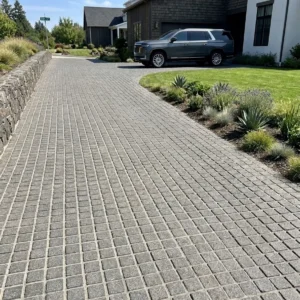
Setts are a hand-laid product. Every unit is placed individually, so labor per square foot runs higher than for large-format paving and it is the line most often underestimated. That is the honest trade: you pay more to lay them, and you get a surface that follows uneven ground, turns curves without saw cuts, and repairs in patches instead of sheets. When comparing quotes, check that everyone has priced the same base construction, because a shallow build-up under sett unit sizes and packing intended for vehicle areas will always look cheaper and always cost more later.
Phasing a large area sensibly
Phasing is normal here, and done well it costs almost nothing extra. Done badly it produces two areas that never quite match.
- Order the whole quantity at once even if you lay it in stages, so every phase comes from the same production run.
- Store later phases dry, covered and away from the other trades.
- Break phases at a natural line such as a step, a border course or a gate, never mid-field.
- Lay the entrance last if it is also the site access route.
Buying once versus buying twice
The most expensive stone in the Cayman Islands is the second shipment. A handful of extra pieces cannot travel economically to an island served by barge, so the sensible move is to build a cutting and breakage allowance into the original order and keep a small stock of spare units when the job finishes. Those spares become your repair kit for the next twenty years. Invoicing is usually in United States dollars, with the CI dollar pegged at roughly one to one dollar twenty, so the currency question is simple. The quantity question is the one worth getting right.
What to send when you ask for a quote
Good quotes come from good information, and the information is easy to gather.
- Area in square feet, with vehicle areas and foot-traffic areas separated.
- Which island the material lands on, since duty differs between them.
- Access details: road width, gate width, standing space, storage space.
- Target dates, including whether the work falls inside hurricane season.
Send those four things and ask for a written quote for setts that separates stone, freight, duty and handling into visible lines. A quote you can read is a quote you can compare.
A realistic timeline
Allow time for sampling, for production, for the ocean leg and for the barge transfer, then add contingency for weather between June and November. Projects that begin their material conversation early get better prices and calmer sites, while projects that order late pay for speed twice. Sampling early is the cheapest step in the whole sequence and the one most often skipped, and it is far easier to change a selection on a desk than on a pallet. Nothing about buying stone for a Cayman project is difficult, but almost all of it rewards being early. Plan the chain from quarry to gate and the budget stops surprising you.