Why curves are easy in small units
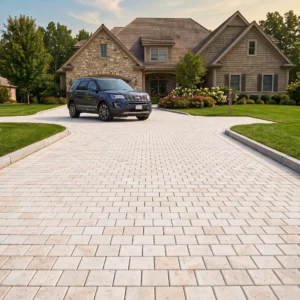
Geometry decides this one. A curve is a straight line that changes direction continuously, and any paving module has to approximate it in steps. The smaller the module, the smaller each step, and below a certain size the eye stops registering steps at all and simply sees a curve. That is the whole trick. Setts do not bend, but they are small enough that a course of them follows an arc with joints that open and close by fractions rather than by inches. Large slabs cannot do that without cutting, and every cut is a decision you have to defend later. It also explains why setts survive in old street layouts no engineer would draw today. The module was small enough to follow whatever line the ground and the buildings demanded of it.
Setting out before a stone is moved
The difference between a curve that looks intentional and one that looks approximate is set out with pegs and string, not with stone. Give this stage real time.
- Mark the curve on the ground with a hose or rope and look at it from the house windows, not just from the lawn.
- Find the center point of each arc and record it, because you will want it again during laying.
- Decide where the pattern starts, since everything else on the site will answer to that line.
- Check the curve against the way people actually walk, which is rarely the way a drawing assumes.
Running courses around a radius
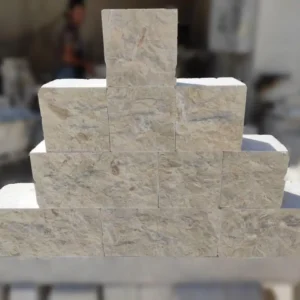
The classic method is to lay courses that follow the curve rather than cross it. Each course sits concentric to the arc, joints stay perpendicular to the line of travel, and the curve becomes the organizing idea of the whole surface. This works because small-format setts we supply tolerate a slight taper in the joint from the inner edge to the outer edge of each unit. On a tight radius that taper becomes visible and courses need breaking with occasional half units; on a generous radius it disappears entirely. The alternative is to run straight courses and cut them against the curve, which is quicker to lay and less forgiving to look at, because every cut lands on the most visible line in the scheme.
Courtyards and enclosed spaces
Enclosed areas behave differently from open terraces. In a courtyard the boundary is fixed on all sides, so the pattern cannot drift and then be trimmed at the far end. Enclosed spaces also amplify sound and heat, so the surface has more work to do than simply looking right, and a small courtyard rewards restraint more than invention.
- Set out from the most-seen edge, usually the main door, and push tolerance to the least-seen one.
- Use a border course against the walls so the field pattern never dies awkwardly into masonry.
- Keep drainage falls working in an enclosed space where water cannot simply run off the edge.
- Allow for furniture, since a table wants a flat area and a strongly directional pattern under it fights the setting.
Fans, circles and focal points
Where a curve is the subject rather than the boundary, radial layouts come into their own. A fan layout builds the surface from repeated arcs and reads as movement, which suits a forecourt or a wide turning area, while a circular set piece anchors the middle of a courtyard and gives the rest of the field something to answer to. If you are weighing the options, it is worth reading about fan pattern paving in detail before committing, because radial work asks more of the setting out than of the laying. Neither layout tolerates a moving start point. Mark the center, fix it physically, and check the radius at intervals as the work builds outward, since a fan that drifts by an inch early will be out by half as much again at the perimeter.
Cuts, closures and where they hide
Every curved scheme produces cuts. Good schemes decide in advance where those cuts will live.
- Push closures to the edge against a wall or planting, never into the middle of an open field.
- Avoid thin slivers, which chip in service and look like a mistake even when they are not.
- Keep cut faces consistent, because a mixture of sawn and split edges reads as carelessness.
- Order a sensible allowance for waste, since cutting a curve consumes more material than a rectangle does.
Pattern and glare on a bright island
Cayman light is strong, and low reflectivity is a comfort issue rather than only an aesthetic one. Textured small units break up glare far more effectively than large smooth surfaces, and the joint grid of a curved layout adds a second layer of shadow that softens midday sun. Around a pool or an amenity deck on the Seven Mile Beach corridor, that difference is felt underfoot and in the eyes before anyone thinks about pattern at all. Light also changes how a pattern reads through the day, and a layout that looks busy at noon can look quiet by late afternoon, so judge a sample panel at more than one hour before committing to a large area. Curves, small modules and textured faces all point the same way. Let the curve lead, and the stone will follow it without complaint.