Why absorption is the first number to ask for
Every paving conversation in the Cayman Islands ends up at water. Not rain alone, though rain here arrives hard and leaves fast, but the whole moisture story: salt haze drifting inland off the water, spray on exposed shoreline terraces, irrigation overspray, pool splash-out, and the freshwater rinsing that counts as ordinary maintenance on these islands. Absorption is the one figure that predicts how a stone will behave inside that cycle, and it is the figure most often missing from a quotation.
The moisture cycle a Cayman terrace lives in
Frost is not the enemy in this climate. Salt is. A dense stone that wets and dries cleanly will shrug off a decade of the pattern below, while an open, thirsty stone quietly comes apart from the inside while still looking fine in photographs.
- Warm rain saturates the surface, then strong sun drives the moisture back out within hours.
- Salt carried on the breeze settles, dissolves in the next shower, and wicks into open pores.
- As that water leaves, salt crystals grow inside the pores and push outward against the stone.
- Repeat the cycle several hundred times a year and a porous paver spalls, sugars or stains at the edges.
What a density figure actually predicts
Density and absorption are two readings of the same property. Tightly packed stone leaves little room for water, so it generally reports low absorption and far better edge retention under furniture legs, planters and constant traffic. It is also heavier, and weight is the constraint that shapes how an order actually lands here.
- Low absorption gives salt fewer pores to crystallize inside.
- Higher density usually brings higher compressive strength and cleaner edge retention.
- Heavier stone fills a container sooner, so format and thickness become budget decisions.
- A dense stone in a thinner format often beats a bulky, softer one outright.
Ask for both numbers together, because a stone quoted with a density figure and no absorption result is a stone somebody would rather you did not compare.
Matching absorption to the place it sits
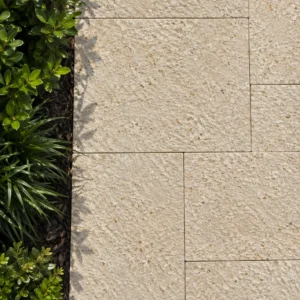
Not every square foot of a property needs the same specification, and sorting a plan into exposure zones before you choose is the cheapest decision you will make all project. Our dense limestone paving units are graded against these zones before anything is quoted.
- Shoreline terraces and dock aprons: the lowest absorption you can afford, without exception.
- Pool surrounds and outdoor shower runs: low absorption plus a texture that keeps grip when wet.
- Covered loggias and interior floors: mid-range absorption is fine and widens the palette open to you.
- Driveways and service yards: thickness and density outrank appearance, because vehicle loads punish thin stone.
Ironshore, Bluff stone and the calibration gap
These islands are made of stone. The Pleistocene Ironshore Formation and the Oligocene-Miocene Bluff Formation dolostone are worked here for fill and aggregate, and both are genuinely hard rock; anyone who has crossed ironshore barefoot can confirm that. What that material is not is a calibrated paving product. It breaks irregularly rather than cutting to a consistent thickness, which is why local stone and imported dimension stone have never been rivals on these islands. One supplies base course, fill and structure. The other supplies the finished walking surface with a test report behind it.
Lighterage and what it does to your pallets
George Town has no deep-water container berth. Ships lie at anchor and cargo comes ashore by barge, a detail most mainland suppliers never think about and every Cayman contractor lives with. Heavy stone that crosses water twice has to be packed for it.
- Pallets are built shorter and banded harder so the load stays square through a lift and a barge transfer.
- Weight per pallet is capped to what the receiving equipment can lift off a barge deck safely.
- Edges and corners get more protection than a mainland job needs, because every unit is handled twice over.
- Delivery windows follow the barge rotation rather than a truck arrival time, so lead times start earlier.
The duty ladder that changes the math
Government revenue here comes from the border rather than from income or property tax, so duty is never a rounding error in a stone budget. Building materials landing on Grand Cayman are assessed at a concessionary flat rate of about 15 percent instead of the general tariff of roughly 22 percent, and Cayman Brac and Little Cayman carry a full waiver on building materials extended through 31 December 2030. The same pallet can land at a very different cost depending on which island it is bound for. Classification sits with Customs and Border Control, so confirm the current rate with your broker before you fix a budget, and talk to us early so we can shape stone supply into George Town around the island you are building on.
Prove it with a sample before you buy
Datasheet numbers are the start of the process, not the end of it. Take a small sample, leave it outdoors on the actual site for a few weeks, rinse it with the same water your maintenance crew will use, and look at it in the light your terrace gets at three in the afternoon. The generation that rebuilt after Ivan in 2004 learned to test assumptions rather than trust brochures, and that instinct serves a paving specification just as well as it serves a roof detail. Ask for the absorption figure, ask for the density figure, and ask for a piece of stone you can leave out in the sun.