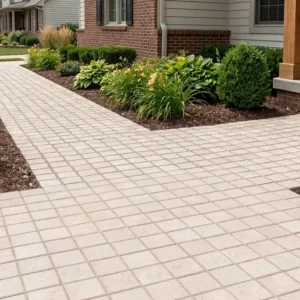
A Setting With Its Own Rules
Historic Bridgetown and its Garrison is a UNESCO World Heritage property, and that status does not stop neatly at a fence line. Work on a house, a courtyard or a commercial forecourt anywhere in the surrounding streets sits inside a setting that people travel a long way to see. Nobody expects a private owner to turn into a conservation architect. What the situation does ask for is restraint, and a willingness to let the older fabric set the terms of the conversation.
The good news is that the answer is rarely expensive. Most of what goes wrong near heritage streets is not a budget failure at all; it is a surface that shouts.
What the Garrison Already Teaches You
Spend an hour walking before you draw anything. The existing ground has the answers written into it already, and they are more useful than any specification you could assemble at a desk.
- Units are small, and the scale of the paving matches the scale of the buildings standing above it.
- Surfaces are worked rather than mirror-smooth, so light lands softly instead of glaring back at you.
- Tones sit inside a narrow band, and nothing competes with the coral stone in the walls.
- Edges are simple and functional, with drainage handled by falls rather than by hardware.
Complement, Never Compete
Barbados quarries its own coral limestone and has been building with it for more than three centuries. Great houses, churches and boundary walls across the island are made of it, and it is a national material in the fullest sense of the phrase. Imported stone has no business trying to outrank that. The only sensible role for material brought in from Middle East quarries is a supporting one: a paving field that sits below the coral stone in tone and weight, letting local walls remain the thing you actually look at. Buyers who accept that early end up with better projects than those who arrive with a hero material and go hunting for somewhere to put it.
The test is simple enough to run in a minute. Stand at the gate, look in, and note what your eye lands on first. If the answer is the new paving, the balance is wrong and no amount of quality in the stone will correct it.
Permissions and Who You Talk To
Process near a heritage setting is worth respecting from the very beginning.
- The Town and Country Development Planning Office administers development under the Planning and Development Act.
- Ask early whether your works need permission rather than assuming resurfacing is automatically exempt.
- Bring a sample and a photograph of the adjoining street, not just a product name on a sheet.
- If the site sits near the shoreline, check coastal setback requirements before committing to a layout.
Finish Matters More Than Color
In this part of the island, two surfaces cut from the same block of stone can behave completely differently in the eye, and the finish decides which of them you get.
- Tumbled and split faces read as older work and take foot traffic without turning slick.
- Sawn faces look brand new for years, which is exactly the wrong signal beside weathered coral stone.
- Bush-hammered and brushed textures scatter the strong midday light instead of bouncing it upward.
- A little variation between blocks is an asset here; flawless uniformity is what gives an imported job away.
Comparing surface finishes for natural stone against a photograph of the neighboring wall is a five-minute exercise that saves a great deal of regret.
Joints, Mortar, and Reversibility
Old fabric prefers work that can be undone. Wide, hard, over-strong mortar beds trap moisture against older masonry and make future repair destructive. Sand-jointed or lime-friendly detailing keeps the paving as a separable layer, so a future owner can lift it without damaging anything historic underneath. Reversibility is the quiet principle sitting behind almost every conservation decision, and it applies to a private courtyard just as much as it does to a monument.
It pays the owner back as well. A sand-jointed sett field can be opened to run a cable or a pipe and closed again inside the same week, with no saw cuts and no rectangle of mismatched concrete left in the middle of the court as permanent evidence that somebody once needed access.
Working Hours and the Street
The practical side of building in these streets is the street itself.
- Deliveries are tight and parking is contested, so book an unloading window rather than hoping for one.
- Cruise-season foot traffic fills a sidewalk in minutes, which makes a clean, narrow working area essential.
- Stage material off the public way wherever the plot allows, even if that means double handling.
- Small units move by hand in stages, avoiding lifting plant parked across a historic frontage.
Restraint Reads as Quality
The best paving near the Garrison is the paving nobody photographs on its own. It looks as though it has always been there, holds its color through a wet season, and lets the architecture do all the talking. That is what well-chosen traditional setts laid by hand achieve when they are treated as background rather than statement. In a heritage setting, the highest compliment your paving can receive is that nobody noticed it.