Rooms shaped by the breeze, not by a plan grid
Look at how a Barbadian house is set out and the logic is ventilation, not symmetry. Rooms run one deep so air crosses them, galleries stretch along the windward side, and openings line up front to back so the trade winds have a clear path. That produces long, relatively narrow spaces with a strong direction built in, which is exactly the condition where tile format and joint direction stop being a detail and start controlling how a room reads.
Which way the joints should run
Joints are lines, and lines lead the eye. Run them along the length of a gallery and the space stretches toward the view at the end of it. Run them across and the same gallery reads shorter and calmer. In rooms facing the sea, the usual instinct is to lay the long dimension toward the water so the floor points at what you came for. In a room with no view worth aiming at, running joints across the short dimension can rescue proportions that otherwise feel like a corridor.
There is a second consideration that only shows up once the house is lived in. Joints running parallel to the main traffic route collect less visible dirt than joints crossing it, because feet track along a line rather than over it.
Format sizes and how many joints you end up with
Format is really a decision about how many lines you want on the floor.
- Large formats leave fewer joints and a calmer field, suiting open plans where the eye should travel to the sea rather than stop at the floor.
- Mid-size formats are the safe middle: forgiving to lay, easy to replace, and comfortable in rooms broken up by furniture.
- Small formats add texture and joint lines, useful in service rooms and stair landings but busy across a drawing room.
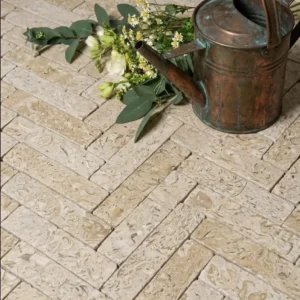
- Modular blends mix two or three sizes in a repeating unit and read as a pattern rather than a grid.
Bigger tiles also demand a flatter substrate, so ask the installer what the slab is doing before falling in love with a size.
The veranda line and where the floor should change
Every plan has a moment where inside becomes outside, and the floor either acknowledges it or glides past. Both work. What fails is doing it by accident. If the veranda should feel like a room, carry format and tone straight through and change only the finish. If it should read as an outdoor space, change format at the threshold and keep tone close. Buyers comparing large format limestone tiles for both sides of that line usually find one format works inside while a slightly smaller, more textured unit works outside.
Patterns that suit open island plans
Pattern is where restraint pays. In a house with several rooms visible at once, a busy pattern repeated through all of them becomes noise.
- Stack bond reads as the calmest grid and works with large formats and long sightlines.
- Running bond breaks up continuous joints and hides small setting-out drift against older, less square walls.
- Modular blends suit galleries and entrances where you want interest without a strong direction.
- Keep one pattern across connected spaces and save any change for a room you close the door on.
Tone variation across a long floor
Natural limestone varies, and an open plan shows every bit of it because you see a long stretch at once under strong daylight. Ask for enough material to dry-lay several boxes and blend them before fixing, rather than working straight out of one crate and then the next. Under the light levels here, a tonal step that would vanish in a northern interior stands out plainly, especially where a shaded gallery meets a sunlit room.
- Order a sensible surplus over the measured area so blending has material to work with.
- Dry-lay several boxes side by side and shuffle them before any adhesive is mixed.
- Keep the strongest-toned pieces for edges and under furniture rather than the middle of a sightline.
- Photograph the approved blend so a later phase or a repair can be matched to it.
Crate sizes, parish roads and the last mile
Format carries a logistics cost that nobody mentions at the design stage.
- Larger tiles mean heavier, more awkward crates and slower handling on site.
- Parish roads narrow quickly, and a full-size delivery truck may not reach a hillside plot at all.
- Plan a staging point where crates can be broken down and carried on in smaller loads.
- Order a breakage allowance up front, because a single replacement tile shipped later costs far more than a spare box.
Drawing the setting out before anyone mixes adhesive
A setting-out drawing costs an hour and saves a floor. Start the grid from the most visible line in the house, usually the run of openings toward the sea, and let the cuts fall in the least seen corner. Decide where the pattern breaks at doorways. Mark the finish change on a joint. If you want a fuller reference before drawing, our overview of laying patterns for stone floors shows how each bond behaves across a long span.
The floor you notice least is usually the one that was set out first and laid second.