Chosen by Physics, Kept for Looks
Most laying patterns are chosen by the eye. Herringbone is chosen by physics. Turn every paver perpendicular to its neighbors and the field stops behaving like rows of stone and starts behaving like a woven mat: a wheel that brakes or turns pushes against an interlocked mesh, the force sheds sideways through half a dozen units, and no joint line runs in the direction of travel for movement to exploit. Cart streets figured this out centuries before cars existed, and nothing since has beaten it – which is why the pattern still paves the driveways that intend to outlive their owners.
45 Versus 90: The Real Trade
The two sets share one geometry at two angles, and the choice between them is a budget decision as much as a visual one:
- The 90 degree set runs square to the borders – most units stay whole, cutting stays modest, and the field reads calm and orderly
- The 45 degree set turns the weave diagonally – the interlock is at its strongest, the look is unmistakable, and every border course ends in an angled cut
- Waste follows the angle: five to ten percent at 90, ten to fifteen at 45
- Setting-out time follows it too – the diagonal set demands more layout discipline before the first paver beds
When in doubt: 45 for the entrance the house is judged by, 90 everywhere the work should be strong but the budget sensible.
Formats the Weave Demands
The classic herringbone module is the two-to-one rectangle, with plank ratios running the same weave at a longer, more contemporary stride:
- 6 x 12 inches – fine texture, small courtyards and walks
- 8 x 16 – the versatile middle, patios and standard drives
- 12 x 24 – large-format herringbone, bold and fast to lay
- Plank setts in three- and four-to-one proportions – the elongated weave of modern streetscapes
- Vehicular thickness for anything wheels touch, confirmed against the build-up
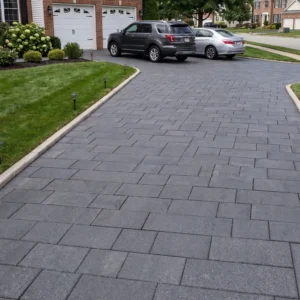
Dense stone earns its place here: basalt pavers cut as true rectangles take the point loads of a turning tire without complaint, and their charcoal tones make the weave read graphic rather than busy.
Setting Out, Once and Correctly
The pattern punishes a sloppy start more than any bond, because every unit registers against four neighbors and an error propagates in two directions at once. The discipline is short: establish the main sightline, chalk the first two courses full-size, and check the diagonal of the first square meter before bedding anything permanent. From a true start the weave assembles almost mechanically; from a crooked one it argues with the layer all the way to the far edge. Guide strings stay up until the field is closed.
Borders, Cuts and Where the Waste Goes
The border is where herringbone spends its money. A soldier course – a single line of pavers laid square around the field – frames the weave, absorbs the angled cuts invisibly, and gives edges a straight, protected line to finish against. Skipping the border does not avoid the cuts; it just displays them. The offcut pile from a 45 degree field looks alarming and is simply the pattern doing what it said it would do – which is why the margin belongs in the order, priced and planned, rather than in an apologetic second delivery.
Where Herringbone Belongs
The pattern earns its cutting waste in three places:
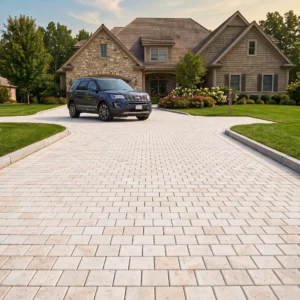
- Driveways and aprons – anywhere wheels brake, park or turn, the interlock is the whole point
- Sloped walks and ramps, where the weave resists the downhill creep that opens straight joints
- Surfaces meant to read established rather than installed – the geometry carries centuries of streetscape, and the eye knows it
For flat garden terraces where nothing heavier than a dinner party crosses, the effort is optional – the herringbone or circular patio decision walks one real choice at that end of the spectrum, and the running bond guide covers the calmer default.
What the Weave Costs, Honestly
Herringbone is priced in three currencies, and only one of them is stone:
- Cutting waste – the margin covered above, real but plannable
- Layout time – the setting-out discipline adds hours at the front of the job, not days
- Laying pace – slower than a straight bond early, nearly as fast once the weave establishes its rhythm
Against that sits the return: a surface that will not creep, rut or shuffle under two decades of vehicles, and a face that raises the read of the whole frontage. Spread over the life of a driveway, the premium rounds to nothing – which is why the pattern keeps being chosen by people who have owned a failing one laid in something else.
Repairs and the Long Life
A herringbone field ages the way its owner hoped: the interlock that spread the loads also locks each unit against its neighbors, so individual pavers rarely rock loose, and the ones that do lift out and re-bed without disturbing the weave around them. Keep two dozen spare pavers from the original run in the garage and every future repair is invisible – matching stone years later is the only hard part of maintaining the easiest-wearing pattern in the book. Joints topped up after the first winter, and the surface is effectively set for decades.
Order the Weave, Not Just the Stone
Send the drawing with the angle chosen – 45 or 90 – and the quote comes back with formats, vehicular thickness where it matters, and the waste line stated plainly for your angle. Browse the full paver range in two-to-one formats to pick the material first if that is how your decisions run. Herringbone rewards everything done properly and forgives nothing done casually – order it with the margin, lay it from a true line, and it will outlast the car it was built for.
Waste, Cuts and What to Actually Order
Herringbone is the most expensive pattern to cut and the cheapest to live with. Every unit that meets a boundary is cut, and at 45 degrees each of those cuts produces two triangles rather than one usable closer. That is the trade: you pay for it once at the saw, and you stop paying for it every year afterwards in joint creep and rutting. Order against the figures below rather than against the bare area.
| Pattern | Straight edges | Curved or angled edges | What drives the number |
|---|---|---|---|
| Herringbone at 45 degrees | 10-15% | 15% | two cut triangles at every edge, both offcuts small |
| Herringbone at 90 degrees | 10% | 12% | every perimeter unit is cut |
| Running bond, laid parallel to the edge | 5% | 8% | half-unit closers only, all at the perimeter |
| Border or soldier course | add 5% on the run | add 8% | mitered corners and short closers |
Those allowances assume a soldier or sailor border to absorb the cuts, which is the standard detail described in the Brick Industry Association technical note on clay paver paving systems.
What the Standards Actually Say About Interlock
This is not a matter of taste. The Concrete Masonry and Hardscapes Association is explicit that 45 or 90 degree herringbone patterns are recommended in areas subject to continual vehicular traffic because they provide maximum interlock and structural performance, and the brick equivalent puts it the same way: patterns that distribute horizontal loads across multiple units are the ones specified where vehicles turn, brake and accelerate.
- Use herringbone anywhere a vehicle turns, brakes or parks
- Reserve continuous-joint patterns for foot traffic, or turn their joints across the line of travel
- Match the unit thickness to the duty, not to the pattern
- Keep the joints tight and the jointing sand full, because the interlock lives in the joint
The full application guidance is set out by the Concrete Masonry and Hardscapes Association, which also fixes the thickness bands for pedestrian and vehicular duty.
Herringbone paver pattern, specified for the traffic it carries
Get three decisions right and the rest of the job is carpentry: the angle, the border, and the unit format. Everything else follows from those.
- 45 degrees for driveways and anywhere turning loads arrive at an angle
- 90 degrees for straight runs, walkways and simpler set-outs
- A true two-to-one unit, so the weave closes without a fudge
- A border deep enough to take every cut off the visible field
The wider pattern library, with the formats each layout needs, sits in our guide to paver laying patterns.
Pay for herringbone once at the saw and it stops charging you every winter afterwards.