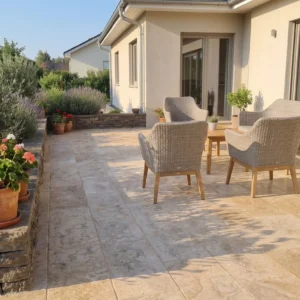
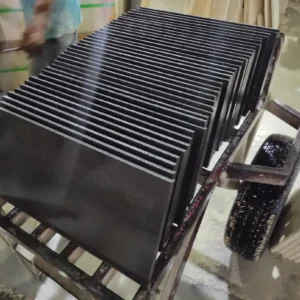
Punta Cana is where the Caribbean goes industrial about paradise: the Bávaro corridor’s resorts running thousands of rooms behind one long white beach, Cap Cana’s marina and cliff-line estates, golf coasts stitched between them, and an airport that moves more tourists than any other in the region. The east coast builds at a scale nowhere else attempts, and its stone brief is the resort industry’s own: procurement by the phase, consistency by the container, and surfaces specified for guest volumes that never pause. This guide walks the mega-coast’s craft.
The Bávaro Scale
The corridor’s resorts consume surfaces by the hectare – lobby floors flowing to pool complexes, kilometer-class corridors, beach clubs and spa villages – and the specification runs institutional throughout: crowd-rated textures documented for the insurer, batch consistency across every phase the masterplan adds, maintenance written for contracted crews, and repairs matched from project-scale attic stock. The scale changes procurement more than design: the canon is the region’s, multiplied – and multiplied is where documentation stops being paperwork and becomes the product.
The Cap Cana Register
South of the corridor, Cap Cana runs the estate register: marina quarters, cliff-line villas above the famous blue, golf estates and branded residences inside a master-planned frame. The brief mirrors the region’s governed-luxury standard:
- Villa-grade packages inside community palettes and design review
- Marina and beach-club surfaces at hospitality-marine duty
- Arrival sequences – gatehouses, drives, entry plazas – built as permanent first impressions
- Documentation cultures the management companies enforce contractually
infinity edges at villa tolerance maps the premium pool craft the estate register orders here, basin after cliff-line basin.
The All-Inclusive Operations Test
All-inclusive operations run surfaces through the industry’s hardest daily cycle: buffet-adjacent floors washed on rotation, pool decks hosting sunrise-to-midnight occupancy, corridors moving convention crowds, and everything reset overnight to look untouched by breakfast. The stone answers are operational: textures that grip through the wash cycles, falls that drain them fast, tones that show honest-clean rather than demanding cosmetic perfection, and the piece-by-piece repairability that lets night crews fix what the day broke. Operators audit all of it; the specification that passes years of audits is the one written for them.
The Golf Coast Layer
The east’s championship courses thread the resorts and estates, and their stone layer runs the golf canon at tropical grade: cart-path pragmatism, comfort stations and halfway houses at hospitality standard, clubhouse terraces built for spike traffic and sunset weddings alike, and the tee-adjacent viewpoints where the coast performs. The register borrows from every brief on the coast – resort durability, estate polish, storm-zone fixing – and its maintenance rides the course’s own dawn rhythm, surfaces reset before the first foursome.
The Beach Machine
The strand itself is the coast’s product, and the built edge serves it at industrial hospitality grade: beach-club floors running the barefoot-to-dinner transformation for hundreds at a time, walkover paths protecting the dune line while moving the crowds, rinse architecture at guest-flow scale, and crews managing the seasonal seaweed arrivals as routine beach operations. The stone specification is the shore canon under volume – textured, pale, fast-draining, sand-releasing – and its quiet job is keeping a beach that hosts thousands photographing like it hosts you.
The Condo-and-Villa Wave
Around and behind the resorts, the east’s residential wave builds hard: condo towers and villa communities selling the resort coast as an address, most units joining rental programs from day one. The brief blends registers – villa-canon pools and terraces, hospitality-grade amenity decks, turnover disciplines contractual through the program managers – and the comparison shopping runs regional: a villa-engine coast compared walks the Pacific version of the same wave, and buyers increasingly know both coasts before they choose one.
The Mockup Culture
Resort-scale procurement decides on mockups: sample panels approved formally, model rooms and terrace mockups signed before production releases, and every later consignment matched to the physical control. The culture protects everyone – operators lock the look, contractors lock the target, suppliers lock the batch – and its discipline is the east coast’s real specification: not the drawing alone, but the approved square meters standing in the sun where every stakeholder walked them. Orders here begin at the mockup and end at the final container that still matches it.
The Installation Industry
The east coast’s build volume sustains what smaller markets envy: genuine installation industry – crews that lay stone by the thousand meters, supervisors fluent in mockup tolerance, and a trade culture that treats corridor-straight joints as ordinary professionalism. For suppliers the partnership is straightforward: calibrated material, drawn layouts, batch-labeled crates arriving in phase order. For owners it means the region’s deepest bench of installers – and the responsibility of briefing them with the documentation their professionalism expects.
The Scale That Sets the Standard
Punta Cana’s scale sets the region’s procurement standard: mockup-governed, batch-disciplined, operator-audited, guest-tested by the million. Stone built the coast’s surfaces because it survives exactly that test. Order at the coast’s own scale – documented, batch-matched, appointment-delivered – and the biggest resort machine in the Caribbean lays your stone the way it does everything: professionally, by the phase, to the mockup.
The Refurbishment Cycle
The east coast’s resorts renovate the way ships repaint – constantly, section by section, without ever closing: a wing refurbished behind hoarding while the property sells every other room, the pool complex renewed basin by basin, restaurants cycled one concept at a time.
- Stone packages phase to the hoarding plan: wing-sized consignments, batch-matched to the standing mockup across years of cycles.
- Night and shoulder-season installation windows do the loud work; guests wake to finished corridors.
- The original batch records make decade-later phases matchable – the file outlives every renovation manager.
- Attic stock absorbs the daily repairs between cycles, keeping the audit clean.
The cycle is the coast’s quiet superpower: properties that never close never look old, and their surfaces renew on a rhythm guests never witness. Suppliers join the rhythm by documentation – the operator’s file, not anyone’s memory, is what keeps a 2030 wing matching a 2024 mockup – and the coast’s best-run resorts prove the system every season.
Specifying for Traffic Nobody Counts
Resort paving in Bavaro and Cap Cana carries pedestrian volumes that residential specification never anticipates. A single buffet approach can see thousands of wet footfalls a day, and the surface has to hold its slip performance through all of them. Wet slip resistance is measurable rather than a matter of opinion, and the ANSI A326.3 test method with its 0.42 dynamic coefficient of friction benchmark is the reference the industry uses for level interior and exterior walking surfaces.
- Ask for wet DCOF data on the exact finish, not the material family
- Specify a higher texture grade at pool exits, ramps and shower approaches
- Keep one finish across a whole circulation route so the surface never changes underfoot
- Re-test after any change of quarry block or finishing line
The background on how frictional properties are tested on natural stone is worth reading before a submittal meeting.
Buying at the Scale the Corridor Works At
Punta Cana buys in phases because it builds in phases. That is a procurement structure, not a scheduling accident, and it changes what a supplier has to guarantee. With the national economy growing at 5.1 percent in 2024 and construction concentrated in a few coastal corridors, the same quarry is often serving several large sites in the same quarter.
- Reserve block or batch capacity for later phases at the time of the first order
- Record quarry, block and batch references in the operations manual, not just the invoice
- Agree a tolerance for shade drift between phases before anyone signs
- Plan attic stock by phase, since a phase four repair should not use phase one stock
The published overview of the Dominican market gives useful context for why capacity is contested.
The Handover Documents That Actually Get Used
Resorts change operators, and the paperwork outlives the project team. What survives the handover is what the maintenance manager will rely on in year six.
- A material register with quarry, finish, thickness and batch per zone
- Cleaning products approved for the stone, and the ones that are not
- A simple replacement procedure with photographs of the bedding detail
- Named attic stock locations, with quantities
For a wider view of how material reaches sites across the country, our Dominican supply and logistics overview covers the routes and timings.
Punta Cana resort stone, specified for the phase
The corridor rewards suppliers who can hold a standard across years rather than weeks. That means documented batches, repeatable finishes and a slip specification that does not quietly drift between phases.
- Fix the finish and the wet slip target in phase one
- Reserve capacity before the next phase is designed
- Keep the material register current at every handover
- Budget attic stock as part of each phase, not the last one
At resort scale, consistency is the specification, and everything else is detail.