The Nicoya peninsula carries one of the world’s celebrated longevity regions, and at its surfing heart sits Nosara – the wellness coast’s capital, where yoga platforms outnumber billboards, the beach road is deliberately unpaved, and the jungle runs unbroken to the sand because the community decided decades ago that it should. Building here means joining a place with strong opinions about how building behaves, and the properties that thrive are the ones that heard them. This is the wellness coast’s brief, walked barefoot.
The Restraint Rule
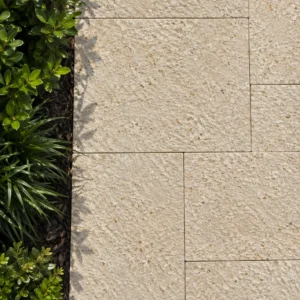
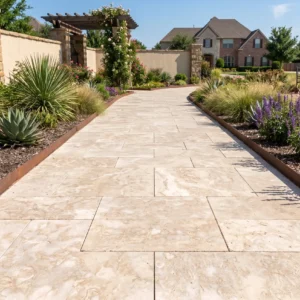
Nosara’s character is a chosen thing: development held low and set back, the beachfront kept green, sand roads retained on purpose, commerce at village scale. The design consequence is a register of restraint – buildings tucked into canopy, materials that defer to the green, and hard landscaping that works in clearings rather than carving statements. Stone serves the register precisely because it does not shout: pale textured surfaces underfoot, walls that hold slopes quietly, and nothing on the ground plan that competes with the jungle the community protects.
The Yoga Platform
The wellness economy’s signature structure is the practice platform – open-sided, canopy-shaded, floored for bare feet and long stillness – and its stone edition has a precise brief:
- Honed-textured surfaces smooth enough for seated practice, grippy enough for flowing wet-season classes.
- Dead-level floors on engineered bases; a practice platform that ponds or rocks empties fast.
- Thermal comfort by tone and shade – pale stone under canopy stays cool through the morning classes.
- Edges rounded and flush – the platform’s perimeter is walked blind, in poses, daily.
Studios judge their floors the way restaurants judge kitchens; the platform is the product, and its stone is specified like it.
The Barefoot Lanes
Nosara moves on foot and by bike over sand roads, and properties meet the lanes with the district’s gentlest thresholds: stone aprons where gates meet sand, paths textured for bare soles and bike tires, rinse points at every transition from beach to built. The detailing philosophy runs soft-edged throughout – the town’s surfaces serve feet that have not worn shoes in weeks – and gentle-shore design for bare feet writes the same canon for another barefoot economy, transferable line by line.
Living at the Jungle Margin
Nosara’s lots sit inside working habitat – howlers commuting the canopy at dawn, congo calls as the town’s alarm clock – and the ground plan negotiates with the green daily: leaf-fall composting on every horizontal surface, roots patrolling every edge, humidity feeding biology in every shaded corner. The specification is the wet-green canon with a jungle-margin addendum: textured finishes everywhere, falls that dry surfaces between rains, root-tolerant unit construction that lifts and relays where a slab would crack, and a sweep-and-wash rhythm that keeps the clearing a clearing.
The Wellness Property
The district’s hospitality runs retreats rather than resorts – surf camps, yoga lodges, health-focused villas – and their stone plans serve programmed days: platforms for the morning practice, shaded breakfast courts, pool terraces at the family standard, cold-plunge and shower courts at working grade, and paths connecting the circuit legibly for guests moving between sessions. The register stays calm throughout – the product is nervous-system rest, and the ground plan participates: no glare, no clatter, no hard edges where soft ones serve.
The Turtle Coast Next Door
North of town, Ostional’s beach hosts one of the planet’s great turtle arrivals – the arribadas, protected and famous – and the coast’s conservation manners radiate from it: beachfront lighting low and warm wherever hatchlings might navigate, construction staging clear of nesting seasons’ sensitivities, runoff managed so the surf zone stays what the turtles need. The wellness coast wears its ecology as identity; projects that build to the manners join the identity, and the district’s long memory notes those that do not.
Sand-Road Logistics
Deliveries to Nosara run the peninsula’s roads – paved to the district, sand within it – and the disciplines are familiar: dry-window scheduling for heavy loads, vehicles sized to the lanes, staging inside the lot with the road left to the town, and consolidated consignments so the journey happens once. The reward for planning is the district’s own calm; the penalty for winging it is a stuck truck on the road everyone uses, remembered by everyone who used it that day.
Standing in the Community
Nosara’s development conversation is active and local – road committees, conservation groups, the standing question of how much growth the character can carry – and builders inherit a seat in it whether they asked or not. The manners are the small-community canon: local hiring, quiet works hours, contributions where the community organises them, and projects explained before they surprise anyone. small-community site conduct writes the rulebook; Nosara applies it with a wellness coast’s particular attentiveness.
Built to Exhale
The wellness coast’s brief reduces to its own vocabulary: restraint, softness, ecology, calm. Stone serves all four – quietly structural, gentle underfoot, honest beside the jungle, and calm by nature – which is why the district’s best properties stand on it. Build Nosara the way its visitors are taught to breathe – slowly, deliberately, without strain – and the longevity coast returns the favor to the property itself.
The Rainy Practice
The wellness calendar does not pause for the green season, and Nosara’s studios run their busiest energy through the rains: covered platforms filling as the weather performs, practice continuing to percussion the sound system cannot match.
- Covered platforms carry the wet-season load: roof spans generous, floors at the same platform standard, sides open to the rain’s theater.
- Approach paths earn their textures in exactly these months – wet stone at barefoot grade, tested daily.
- Transition zones grow: mat storage, towel shelves and drip lines where practitioners arrive rain-wrapped.
- Drainage keeps the platform’s surrounds honest; a practice space ringed by puddles empties fast.
Studios that build for the rainy practice discover the season’s secret: the green months are the coast’s most atmospheric, the retreats fill with practitioners who prefer them, and the covered platform over wet-rated stone becomes the property’s photograph. The wellness coast works all year; its surfaces are simply specified to agree.
Barefoot is not a style, it is the specification
On this coast the shoes come off at the road and stay off. Guests move between a yoga deck, an open-sided kitchen, a sand path and a pool without ever putting anything on their feet, and every threshold in that sequence is crossed wet, sandy or both. That single fact should drive the whole material decision, because a finish that photographs beautifully and abrades bare skin, or heats past comfort by midday, has failed at the only test that matters here.
- Textures that grip without abrading bare feet
- Light tones so surfaces stay walkable through the afternoon
- Eased or bullnosed arrises at every step and threshold
- Level transitions between deck, path and building
- Sand-tolerant detailing at every doorway
Wet feet, sand and a measurable number
Slip resistance is the part of this brief that can be proved rather than argued. The work behind frictional testing of natural stone walking surfaces describes the ANSI A326.3 wet method and a benchmark dynamic coefficient of friction of at least 0.42 for level interior floors expected to be walked on wet. A yoga deck reached across wet sand sits beyond that reference case, which argues for testing the delivered finish and holding margin above the minimum.
- Wet values requested on the exact finish supplied
- Grip that holds with sand on the surface, not only when clean
- One texture from beach path through to interior threshold
- Rinse points drained clear of the walking line
A protected coast with a low-key building culture
The wider region is defined by conservation. UNESCO lists the Area de Conservacion Guanacaste, inscribed in 1999 and extended in 2004 across 147,000 hectares of land and marine area holding the finest tropical dry forest in the region, and the same instincts run through the smaller communities down the peninsula. Building here quietly is not only good manners; it is what the planning culture and the guests both expect.
- Materials and colors kept within the natural range of the setting
- External lighting low, warm and shielded from the beach
- Native planting retained and reinstated around works
- Construction noise and hours agreed with the community
Choosing nosara blue zone stone for a village that walks everywhere
Specify for bare feet first, sand second and appearance third, and keep the build-up simple enough that a local crew can lift and reset a section between guests.
- Modest formats a two-person crew can handle
- Granular bedding that tolerates sand migration
- Continuous edge restraint where paving meets loose ground
- Spare stock held on site from the first delivery
Our Costa Rica stone supply guide sets out the formats, finishes and lead times that suit this country. If it is uncomfortable barefoot it is the wrong surface, however good it looks.