South of Manuel Antonio the coast changes character: the mountains walk into the sea, the rain doubles, and the towns – Dominical, Uvita, Ojochal – serve a different dream from Guanacaste’s: the jungle ridge with the whale-coast view, toucans at breakfast and the Pacific a thousand green feet below. The southern zone is Costa Rica’s steep, wet frontier, and its building craft is the country’s most demanding – equal parts engineering, drainage and patience. This guide walks it ridge by ridge.
The Green Vertical
Southern-zone lots are hillside lots almost without exception – the flat land is floodplain or town – and the ocean view that sells them sits at the top of a genuine climb. The building consequence is the steep-country sequence at rain-forest intensity: cut the slope into benched terraces, hold each with engineered walls, drain everything twice as generously as instinct suggests, and pave only what has survived a wet season. green-slope terracing lessons writes the sequence for another wet, steep island, and the southern zone applies it with bigger rain and longer drops.
Rain at Southern Scale
The zone’s rain is not weather; it is infrastructure load. The green season delivers volumes that reshape unmanaged slopes, and the hard landscape is designed as the water’s formal route:
- Falls run steeper than dry-country practice, and every terrace sheds to a designed channel, never a hopeful edge.
- Retaining walls carry weep systems and back-drainage as their first specification, before height and finish.
- Cut-off drains intercept the hillside above the build; the slope’s water is managed before it arrives.
- Soakaways and dispersal fields size for the cloudburst; the average rainfall figure is a fiction here.
Seismic Plus Saturated
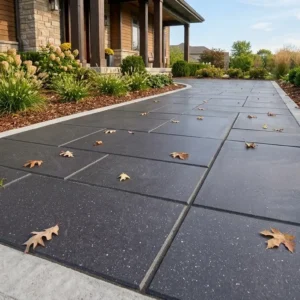
The national seismic code governs everywhere, but the southern zone adds the multiplier: saturated slopes. Wet ground moves more, loads walls harder and punishes improvization faster, so the zone’s engineering culture is the country’s most conservative – geotechnical studies before design, walls calculated for wet-season soil, benching over boldness. Unit stone paving earns its keep in exactly this setting: flexing over the ground’s small seasonal movements, repairing piece by piece, and never pretending to be structure. The structure is the engineer’s; the stone is the finish that forgives.
Biology, Daily
The rain forest treats every surface as habitat: algae films the shaded, moss upholsters the damp, and leaf-fall composts wherever it lands. The specification answers with the wet-green canon at full strength – brushed and textured finishes without exception outdoors, falls that dry surfaces between rains, sun and airflow designed into the path network, and a gentle wash regime on a calendar the household keeps. rain-forest specification next door details the regime for hospitality; southern-zone homes run the same rules at family scale.
The Whale-Coast Towns
The zone’s towns each carry a register: Dominical keeps its surf-town bones – sand streets, barefoot commerce, surfaces built for wax and boards; Uvita is the working hub where the whale-tail beach meets banks, clinics and the weekly shop, its premises specified for real traffic; Ojochal runs a culinary-village economy of restaurant terraces in the jungle – the wet-green dining brief at its most atmospheric. The stone family can hold across all three; the detailing reads each town’s day.
The Ridge Roads
Access is the zone’s tax: ridge lots climb from the coast highway on steep, sometimes unsurfaced roads that the green season tests annually. Deliveries follow the mountain disciplines – dry-window scheduling for the heavy loads, vehicles matched to the gradient and the turns, offload points agreed where the truck genuinely stops, and the last meters planned for machine or many hands. Consolidated consignments matter doubly when every trip up the hill is an event; the one-order rule is not advice here, it is the budget’s best friend.
The Jungle-Luxury Register
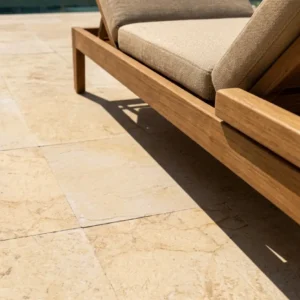
The zone’s architecture has found its voice: open pavilions under big roofs, infinity pools aimed at the whale coast, stone terraces that hold the jungle at a livable distance. The register asks stone for two things at once – the calibrated cool of villa-grade surfaces and textures that belong beside untamed green – and pale brushed limestone answers both, framing the jungle without competing with it. The best southern builds feel discovered rather than imposed; the stone’s job is making that illusion durable.
The Frontier That Rewards Patience
The southern zone asks more of its builders than anywhere in the country – more engineering, more drainage, more patience with the mountain and the rain – and returns more of what Costa Rica promises: the green vertical world, whales in the season, the toucan at breakfast. Build the sequence honestly – structure, water, then stone – and the hillside keeps its promises for decades. The south is earned, not bought; its stone craft is how the earning is done.
The Mirador
Every southern-zone property builds toward one moment: the mirador – the view platform where the ridge finally hands over what the climb promised, the whale coast spread below and the horizon running to Panama on a clear day. The platform’s craft is compact and worth doing properly:
- The deck benches into the slope on its own engineered footing – a mirador is a small structure, not a wide path.
- Textured stone underfoot assumes cloud-forest damp; the best view in the county is no place for polish.
- Edge protection meets code without fencing the panorama – low walls with coping comfortable to lean on, rails where drops demand them.
- The approach path reads clearly in dusk light, because sunset is the mirador’s working hour.
Owners furnish miradors sparely – two chairs, a rail to lean on, sometimes a fire bowl on a stone plinth – because the view is the furniture. The stone’s job is holding the moment steady: dry-footed, safe-edged and reachable at the hour the light performs. Build the mirador as carefully as the pool terrace; on a ridge lot it is the second place every guest is taken, and the first they remember.
The mountains behind are World Heritage
The ridges rising inland from this coast belong to one of the largest remaining forest blocks in Central America. UNESCO lists the Talamanca Range and La Amistad reserves, inscribed in 1983 and modified in 1990, covering 570,045 hectares across Costa Rica and Panama, holding roughly 10,000 flowering plant species, around 600 birds and 215 mammals, and supporting four indigenous peoples. Everything that leaves a hillside site here runs downhill through that catchment before it reaches the sea, which makes sediment control the first design decision rather than a site instruction.
- Silt containment specified as a permanent works condition
- Cut faces stabilized and planted before the wet season
- Watercourse setbacks drawn from the start
- Cutting and washing stations kept well away from streams
- Access tracks reinstated fully at completion
Steep ground plus heavy rain is a structural brief
Slope and rainfall combine here in a way they do not elsewhere in the country. Terraces are cut and retained, water arrives in volume, and a saturated subgrade behaves nothing like the dry one a design was drawn on. Retaining, drainage and bedding all have to be resolved before any finish is chosen, because correcting them later means lifting whatever was laid on top.
- Drainage designed behind every wall that holds ground
- Retaining kept low and repeated rather than tall and singular
- Subgrades assumed wet when calculating the build-up
- Cut and fill balanced on site so nothing leaves by road
Choosing southern zone stone for a remote steep site
Distance and gradient decide the format long before appearance does. Guidance on detailing natural stone paving for lasting durability ties installation method to thickness and format, and on a ridge site reached by a steep track those are precisely what determine whether material arrives at the working face at all.
- Unit sizes matched to a barrow or a two-person carry
- Pallet weights set by the smallest vehicle on the route
- Cut to list so nothing is hauled up the hill and back down
- Spare stock delivered with the main load, never chased later
Our Costa Rica stone supply guide sets out the formats, finishes and lead times that suit this country. On this coast the road and the rainfall write the specification between them.