Rincon sits where Bonaire keeps its memory: a village folded into the island’s greenest valley, chosen centuries ago precisely because it could not be seen from the sea. The island’s oldest town raised generations of Bonairean families, hosts the island’s biggest cultural day each April, and holds a townscape of modest houses, old churches and mango shade that the whole island regards as its heartland. Building here is building in everyone’s hometown, and the brief begins with that understanding.
The Valley Setting
The valley gives Rincon what the coast never gets: sheltered air, deeper soils, real greenery and a sense of enclosure the flat south cannot imagine. For builders it also writes the technical brief – runoff from the surrounding slopes crosses the village on its way seaward, so drainage is designed rather than assumed; the deeper soils move more than coastal rock, so bases are prepared honestly; and the shade of established trees is an asset held onto at almost any cost. The valley made the town liveable for five centuries; new work borrows its logic rather than fighting it.
Everyone’s Hometown
Rincon’s social fabric is the island’s densest, and building manners follow:
- Scale stays village – a lot that outgrows its neighbors has misread the town entirely.
- Works schedule around church, school and the fishing-and-family weekend.
- April’s cultural festival – the island’s great day – clears the calendar; no works, no blocked lanes, full stop.
- Local hiring is the default; the village’s trades built the village.
The reward is the deepest welcome on the island – and in a town this connected, the welcome is worth more than any drawing.
The Village Vernacular
Rincon’s houses are the island’s domestic archive: modest masonry volumes, painted bright, shuttered against the sun, yards shaded by fruit trees and edged in coral stone. Renovation is the town’s main building activity, and the good projects follow the vernacular’s division of labor – structure and color above, stone at the ground layer: threshold-level terraces, shaded court floors, path stone worn smooth by feet that know the way. village vernacular, renovated rightly walks the same ethic on a French island, and the two traditions would recognize each other across the water.
The Yard Culture
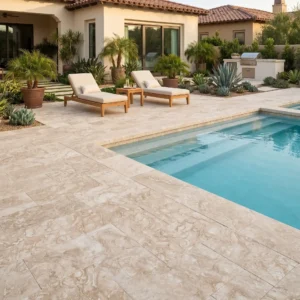
Rincon lives in its yards – the shaded family ground where Sundays happen, mangoes drop and every celebration finds its tables. The stone brief for a Rincon yard is domestic and precise: a court floor that sweeps clean under the trees, edges that hold the yard’s geometry against roots and rains, a cooking corner floored at working grade, and paths that connect house, kitchen and gate at the width two chairs need when the party spills. Pale stone under mango shade is the town’s own palette, and it photographs like the memory everyone already has of it.
Festival-Ready Ground
When the island converges on Rincon each April, the village’s ground works overtime – yards host, lanes fill, and every court and threshold takes a year’s traffic in a day. Properties that host well are built for it: surfaces at hospitality grade, falls that recover from a crowd’s spills by morning, and nothing precious where the dancing happens. It is the region’s event-night logic at family scale, and stone is its natural floor – dense enough for the day, handsome enough for the year around it.
Green Valley, Real Water
Rincon’s rains are the island’s most generous, and the valley concentrates them: the wet months send real water down the slopes and through the village grid. The stone response is the standard one applied seriously – court and path falls that route water to planted ground, channels where the slope insists, raised thresholds at the downhill doors – plus the valley’s own habit of working with the flow lines the old-timers can point out from memory. The village has watched its water for centuries; the cheapest hydrology study in Bonaire is a conversation on a Rincon porch.
The Heartland Premium
The market has noticed what the island always knew: Rincon offers what the coast cannot – community, shade, shelter and the deepest sense of place on Bonaire – and renovated village properties carry a quiet premium among buyers who understand it. The premium follows authenticity, not spectacle: the projects that respect the vernacular, hire the village and keep the yard culture intact are the ones the town embraces and the market rewards. In Rincon, belonging is the asset class.
The Village Porch
Rincon’s social architecture runs on porches – the shaded front room where neighbors are greeted, weather is judged and the village’s news makes its rounds. The porch floor is its working surface, and the renovation brief treats it with respect: stone at the threshold level the house always kept, a fine texture that suits bare feet and church shoes alike, a front edge that sheds the rain squall cleanly, and width enough for the extra chairs that every good porch eventually attracts. The porch is where the village decides what it thinks of a renovation; a floor that invites sitting – cool, honest, unshowy – announces that the new owners understood the town before they changed anything. It is the cheapest diplomacy on the island, laid one course high.
Building in the Memory
Rincon asks builders for the same respect every heartland asks: keep the scale, learn the calendar, honor the ground’s history and add quietly to a story that was running long before the project arrived. The wider principle – history stays where it stands, and new work borrows its language legally – is mapped in history that stays where it stands, and Rincon applies it at the scale of a family yard. Build the oldest town gently, in its own pale stone and mango shade, and the village that raised the island will make room for one more.
The Lookout Ridges
The hills that hide Rincon from the sea also gift it the island’s best views: the lookout ridges above town, where the whole valley spreads green below and the coast glitters beyond the saddle. Properties on the ridge lines build for the panorama with hill-country discipline the flat island rarely needs:
- View terraces bench into the slope on engineered walls, their falls draining to the planted hillside, never the track.
- Wind arrives over the saddle stronger than the valley suggests – ridge detailing borrows the windward rulebook.
- Access tracks climb steeply; deliveries stage below and materials move up by small loads and patience.
- Terrace edges hold rails and low walls where the drop earns them – the view is the point, safely.
The ridge properties look down on the village that raised them, and the good ones return the compliment – low profiles, valley-toned materials, lights kept gentle so the town’s evening view uphill stays as dark and starry as its own. The valley watches its ridges the way the ridges watch the valley; building well in sight of both is Rincon manners at altitude.
Why the oldest settlement sits inland
Rincon was placed where it is for reasons that still hold. A sheltered valley away from the coast is invisible from the sea, cooler at night, less exposed to salt, and it holds what little runoff the island receives. Those advantages have not changed. Building here means working with a microclimate genuinely different from the shore, and specifications copied from a coastal villa will be wrong in both directions: over-engineered against salt and under-engineered against runoff.
- Specify against valley conditions, not against a coastal exposure
- Design for concentrated runoff after rain in the surrounding hills
- Expect longer damp periods in shaded, sheltered corners
- Take advantage of lower salt loading in fixing selection
Rain arrives rarely and then all at once
An arid annual total conceals an intense event pattern. The climatology published by the National Hurricane Center sets the Atlantic season from June through November with a peak on September 10, and while this island sits at the southern margin of the basin, the systems that do reach it deliver a large share of the year in a short time. A valley collects that from the surrounding ground as well as from the sky.
- Drainage sized for the intense event, never the annual average
- Overland flow routes identified before levels are fixed
- An overflow path provided for the day a primary outlet blocks
- Inspection after the first heavy rain of each season
The village register is modest and worth matching
Rincon reads as a coherent place because its buildings share a scale, a palette and a relationship to the street. New work that adopts that reads as part of the town; work that imports a coastal resort language never settles. The Natural Stone Institute overview of limestone and travertine is the practical check on whether a chosen material will actually weather into that setting rather than stand apart from it.
- Unit scale matched to the village, not to modern pallet sizes
- Quiet color so the painted facades carry the interest
- Density and absorption compared before appearance
- One source across a scheme so everything ages together
Choosing rincon valley stone for an inland site
Drain for the storm, specify for damp shade rather than salt spray, and keep the ground plane quiet enough to belong to the oldest town on the island.
- Falls resolved locally rather than across a long flat plot
- Open joints that can be raked and refilled by hand
- Modest formats a local crew can lift without plant
- A documented spare stock held on the property
Our Bonaire stone supply guide sets out the formats, finishes and lead times that suit this island. The village chose this valley four centuries ago and it was right then too.