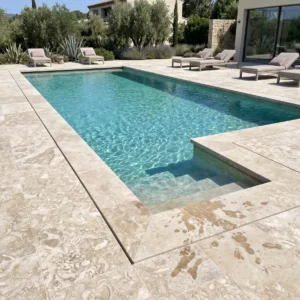
The infinity pool over the Caribbean is St. Barths’ visual signature – the image the island exports, the frame every villa listing leads with, the detail architects fly in to get right. Behind the photograph sits a compact discipline: a pool terrace on this island is almost always small, almost always steep-sided, and always judged against the best pool terrace the client has ever stood on, which was probably also here. The stone specification that survives that judgment is consistent, and this guide walks it edge to edge.
The Edge That Carries the Island
The infinity detail is deceptively simple: a weir wall whose cap disappears into the sea beyond it. Getting the disappearance right is stonework at its most exacting – weir stones cut to millimeter tolerance so the sheet of water breaks evenly, a cap tone matched to the water’s color band rather than the deck’s, and a maintenance reality nobody photographs: the weir face grows biology fastest of any surface on the property and is cleaned from a harness or a ledge. Design the access with the edge, not after it.
Small-Lot Geometry
St. Barths pools work inside tight, terraced lots, and the terrace succeeds by editing:
- One generous lounging zone beats three cramped ones – the island’s best decks hold six loungers with real circulation, not ten without.
- The dining moment moves under shade at the terrace’s inland edge, leaving the view line clear.
- Steps double as seating where the slope invites it – cut treads wide and let the geometry work twice.
- Planting pockets are designed into the paving plan from the start; retrofitted greenery on a finished deck always reads as an apology.
The Barefoot Brief
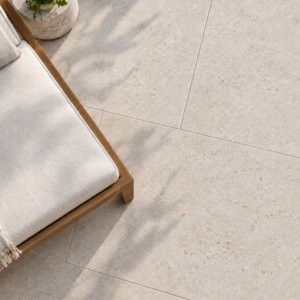
The deck is walked barefoot from November to April by guests who will mention it if it burns. Pale, dense limestone answers the brief the way it does across the region – reflecting rather than banking heat – and the finish carries the second half: honed-textured surfaces that grip wet feet without rasping dry ones. The combination is not a luxury choice on this island; it is the rental standard, checked by agencies and felt by every guest before lunch on arrival day. profiles that finish a waterline walks the coping decision itself – overhangs, drip grooves, eased edges – and every line of it applies at this latitude.
Salt Systems and the Splash Zone
Most of the island’s pools run saltwater chlorination, and the splash zone – coping plus the first meter of deck – lives in brine mist. Specification answers with density: low-absorption stone that keeps salt at the surface where the rain and the rinse hose can reach it. The maintenance rhythm is a staff task measured in minutes: fresh-water rinse of the splash zone, a gentle wash cycle for the wider deck, and the pH-neutral chemistry that protects both stone and pool balance. Nothing exotic – which is precisely what a property manager wants written into the manual.
The Night Swim Shift
The island dines late and swims later, and the terrace works its second shift under lighting. The rules are the region’s, tightened: warm-temperature fittings washed across stone rather than glaring off water, step edges found by light before feet find them, and the pale deck doing half the work by returning every lumen softly. Conduit crossed under the paving before bedding makes all of it cheap; the same capability cut into a finished deck is the island’s most avoidable invoice.
One Batch, One Family
The terrace reads as a single gesture because it ships as one: coping, weir caps, deck field, steps and spare stock cut from the same production batch, color-matched before the crates close. Same-batch attic stock is the quiet hero of the island’s pool culture – a cracked coping in February is an overnight repair instead of a season-long mismatch, and the agencies’ inspection notes stay clean. Five percent over the measured area, stored flat in the plant room, is the standing rule.
The Shallow Shelf
The island’s pool briefs increasingly add a shallow shelf – the wide, ankle-deep ledge where loungers stand half in the water and small children get their own domain. In stone terms the shelf is a precision element: a large, dead-flat plane a hand’s depth under water, where every tolerance error reads as a visible wedge of depth change. The specification follows the weir logic – calibrated thickness, tight joints, a finish textured enough for wet bodies and fine enough for bare skin – and the color decision matters doubly, because the shelf’s stone reads through the water and sets the pool’s shallows palette. Pale stone turns the shelf turquoise in sunlight, which is usually the point. Furniture on the shelf adds its own detail: lounger feet bear on small points, so the stone is chosen dense and the feet are padded, and the drainage around the shelf edge keeps splash-out from staining the dry deck beside it. Done well the shelf becomes the pool’s most used square meters; done casually it is a permanently visible error list. It rewards the same discipline as the edge – which is to say, complete drawings before a single stone is cut.
The Standard Travels
The infinity standard is demanding but not mysterious: tolerance at the edge, comfort underfoot, density against salt, light at night, one batch throughout. Owners weighing the same decisions on other shores will find pool registers on another sea a useful comparison – three climates, one specification skeleton. Build the edge to tolerance and the deck to the barefoot brief, and the photograph the island is famous for takes itself.
The Outdoor Shower Pairing
The island’s pool terraces increasingly ship with a partner: the outdoor shower, tucked behind a stone screen wall at the terrace’s service edge. The pairing is functional first – salt and sunscreen rinse off before the pool, sand stays out of the skimmer – and sensory second, because an open-air shower in dappled light is half the reason people move to the tropics.
- The shower floor runs the terrace’s textured stone at a tighter fall, draining fast to its own gully.
- The screen wall doubles as the towel wall – hooks and a shelf recess cut into the stonework at build time.
- Water lines and the drain rough-in go under the terrace with the pool services, in the same trench episode.
- Pale stone keeps the enclosure bright; a dark shower box in the tropics reads as a utility closet.
Sized generously and detailed in the terrace’s own family, the shower becomes the pool’s completing gesture – and its stone takes the hardest chemistry on the property, soap and sunscreen daily, which the dense low-absorption specification absorbs without comment.
The edge is a structure, not a finish
A vanishing edge only reads correctly if it is dead level and stays that way, which makes it the least forgiving element on the whole property. It sits at the top of a retaining structure, it is wet permanently on one face and intermittently on the other, and it is the first thing a guest photographs. Everything about its specification should follow from that: the thickest section on the job, mechanical restraint as well as bedding, and a tolerance regime agreed before anything is ordered rather than negotiated on site.
- Level tolerance stated in writing and checked before grouting
- Mechanical restraint at every unit, not bedding alone
- The thickest section on the project reserved for the edge
- Movement provision between the pool shell and the surrounding deck
- Spare units from the same block held for the inevitable chip
Grip is the number that has to be proved
The rest of the deck is judged barefoot and wet, which is a measurable condition rather than an opinion. The work behind frictional testing of natural stone walking surfaces sets out the ANSI A326.3 method, tested wet with a tribometer, and a benchmark dynamic coefficient of friction of at least 0.42 for level interior floors expected to be walked on wet. A sloping hillside deck with sunscreen and salt on it is a harder case, which is the argument for testing the delivered finish and specifying above the minimum.
- Wet values requested on the exact finish and batch being supplied
- More margin on the approach from the house and on every step
- One texture held across deck, coping and surround
- The test record kept, because grip is the claim worth proving
Choosing pool terrace stone that ages the way the island expects
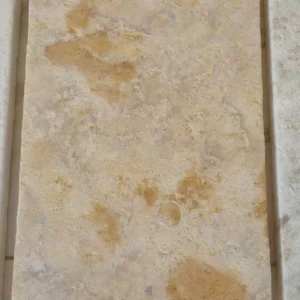
Consistency matters more than novelty at this level. The Natural Stone Institute overview of limestone and travertine shows how far density and absorption range inside one commercial name, and those numbers decide whether a pale deck stays pale, how hot it gets by three in the afternoon, and how it behaves where chlorinated water crosses it every day.
- Low-absorption stone anywhere splash-out is constant
- Light tones where guests cross open deck without shoes
- One source across deck and coping so the whole terrace weathers evenly
- Batch numbers recorded so a later repair can be matched
Our St Barths stone supply guide sets out the formats, finishes and lead times that suit this island. The edge is what sells the villa, and the deck is what keeps everyone on their feet.