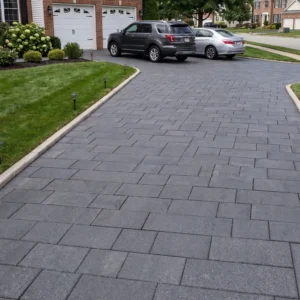
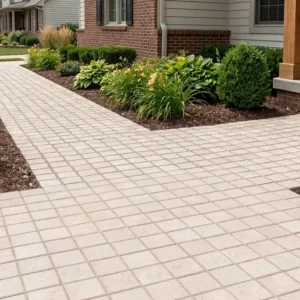
Toledo is where Belize’s pavement ends and its rainfall peaks. The deep south takes several times the north’s rain, grows the cacao that made the district’s name, and holds the country’s strongest living Maya presence in villages threaded through the hills. Punta Gorda – PG to everyone – anchors it all: a small sea-front market town, the Southern Highway’s last stop, a dock with boats to Guatemala. Building here is building in the wettest, greenest, most patient corner of the country.
Where the Rain Writes the Rules
Toledo’s rainfall – roughly triple Corozal’s – is the specification’s first author. Everything outdoors is a drainage question before it is a design question:
- Paving laid to generous falls, with channels that assume tropical volume, not temperate drizzle.
- Verandas deep enough that rain arrives horizontally without emptying them.
- Ground floors lifted – the platform instinct the Maya applied here first.
- Textured stone surfaces throughout; the district is never dry long enough for polish to be safe.
Cacao Country Economics
Toledo’s farm economy runs on cacao – smallholder groves under forest shade, a chocolate festival that draws the country each May, and a farm-stay tourism trade growing alongside the beans. The building brief that follows is modest and specific: processing floors that wash down clean, drying areas that shed sudden rain, farm-stay verandas and paths that carry visitors through mud season without carrying the mud indoors. Stone earns its keep here as working surface first, ornament second.
The Village District
Toledo’s Maya and Garifuna villages hold the district’s cultural weight, and outside building enters as a guest. The manners mirror Hopkins’ but run deeper: village land tenure is often communal and demands proper process; local labor is skilled and expects fair hiring; and the church, school and festival calendar shapes the working week. Builders who move at the district’s pace – and pay at it, promptly – find Toledo’s crews as capable as any in the country.
Punta Gorda’s Sea Front
PG faces the Gulf of Honduras across a working waterfront – market days, fishing boats, the Guatemala ferry – with the Sapodilla Cayes out beyond. Town building is small-scale and practical: guesthouse courtyards, veranda floors, market-adjacent premises that hose down at closing. The sea front takes weather without the Caribbean coast’s full fetch, so the detailing runs coastal-standard – salt-dense stone, textured finishes – at village scale. remote-site building logistics captures the supply rhythm every PG project learns.
The Phased-Build Culture
Toledo budgets build in phases as money and seasons allow – a platform this year, walls the next, the veranda after. Stone fits the culture when ordered with the endgame in mind: one material family declared at the start, the first consignment covering the surfaces that stop mud and rot, later consignments matching because the specification never wandered. The alternative – a different cheap surface each phase – is visible all along the highway, and nobody admires it.
The Long Road South
Toledo’s freight leg is the country’s longest: clearance at Belize City or Big Creek, then the Southern Highway to its end.
- Big Creek routing saves real distance for the deep south – confirm it at booking.
- Wet-season village roads demand dry-window scheduling and patience in equal measure.
- Consolidate ruthlessly: one clearance, one long drive, everything for the phase aboard.
The Patient District
Toledo rewards the builder who accepts its terms – rain-first design, village-pace process, phases that finish. Off-grid patterns from other markets, like off-grid living stone strategies, translate naturally to a district where self-sufficiency is ordinary. Build the deep south patiently, in stone that shrugs off the wettest sky in Belize, and Toledo gives back the greenest setting a home can have.
The Veranda as the House’s Best Room
In a district this wet, the veranda is not a transition space – it is the living room with better air. Toledo’s builders size them accordingly, and the details that separate a good veranda from a damp one are small, cheap on the drawing and expensive on the finished house.
- Depth first: deep enough that horizontal rain stops short of the furniture, long enough for the hammocks that are the region’s true seating.
- A stone floor that stays cool through the afternoon and dries fast after the squall passes.
- A gentle outward fall and a drip edge that actually drips clear of the wall.
- Screened storage at one end for the wet-season kit the district lives by.
Build the veranda first in the mind and the house behind it follows – Toledo’s older homes were designed exactly that way, and their verandas still hold the evening better than anything built since. In the wettest district of a wet country, the covered outdoor room floored in honest stone is not a luxury; it is the architecture admitting where life actually happens.
The Mudroom Entry
Toledo’s rain economy runs on boots, and the deep south’s smartest houses build for the moment they come off. The mudroom entry is a stone-floored transaction zone between the wet world and the dry house: a covered landing where gear sheds its water, a wash point with a drain where boots rinse before they cross, a bench at sitting height because balance and wet rubber are enemies, and hooks above stone rather than above timber that would record every drip. The floor falls gently to its own drain, dries fast, and hoses clean on market day. It is the least glamorous stone surface on the property and the one the household thanks most often – the veranda’s working partner at the back door.
Distance is the dominant cost
Toledo sits at the far end of the Southern Highway, and that single geographic fact reorders every line in a budget. A material that is competitively priced in Belize City is not competitively priced here once the haul is added, and a delivery that would be routine further north becomes an event that has to be planned around. The projects that work in the deep south are the ones that order less often, order more completely, and choose formats a small crew can handle without waiting for plant to make the same long journey.
- Fewer, larger orders rather than frequent top-ups
- Cut to list before dispatch so nothing travels twice
- Formats sized for hand placement, not for a machine that may not come
- Consumables, fixings and spares shipped with the main load
- A dry, secure store on site, because the next delivery is far away
The wettest corner of a wet country
Toledo receives more rain than anywhere else in Belize, and the difference is not marginal. Ground stays saturated, unsealed tracks soften, and surface water arrives in volume rather than as drizzle. On top of that the district sits in the same basin as everywhere else: the climatology from the National Hurricane Center puts the Atlantic season from June through November, peaking on September 10. A build here has a genuinely short window for anything that depends on dry ground.
- Groundworks and bulk deliveries concentrated in the drier months
- Drainage designed for volume, with an overflow route for blockages
- Subgrades assumed wet when calculating the build-up
- Temporary haul surfaces laid before the wet months, not during them
Choosing punta gorda toledo stone at the end of the road
When a repair means a long haul, repairability stops being a nicety. Guidance on detailing natural stone paving for lasting durability is clear that installation method drives long-term performance, and in a remote district the method that wins is the one that lets a local crew lift, repair and reset a section using only what is already on site.
- Granular bedding that can be recharged rather than broken out
- Joints that can be raked and refilled by hand
- One format and finish so any spare matches any location
- A written repair method left with whoever maintains the property
Our Belize stone supply guide sets out the formats, finishes and lead times that suit this country. The further you are from the supplier, the more the specification has to look after itself.