Every successful Ambergris Caye build starts from one accepted fact: the island manufactures nothing and stores little, so the project’s real schedule is written by barges, not builders. Building on Ambergris Caye rewards the owner who plans backwards from that constraint — and the ones who don’t discover it during the most expensive weeks of their lives. Here’s what to weigh before the architect draws a line.
The Barge Constitution
Everything solid on the island crossed from Belize City by barge: cement, steel, glass, stone and the excavator that places them. The planning consequences are non-negotiable:
- Materials consolidate into phase-sized consignments — trickled orders multiply fixed costs and waiting
- Staging ground on the island is arranged before cargo ships, not after it lands
- Spares travel with the first consignment, because a reorder waits on the next full sequence
- The build program keys to barge schedules the way mainland programs key to concrete trucks
Stone handles this environment better than most materials — it ships dense, stacks outdoors and waits indefinitely — which is one reason the island’s better builds lean on it for every exposed surface.
Golf-Cart Streets and the Last Hundred Meters
San Pedro’s streets run at golf-cart scale, and the last hundred meters of delivery is its own engineering question. Heavy cargo moves by small truck where streets allow and by cart, dolly and labor where they don’t. What experienced island builders do:
- Crate to weights two people or a small machine can move
- Schedule deliveries outside the tourist day when streets are workable
- Confirm beachfront sites’ access from the water where the street side is impossible
Salt, Sun and Sand: The Material Triage
The caye runs the full tropical-marine exam. Salt haze reaches every surface on the island, the UV load is constant, and sand arrives on every breeze and barefoot guest. Material selection follows the exam: dense low-absorption stone on the walking surfaces, marine-grade fixings without exception, textured finishes where wet feet travel, and pale tones that shed the heat the industry limestone specifications document. Timber and coatings join the renewable layer — budgeted for cycles, not decades.
Reef Manners: Building Beside a World Heritage Site
The Belize Barrier Reef sits offshore of every Ambergris project, and the island’s building culture increasingly holds itself to reef-safe runoff manners: sediment controlled during works, drainage filtered through planted ground, dock and seawall projects permitted properly, and lighting held low where turtles nest. The rules protect the asset every rental listing sells — the water — and operators who respect them visibly earn the community’s side in every future permission.
The Rental Arithmetic
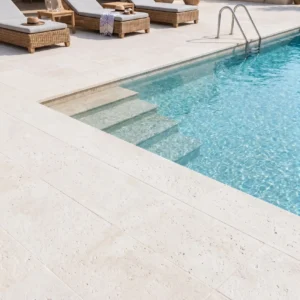
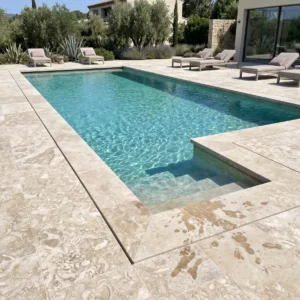
Most caye builds earn, and the specification should admit it from day one. Turnover-proof surfaces between guest weeks, photography-ready finishes that carry the listing, same-batch attic stock for instant repairs, and outdoor rooms — pool deck, veranda, dock — that work as the product’s hero images. For the pool package specifically, choosing the pool edge for villa and rental duty walks the coping logic that transfers to this island intact. A deck that photographs perfectly for a decade is the cheapest marketing the villa will ever buy.
Who Builds It: The Island’s Trades
San Pedro carries a genuine construction sector — contractors who know the barge operators, the permit office and the reef rules by first name — and the mainland adds crews for the big phases. The hiring craft is the small-island standard: references from standing buildings, scopes in writing, stage payments tied to verifiable milestones, and the local relationship treated as the long-term asset it is. Your builder’s barge literacy is worth as much as their concrete work.
Getting the Caye Build Right
Building on Ambergris Caye succeeds on logistics discipline, marine-grade materials and reef-respectful design — in that order. The island rewards owners who consolidate shipments, crate for carts, specify for salt and let the barge set the tempo. When the wider material decisions come up, villa-to-sand path and access craft covers a neighboring archipelago’s answers to the same shoreline questions. On Ambergris Caye, the build that respects the barge finishes on time — and the one that doesn’t funds everyone’s patience.
Power, Water and the Services Underfoot
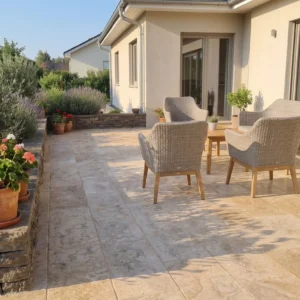
Hardscape on Ambergris Caye is laid over a service layer that mainland builds take for granted. San Pedro town runs municipal power and piped water, but the further north you build past the bridge, the more the house carries its own systems: cistern storage under the terrace, a septic field behind the setback, conduit runs for a generator or solar bank. Every one of those systems sits beneath or beside the paving – which means the paving plan and the services plan have to be one drawing, not two.
- Set inspection covers and cistern lids flush within the paving field, cut from the same stone where the budget allows – a terrace read as one surface, not a patchwork around hatches.
- Run spare conduit under any paved area before the bedding goes down; lifting a finished limestone terrace to add a cable later costs more than the cable ever will.
- Grade the terrace to move rain toward planted ground or the cistern feed, never toward the house slab – a caye storm delivers its water fast.
None of this is exotic; it is sequencing. The builders who work the caye full-time draw the services first, the stone second, and pour nothing until both agree. Owners who arrive with that expectation – and with the stone order timed to the barge schedule it rides on – are the ones whose terraces go down once and stay down.
The reef is a World Heritage neighbor
The water off this island is not simply scenic; it is inscribed. The Belize Barrier Reef Reserve System was listed by UNESCO in 1996 and covers about 96,300 hectares across seven protected areas, one of which, Bacalar Chico National Park and Marine Reserve, sits at the northern end of Ambergris Caye itself. The listing describes the largest barrier reef in the northern hemisphere, with offshore atolls, several hundred sand cays, mangrove forest, coastal lagoons and estuaries, supporting more than five hundred species of fish, sixty-five corals and three hundred and fifty molluscs, along with manatees, green and hawksbill turtles and American crocodiles. Everything that runs off a building site here eventually reaches that.
- Silt control treated as a permanent site condition, not a rainy-week measure
- Cutting and washing stations set well back from the shoreline
- Slurry, fines and offcuts collected rather than left to wash seaward
- Fuel and chemical storage bunded and kept off open sand
- Mangrove margins left alone unless a permit says otherwise
Barge logistics decide the specification
Nothing heavy reaches this island by accident. Cement, block, reinforcement, tile and stone all cross by barge, land at a limited number of points, and then travel the last stretch on roads built for golf carts. That chain sets hard limits long before anyone chooses a finish: pallet weight has to suit the smallest vehicle in the sequence, unit size has to suit a two-person carry, and the delivery has to arrive in the order it will be laid, because there is rarely anywhere to stack a surplus.
- Pallet weights matched to the cart or small truck doing the final leg
- Deliveries staged in laying order, since lay-down space is scarce and expensive
- Cut to list on the mainland so no saw has to run on a sand plot
- A single barge booking for the whole terrace rather than several part loads
- Wet-trade materials ordered with a margin, because a shortfall costs a sailing
Detailing for sand, salt and a shallow water table
The ground here is sand over coral rubble with the water table close beneath, which changes the build-up more than the appearance. Rigid slabs crack when the substrate moves, and anything sealed tight traps moisture that has nowhere to go. Guidance on detailing natural stone paving for lasting durability is direct that installation method matters as much as material choice, and on a caye the method that survives is the one that tolerates movement and can be lifted for repair.
- Flexible, granular build-ups in preference to large rigid slabs
- Open or permeable joints so trapped water can leave without pressure
- Non-ferrous fixings throughout, with no mixed metals anywhere in contact
- Edge restraint continuous, because sand migrates and edges unravel first
- A documented method for lifting and resetting a single unit
Building on Ambergris Caye so the second season is easy
The first year on this island tests the specification; the second year tests the repair plan. Choose materials a local crew can lift, keep a documented surplus on the property, and design every surface to be opened rather than demolished. Our Belize stone supply guide sets out the formats, finishes and lead times that suit this country. On a caye the barge schedule is not a constraint on the design; it is part of it.