Curaçao swims privately: the island’s villa culture — Dutch second homes, diaspora builds, resort-residential districts — treats the pool court as the household’s true living room, worked into walled gardens and trade-wind lee with a craft the island has refined across decades of European expectation meeting Caribbean climate. The Curaçao pool terrace has its own accent, and its stone choices carry the composition. Here is the swim-court guide.
The walled-lee tradition
The island’s constant easterly writes the first rule: pool courts compose in shelter — garden walls, house wings and planted screens making the calm room the trades demand, water surfaces protected from the chop-and-evaporation tax open siting pays, and the sun-and-shade choreography running European: owners who came for winter light want it managed, not survived. Stone walls do double duty as windbreak and warm evening backrest; the court’s microclimate is the design’s first deliverable.
Coral-limestone poolside character
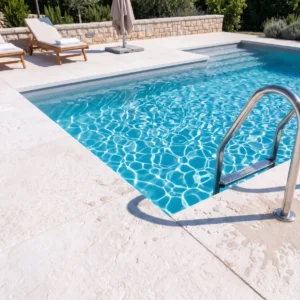
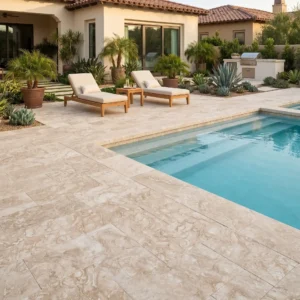
The island’s palette leans pale and mineral — whitewashed walls, ochre accents, the Dutch-Caribbean color card — and pool surrounds answer in kind: fossil-textured shellstone and coral-toned limestone keeping barefoot temperatures honest under full sun, eased coping profiles that flatter both modern-minimal and landhuis-inflected architecture, and wet-edge details executed to the tolerances the coping chapter teaches. Salt systems rule the market; specification runs salt-proof from shell to skimmer lids.
- Choose a pale warm tone so the deck stays walkable through the middle of the day.
- Keep a textured finish rather than a honed one, since texture breaks up heat as well as water.
- Provide a shaded band where people stand longest at the pool edge.
- Test a sample in full sun, because laboratory color says nothing about surface temperature.
Inland-bay and hillside settings
The island’s prized pool sites split by geography: Spanish Water hillsides terracing the bay-view register with infinity edges toward the anchorage, Jan Thiel’s resort-residential courts running to community standards, and the western kunuku country’s wilderness-adjacent restraint where pools sit low and quiet in cactus landscape. Each setting sets its own reveal: the hillside court frames water over water; the kunuku court frames sky.
Dutch expectations, tropical execution
The buyer culture arrives with European process instincts — drawings honored, tolerances checked, handover documented — and the pool court is where expectations meet execution most visibly: level tolerances proven across long copings, slip ratings specified rather than assumed, expansion detailing that survives the thermal swing, and the inspection-culture disciplines applied to outdoor works. The contractor who documents batch numbers and cure logs wins the referral network that drives this market.
Outdoor rooms around the water
The court’s supporting cast completes the living room: shaded dining loggias on the long-table logic, bar counters and grill stations worked into the windbreak walls, sun-shelf lounging in the shallows for the heat of the day, and evening lighting on the warm-register discipline that turns the court nocturnal — the island entertains at home, and the pool terrace hosts the calendar.
- Carry one material from the pool surround through to the shaded terrace.
- Use format changes rather than material changes to signal a different zone.
- Keep the outdoor kitchen surface in the same family so the composition holds together.
- Reserve any contrasting stone for a single deliberate feature.
Building the court that lasts
The specification that survives Curaçao’s sun, salt and constant wind is the cluster’s familiar law: dense low-absorption stone, marine-grade fixings, drainage worked to the island’s cloudburst rains, and spares held against the decade’s small repairs. The island supply guide packages the swim-court kit — copings, field paving, wall cappings, batch documentation — to the standard the market’s European eye expects and the climate quietly demands. The trades blow, the court stays calm, and the water holds the evening light: that is the island’s pool craft, done.
The kas chikí: the pool house, done properly
Curaçao’s walled courts increasingly carry a second building — the pool house, in local affection the kas chikí, the little house — and the structure’s brief is precise: everything the swimming afternoon needs, nothing that competes with the court. The program is compact and complete: a shaded lounge open to the water, a wet-capable bathroom that spares the main house its dripping traffic, a counter kitchen sized for drinks and grill support, and the storage that keeps the court’s furniture, floats and covers out of sight between uses. Its ground writes itself from the court’s own rules — the deck’s stone continuing inside at the same level so the threshold disappears, wet-zone textures in the shower and its approach, and falls that carry the little building’s wash-down into the court’s drainage plan rather than against it.
The Dutch-expectation layer shows in the execution: services drawn and documented like the main house’s — the pool plant often shares the structure, and its access, ventilation and acoustic separation deserve engineering rather than improvisation; the roof either joins the court’s windbreak logic or stays low inside it; and the batch discipline extends to the pool house’s floors and copings, ordered with the court’s stone so the ensemble matches for its lifetime. Hybrid and rental villas lean on the building hardest — the service-route thinking puts the guest-facing amenity here while the main house keeps its privacy.
Done well, the kas chikí is the court’s quiet upgrade from terrace to resort: the swim that never interrupts the house, the evening that migrates naturally to the water, the guests who settle poolside because everything they need is already there. The island’s pool culture was always about the composed court; the little house completes the composition — in the same stone, to the same standard, at the scale the walls always implied.
The number that settles the finish
Everything about a pool terrace is negotiable except the walking surface. Guidance from Use Natural Stone on frictional testing identifies ANSI A326.3 as the applicable method and a dynamic coefficient of friction of 0.42 as the benchmark for level interior surfaces expected to be walked on wet, notes that no published threshold covers exterior use, and records that polished finishes generally fail the wet test. A polished pool surround is therefore a specification error rather than a stylistic preference.
- Specify a textured finish and keep polished material away from anywhere feet land.
- Test the exact finish being bought, since one stone can pass in one texture and fail in another.
- Treat 0.42 as a floor and aim above it wherever the deck falls toward the water.
- Carry one texture through deck, steps and outdoor shower so grip never changes underfoot.
- Retest after a few seasons, because wear and cleaning both move the number.
A climate that keeps the pool in use all year
Curacao does not have a swimming season, it has a swimming calendar. The Meteorological Department Curacao climate summary records a dry season running February through May, a rainy season from October into January, sustained moderate to fresh easterly trade winds, and sea temperatures averaging about 27 degrees Celsius with a low near 25.9 in February and March and a high near 28.2 in September and October. Mean air temperatures peak in September.
- Specify for continuous rather than seasonal use, because the pool is never closed.
- Expect high evaporation, which concentrates chemicals and salts in the water faster.
- Design shade for the September peak rather than for an average month.
- Use the constant easterly to cool the terrace instead of fighting it with enclosure.
- Plan resurfacing works for the dry months, when rain will not interrupt them.
Coping, the one detail everybody touches
The coping takes chlorinated water from one side, salt air from the other and direct sun from above, and it is the only part of a pool that hands and forearms meet constantly. Absorption governs how it behaves: the lower it is, the less the stone takes in and the less it moves, stains or spalls. The profile matters just as much, because this is also the line that sets the geometry of the whole terrace.
- Specify low absorption for coping even where the wider deck uses something more porous.
- Choose a rounded or softly eased profile so a swimmer pulling out never meets a sharp arris.
- Keep coping joints tight and flexible, since this line moves with the pool shell.
- Match batch across the full run, because a tonal step reads instantly along a straight edge.
Curacao pool stone specified properly from the start
A pool here works every month of the year under strong sun and constant wind. That argues for pale, low-absorption, properly textured material, a deck that drains rather than pools, coping chosen for the hand as much as the eye, and one material family carried through the whole outdoor room. Our Curacao stone supply guide sets out the formats, finishes and lead times that suit this island. Get the wet-test number and the surface temperature right and everything else about the terrace becomes a pleasure rather than a problem.