Antiguan outdoor life is a negotiation with sun and breeze, and the courtyard is its masterpiece: walls for shade and privacy, openings for trade winds, and a stone floor that decides whether the space feels like a cool sanctuary or a bright oven. This is how stone shapes the island’s best garden rooms.
The floor is the thermostat
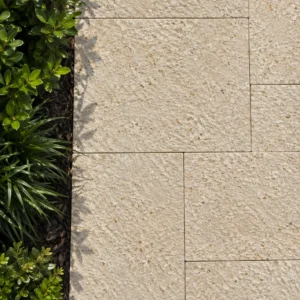
Enclosed courts concentrate reflected heat, so the ground plane must reject it: light white limestone keeps surface temperature civilized and bounces soft light into the rooms that open onto the court. In deep shade the same pale floor prevents the cave effect, lifting the space instead of darkening it.
Compose with the walls
Antigua’s architecture mixes rendered walls, timber shutters and stone accents, and the floor should anchor rather than compete:
- A quiet field — large-format limestone, stack bond, tight joints — lets planting and shadow-play star
- Where the court wants definition, a single basalt border reads as a drawn line rather than a pattern
Water features without regret
Plunge pools, rills and fountains turn courtyards magical and surfaces wet: rim them like pool edges — profiled stone copings, eased edges, textured surrounds — and give the basin course a slight outward fall. The detailing discipline is identical to a pool surround, just at garden scale.
Garden rooms beyond the court
Outdoor showers want textured light stone underfoot and walls that dry fast; dining pergolas want a level stone floor that takes furniture without rocking — large formats again; meditation corners and orchard paths can relax into stepping-stones set in ground cover. Each room borrows the same two-stone palette so the garden reads as one composition.
Installation method matters as much as the stone itself. Industry guidance separates mortar-set work, sand-set exterior paving and pedestal systems, and stresses that drainage, movement and substrate condition drive long-term performance more than the material name does — the detailing guidance is worth reading before you specify.
Night is half the garden’s life
Light stone gives back moonlight and low-level lighting: paths stay legible, steps stay safe, and the courtyard glows rather than disappearing at dusk. Dark accents disappear first — another reason they belong as borders, not fields.
From sketch to shipment
Courtyards are cut-to-order friendly: modest quantities, high detail value — copings, treads, borders — and everything ships together to St. John’s (mechanics in the freight guide). Samples within 3 working days; the full ordering path is in the Antigua supplier guide.
Wind, the invisible courtyard architect
Antigua’s trade winds shape outdoor comfort as much as sun does, and courtyards are wind instruments: walls create calm, gaps create breezeways. The stone floor plays its part by not contributing problems:
- Dust-free, unlike gravel
- Silent, unlike decking
- Stable under the gusts that precede a squall
Plan seating zones in the wind shadow of walls, and leave the breezeway where the evening air wants to move.
The plunge-pool courtyard, detailed
The signature Antiguan move — a plunge pool in a private court — compresses every discipline into a few square meters: profiled coping on the raised rim doubling as seating, textured surround for wet feet in a tight space, falls that carry splash to a discreet slot drain rather than across the court, and the pale field keeping a walled suntrap habitable. Because quantities are small, this is also where specials shine affordably: radius corners, a monolithic step, a spillway stone — jewelry-scale stonework with room-scale effect.
Absorption is the number that separates one limestone from another. The Natural Stone Institute records a range running from under one percent to over ten across the family, and notes that dolomitic stones generally carry higher density, lower absorption and better abrasion resistance — the industry variety data sets this out. That spread is why two stones sold under the same broad name can behave nothing alike underfoot.
Shade gardens and the deep-green pairing
Under mature trees and pergola vines the courtyard grows lush, and the floor’s job inverts from heat rejection to light farming. Pale limestone earns its place three ways:
- It lifts dappled shade into luminosity
- It holds its own against deep green without competing
- It shows fallen organic matter early, so the weekly sweep stays a two-minute job
Night gardens and the lighting budget
Courtyards live longest after dark, and stone choice writes the lighting bill. A pale floor needs only low-level warmth:
- A wash at a wall base
- A glow under a bench
- Moonlight doing the rest
Dark surfaces demand fixture counts that read municipal. Design the night scene at specification — which walls to graze, which tree to uplight — and let the floor distribute it all for free.
Commissioning a courtyard, start to finish
The path from idea to finished court is short and mostly decisions:
- A dimensioned sketch — walls, openings, water, trees
- The two-stone palette and the finish zones
- The specials list — caps, treads, rings, coping
- Samples viewed in your own light
- One consolidated order to St. John’s
Courtyard quantities are modest, which makes them the perfect first project with a new stone supplier.
The courtyard cistern: stone over storage
Antigua’s houses have harvested rain since the island’s first cisterns, and courtyards often sit atop that heritage: a stone court laid to sealed joints and gentle falls is a clean catchment, its outlets feeding the tank below or beside — filtration between. Design notes where court meets cistern: access covers specified as recessed stone trays so inspection vanishes into the field; falls tuned to the collection point without visible channeling; and first-flush diverters doing their quiet work off-stage. The court drinks its own rain — an island tradition, dressed properly.
Dressing the court: pots, sculpture and the bases they deserve
Courtyard character arrives in objects — oil jars, planted urns, a sculpture, a water bowl — and stone underfoot flatters them best with deliberate bases:
- A flush accent unit under a feature pot, which spares the field from ring stains and roots the composition
- A low basalt plinth lifting sculpture into significance
- Saucers and feet under everything that drains
The rule mirrors furniture on decks: objects invited onto stone should be introduced to it properly.
Patina: how a stone court ages, honestly
A limestone court’s first years write a gentle story: the factory brightness settles a shade toward its resident tone, edges soften microscopically at the traffic lines, and the surface takes on the low sheen of use that no new floor can fake. This is patina — the aging that reads as establishment, not neglect — and the maintenance calendar’s job is to let it happen while blocking the impostors (biological film, stains, salt). Ten years on, a tended court looks like it predates the house in the best way; that dignity is the material’s long payoff.
How a courtyard in Antigua earns its shade
A courtyard is the ideal first stone project with an overseas supplier: quantities small enough that freight rides groupage lightly, details rich enough to prove cut-to-order’s worth, and a finished room the household uses daily as the argument for the terrace, the pool surround, the drive that follow. Owners who start with the court almost always continue — which is why the sketch-to-samples path deserves its three working days sooner rather than later.