Barbados is built on coral limestone, and coral stone has shaped the island’s architecture for centuries. So when does it make sense to import limestone instead of cutting it locally? The honest answer depends on where the stone is going — and on understanding what porosity does to a floor in a marine climate.
Where coral stone shines
Coral stone’s warmth and texture are part of Barbadian identity, and there are places it is still the right answer:
- Walls and decorative facades
- Garden features and follies
- Sheltered details where water is incidental rather than constant
Its thermal mass suits the climate, and its softness makes it easy to work by hand. If the design goal is traditional Bajan character on a vertical surface, local coral stone remains a beautiful, legitimate choice.
Where it struggles: the physics of porosity
That same softness is the problem underfoot. Coral stone is highly porous, and in a marine climate porosity is not a cosmetic issue — it is a mechanism of decay. Salt-laden water enters the pores; when it evaporates, salt crystals grow inside the stone and push it apart from within, a process called salt crystallization spalling. The surface powders, pits and loses its face. Add foot and vehicle traffic and the wear accelerates, which is why coral stone floors demand frequent sealing and still age quickly in wet, trafficked areas.
What density changes
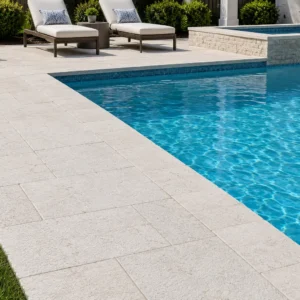
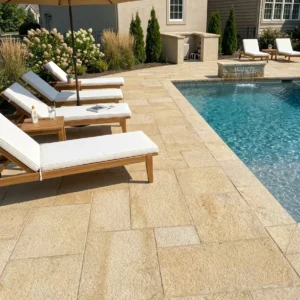
Paving-grade limestone is selected precisely for low absorption and high density. Less water enters the stone, so there is less salt crystallization, less staining, less biological growth, and dramatically slower wear. It takes vehicle loads on a driveway, shrugs off pool chemistry on a deck, and holds its color in full sun. Light tones stay cool underfoot — the property that matters most on a Barbados pool surround at two in the afternoon.
Absorption is the number that separates one limestone from another. The Natural Stone Institute records a range running from under one percent to over ten across the family, and notes that dolomitic stones generally carry higher density, lower absorption and better abrasion resistance — the industry variety data sets this out. That spread is why two stones sold under the same broad name can behave nothing alike underfoot.
Maintenance over ten years, honestly
Coral stone in a wet area is a maintenance commitment: regular resealing, gentle cleaning, and acceptance of gradual surface loss. Dense limestone is closer to set-and-forget: periodic washing, resealing measured in years rather than months, and chips that can be dressed out because the stone is the same material all the way through. Over the life of a terrace, the cheaper installation is rarely the cheaper floor.
A sensible division of labor
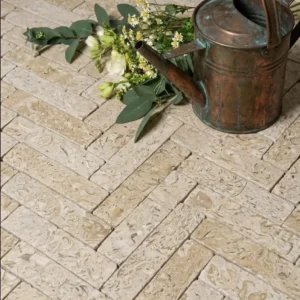
The strongest Barbadian projects use both: local coral stone for walls and character elements where its texture belongs, dense imported limestone for floors, pool decks, coping and driveways where performance is non-negotiable. Our white limestone pavers are cut to your sizes and finished for grip where it gets wet — every finish photographed up close in the Stone Finishes Gallery.
The side-by-side test
Do not take either side’s word for it. Put a sample of dense limestone next to local coral stone and run four tests:
- Wet both, and watch how fast each absorbs water
- Scratch both with a coin, and compare the marks
- Weigh both in your hands — density is immediately obvious
- Leave both in the sun for an afternoon, then touch them
The differences are not subtle, and they are exactly the differences that decide how a floor ages.
Specification checklist for Barbados floors
Whichever stone you choose, specify against the climate: low water absorption for anything exposed to spray or rain; a textured finish (brushed or bush-hammered) wherever bare wet feet walk; light color for barefoot comfort in sun; thickness matched to load — pedestrian terraces need less than driveways; and a single supplied batch for color consistency across the project. Samples of our stone are at your door within 3 working days — details in the Barbados supplier guide.
Anything close to the shoreline sits inside a regulated environment. The Coastal Zone Management Unit assesses physical development applications affecting the coastal zone and monitors the shoreline directly through beach profiling and wave data — the unit publishes its remit in full. Confirm your setback position before you order stone, not after the pallets land.
What the quarries of Barbados actually yield
Barbados’s coral cap has been cut for centuries, and the island’s masons know its grades intimately: the softer beds that saw like timber and weather like it too, and the denser reef limestones that have held up parish churches for two hundred years. That heritage matters — used vertically and detailed against rain, good coral stone is a legitimate, beautiful material with real provenance. The honest question is not whether coral stone is good; it is whether the bed on offer, in the exposure intended, does the job for the decades intended. For walls the answer is often yes. For wet floors it is almost always no — not from any local failing but from the physics of young, open-pored stone.
Numbers to hold both stones against
Strip the marketing and two figures adjudicate:
- Water absorption — dense imported paving limestone typically sits under 2–3 percent by weight, while soft coral beds can absorb several times more, and every extra point is more salt water carried into the section on every wet day
- Density — paving-grade limestone at roughly 2,600–2,700 kg/m³ against notably lighter soft beds, which you feel lifting samples one to a hand
Ask for both numbers whenever anyone quotes you stone.
Where the pairing sings
The best Bajan architecture treats the two materials as a duet:
- Coral-stone boundary walls with dense limestone copings that shed the rain the wall would otherwise drink
- Coral feature facades above limestone terraces that take the traffic
- A coral garden folly beside a limestone path that stays walkable in a squall
In every pairing the assignment is identical: character where water is incidental, density where water and wear concentrate.
Renovating around existing coral stone
Thousands of Bajan properties already stand in coral stone, and renovation is where the comparison turns practical:
- Keep and celebrate sound coral walls — repoint with appropriate lime-based mortars, never hard cement
- Where coral floors have pitted past charm, overlay or replace the horizontal surfaces with dense limestone and leave the vertical heritage intact
- Where a coral parapet or sill has eroded, a limestone cap in a sympathetic tone buys decades
Getting coral stone vs limestone right the first time
Every claim above submits to the same tribunal: put a coral offcut and a dense limestone sample side by side for a week. Wet them each morning and watch the drying race. Scratch both with a coin on day one and day seven. Stand them in a dish of salt water and inspect the rims. Weigh them. By Sunday you will hold the entire geology lesson in two hands — and specification for your particular project becomes obvious rather than argued. Samples arrive in 3 working days; the doorstep does the rest. Let the two stones argue it out on your own floor.