

Reading Grey Limestone Before You Commit to a Palette
The grey limestone color guide most specifiers reach for focuses on broad tone categories — light, mid, and dark — but the real decision-making happens at a finer resolution than that. Grey limestone colour behaves differently under overcast light versus direct afternoon sun, and that shift can be dramatic enough to reverse a confident selection. Understanding how limestone grey colour responds across changing light conditions, finish types, and surrounding materials is what separates a satisfying long-term specification from one you regret six months into the project.
Grey limestone rock forms its characteristic colour palette from mineral inclusions — primarily calcite, clay minerals, and iron compounds — distributed unevenly through the matrix. That uneven distribution is why two slabs from the same quarry batch can read noticeably different once installed at scale. Factor that natural variance into your ordering strategy from the start, and you’ll avoid the most common colour-matching frustration that surfaces during installation.
The Full Tone Spectrum: Light Silver to Deep Charcoal
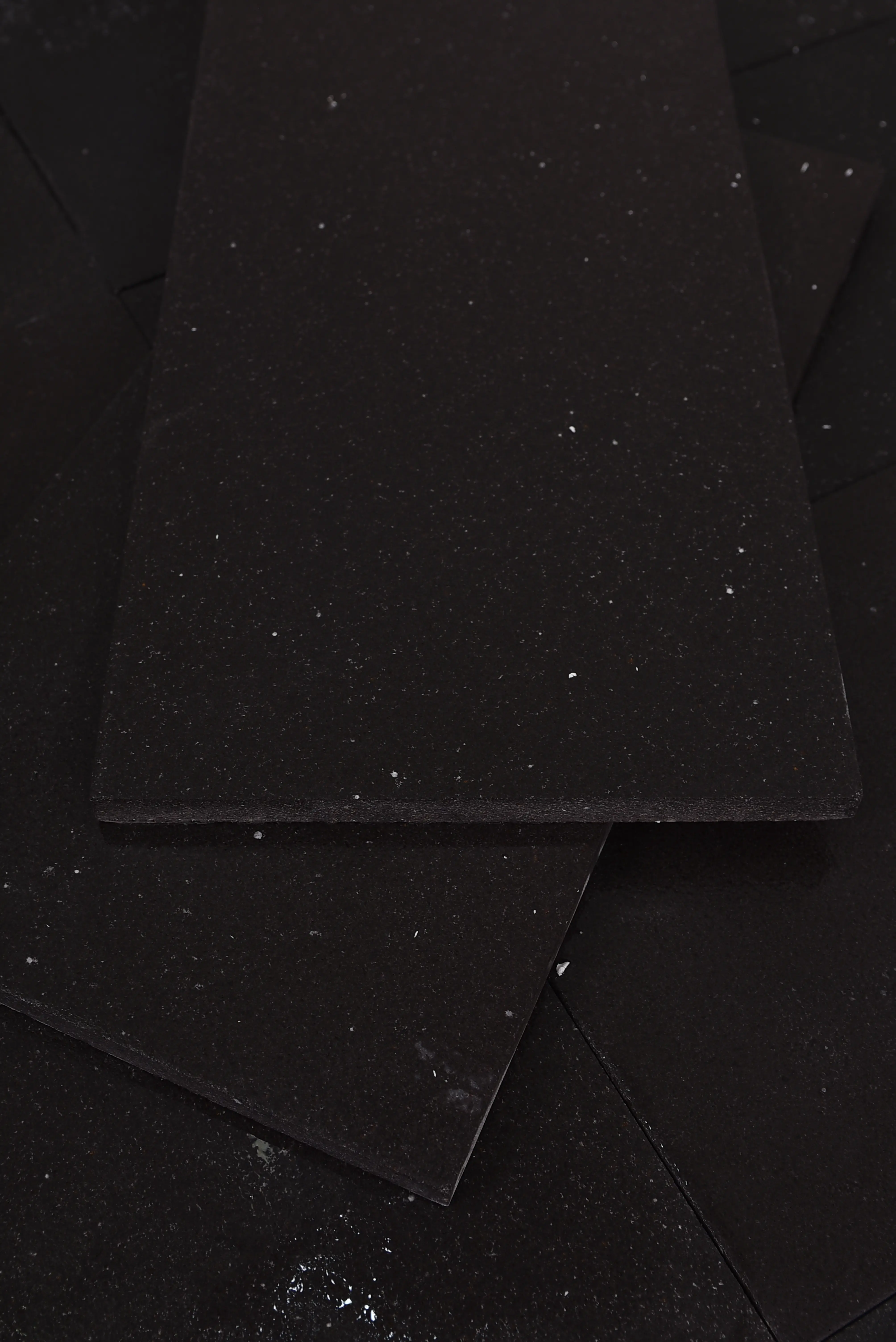
Grey limestone spans a wider tonal range than most buyers initially expect. At the pale end, silver-grey and pearl varieties carry L* values (in the CIELAB colour model) above 70, reflecting enough light to visually enlarge a compact space. At the deep end, dark grey limestone drops below L* 40 — closer in apparent depth to slate or basalt — and holds its colour more consistently across lighting shifts because it has less reflectance to modulate.
The mid-range tones, roughly L* 50–65, present the most complex behaviour. These medium greys are the most responsive to light direction and sky conditions, which makes them both versatile and unpredictable. They shift from cool blue-grey in north-facing shaded areas to a warmer greige tone in full afternoon sun. That shift isn’t a defect — it’s the material’s natural calcite content interacting with the light spectrum — but you need to account for it when coordinating with fixed finishes like grout, cladding, or joinery.
- Light silver-grey tones (L* 70+): high reflectance, visually expansive, most responsive to finish type
- Mid-grey tones (L* 50–65): broadest tonal range under variable light, ideal for adaptable design schemes
- Dark grey limestone (L* below 45): low reflectance, stable colour, dramatic contrast potential
- Blue-grey variants: higher clay mineral content shifts the undertone cooler, particularly evident in honed finishes
- Warm-grey variants: iron oxide traces create a subtle ochre undertone that reads warmer indoors than out
According to NSI limestone technical data, the mineral composition driving these tonal differences — calcite purity, clay content, and trace iron — varies substantially between quarry sources, which is why colour consistency requires specifying both the stone variety and the quarry origin together.
How Surface Finish Alters the Perceived Colour
Finish selection is one of the most underestimated colour variables in any grey limestone color guide. The same raw slab processed to a honed finish versus a brushed finish versus a tumbled finish will produce three noticeably different colour readings at installation, even though the mineral content is identical.
Honing opens the surface microstructure, which absorbs more ambient light and pushes the apparent tone slightly darker and cooler. A honed dark grey limestone can read almost black in low-light interiors. Polishing does the opposite — it creates a specular surface that reflects light directionally, making the stone appear lighter and more dynamic, with strong variation between lit and shadowed areas. For outdoor applications, polished finishes are rarely appropriate because they amplify light non-uniformly and become dangerously slippery when wet.
- Honed: darker apparent tone, matte surface, cooler undertone, moderate slip resistance
- Brushed or aged: textured surface softens colour contrast, introduces tactile warmth, excellent outdoor grip
- Tumbled: rounded edges and micro-pitting scatter light, producing a softer, more muted tone reading
- Sawn: raw, directional saw marks create a slightly lighter, more industrial reading before any secondary processing
- Flamed or thermal: surface carbonisation slightly lightens certain grey limestones while creating a coarse, high-grip texture
The relationship between finish and apparent lightness matters most for large-format installations. A 600×600 mm honed slab field will read two to three tones darker than a sample card viewed at close range under showroom lighting. Always assess large-format finishes as a mock-up panel of at least 1.5 square metres before finalising your specification.
Light Behaviour: Indoor vs Outdoor Colour Reading
The most common feedback after a grey limestone installation is that the stone looks different in-situ than it did in the sample room — and that observation is almost always correct. The reason is the fundamental difference between point-source artificial light (showroom) and diffuse broadband natural light (installed position).
Incandescent and warm LED sources, which dominate indoor residential settings, shift grey limestone toward its warmer undertones. The cool blue-grey that looked clean and contemporary in the sample folder reads closer to a taupe or warm stone under 2700K–3000K interior lighting. Cooler daylight-balanced sources (4000K+) in commercial interiors tend to preserve the cooler, more neutral limestone grey colour. Knowing your lighting specification before you lock in stone colour is not optional — it’s foundational to getting the outcome right.
Outdoors, the colour shifts with the sky. Direct midday sun intensifies the surface, flattening tone and pushing light-grey varieties toward near-white. Overcast conditions reveal the stone’s truest, most nuanced colour because diffuse light doesn’t create the high-contrast specular reflections that distort tone reading. If you can only view samples in one condition, overcast daylight gives you the most honest representation of the material’s actual colour.
Tonal Pairing Strategies for Grey Limestone
A thorough grey limestone color guide becomes most useful when it addresses how each tone bracket pairs with surrounding materials. Grey limestone rock doesn’t exist in isolation — it reads in constant relationship to the jointing colour, the wall finishes, the planting, and any adjacent hardscape.
Light silver-grey varieties create the strongest contrast when paired with dark steel, charcoal grout, or deep green planting. That contrast reads as contemporary and crisp in sunlit settings. In shaded or enclosed spaces, however, the same pairing can feel heavy. For those contexts, consider pulling your grout toward a mid-grey rather than a dark charcoal — this softens the contrast and lets the stone’s natural tonal variation breathe. You can explore specific product tones and see how they read at scale by reviewing Citadel Stone limestone paving tones before making a final selection.
- Light grey limestone + dark steel joinery: contemporary, high contrast, best in sun-exposed settings
- Mid-grey limestone + warm timber: balanced, transitional, suits both indoor and outdoor zones
- Dark grey limestone + white render or light masonry: strong tonal anchor, architecturally graphic
- Blue-grey limestone + cool-toned planting (silver foliage, lavender): reinforces the cool palette coherently
- Warm-grey limestone + natural sandstone or buff brick: blends harmoniously without colour competition
Grout selection deserves its own attention. A grey limestone installed with white or cream grout will always read as a grid pattern first and a stone surface second. Matching your grout closely to the stone’s mid-tone produces a more unified plane that lets the material’s natural variation become the focal point rather than the joint lines.
What the Geology Tells You About Colour Consistency
Understanding the geology behind grey limestone rock helps you set realistic expectations for colour consistency across large orders. Limestone is a sedimentary rock formed primarily from calcium carbonate deposited in marine environments over millions of years. The grey colouration comes from the organic matter, clay minerals, and iron compounds trapped during that deposition — and because deposition conditions varied across a single quarry face, colour banding and tonal shifts within a single block are entirely normal.
The USGS limestone geological data confirms that limestone composition varies significantly with depositional environment, which directly explains why certain grey limestone varieties show strong veining and tonal variation while others — formed in more stable, uniform conditions — are remarkably consistent in colour across the full slab surface. Knowing which type you’re specifying determines how much sorting and batch matching your installation will require.
Higher-consistency grey varieties typically come from dense, deep-water formation limestone with low organic content. More variable, characterful stones with visible fossil inclusions and tonal banding come from shallower, higher-energy depositional environments. Neither is inferior — they serve different design purposes — but mixing them in the same installation without careful batch control creates visible tone breaks that are difficult to correct after setting.
Ordering Strategy: Batching for Colour Consistency
The single most preventable colour problem in grey limestone installations is poor batch management. Natural stone colour shifts between production runs — sometimes subtly, sometimes dramatically — because quarry face conditions change with depth and lateral position. Your order needs to be large enough to complete the entire project from a single batch, with a 10–15% overage to cover cuts, future repairs, and any installation wastage.
Citadel Stone warehouse inventory is structured to support full-project batching, which means your entire project quantity can typically be drawn from a single palletised production run rather than assembled from multiple smaller shipments. That operational detail matters for colour consistency more than most buyers realise. When stones arrive on a single truck from the same production batch, your installer can mix slabs from different boxes across the floor during laying — a technique called cross-stacking — that naturally blends the subtle tonal variation within the batch rather than concentrating it in one zone.
- Order 10–15% over your net area to allow for cuts and future repairs from the same batch
- Request batch certificates or production run numbers when ordering large quantities
- Ask your supplier to hold reserved stock from the same run for at least 60 days post-delivery
- Cross-stack during installation — open multiple boxes simultaneously and mix slabs rather than exhausting one box before opening the next
- Photograph the installed floor after 30 days dry to capture the settled colour for future order matching
According to Britannica’s limestone reference, the sedimentary layering of limestone creates inherent colour variation even within a single quarried block — which underscores why batch discipline at the ordering stage is the most effective colour-consistency tool available to you.
Subgrade Conditions and Long-Term Colour Stability
Here’s a detail that often gets overlooked in colour-focused discussions: the subgrade conditions beneath your grey limestone installation directly affect its long-term colour stability. This isn’t immediately obvious, but the mechanism is straightforward. Expansive clay soils that experience seasonal swell and shrinkage cycles generate differential movement in the stone bed. That movement causes micro-cracking at joint interfaces, which allows moisture ingress. Persistent moisture beneath grey limestone — particularly in the honed or polished finishes — creates localised darkening and efflorescence that reads as patchy, uneven colour across the installation.
Sandy or well-draining subgrades behave the opposite way — they drain freely, allow the base to breathe, and support the stone with minimal seasonal movement. On sites with expansive clay, you’ll need to either replace the upper 200–300 mm of the subgrade with a compacted granular fill, or use a geotextile membrane to separate the clay from the aggregate base and limit capillary moisture rise. Caliche soils present a different problem — their high calcium carbonate content can trigger secondary efflorescence in grey limestone over time, particularly if the drainage layer isn’t isolating the stone from soil contact. Addressing subgrade conditions during base preparation is the practical intervention that protects your colour specification for the full life of the installation.
- Expansive clay: install geotextile separator and minimum 150 mm compacted granular base to limit differential movement
- Sandy soils: confirm base compaction to 95% Proctor density — sand’s free-draining nature is advantageous but requires structural stabilisation
- Caliche-heavy soils: use a moisture-isolating membrane and ensure positive surface drainage to prevent calcium leaching into the stone bed
- Rocky or shallow-soil sites: focus on levelling the substrate rather than depth — inconsistent bearing creates point-load stress that can crack large-format grey limestone slabs
The grey limestone color guide conversation rarely includes subgrade because it feels like a separate installation topic — but colour performance over a ten-year period is inseparable from what’s happening below the surface. Get the base right and your colour stays right.
Sealing: Colour Enhancement vs Colour Neutrality
Your sealing choice is a deliberate colour decision, not just a maintenance step. Sealers for grey limestone fall into two functional categories: colour-neutral penetrating sealers that lock the existing dry tone in place, and colour-enhancing sealers that deepen and saturate the stone’s natural palette. The right choice depends on what you want the stone to look like permanently.
Colour-neutral penetrating sealers are the conservative specification — they protect against staining without visually altering the dry stone colour you selected. Colour-enhancing sealers darken the stone by approximately one to two tone steps, which can be exactly what you want for a mid-grey limestone that reads slightly washed out in strong sunlight. The effect is analogous to the colour of the stone when it’s just slightly damp — richer, deeper, and more saturated. That darkening is permanent as long as the sealer coat is maintained, so apply a test patch to a discreet area and allow it to fully cure before committing to the full installation.
- Colour-neutral penetrating sealers: ideal for preserving a selected dry tone exactly as approved in sampling
- Colour-enhancing sealers: deepen apparent tone 1–2 steps, increase saturation, improve perceived depth
- Topcoat film-forming sealers: alter sheen level (satin to gloss) and should generally be avoided on exterior grey limestone — UV degradation causes patchy peeling that creates colour inconsistency
- Re-application frequency: penetrating sealers on honed dark grey limestone typically require renewal every 3–5 years depending on traffic and exposure
Limestone grey colour under a well-chosen enhancing sealer is particularly effective on dark grey limestone where the enhancement brings out subtle blue or green mineral undertones that read flat in the unsealed dry state. Test first, commit after — it’s a colour decision that can’t be easily reversed.
Specifying Grey Limestone: Bringing the Full Picture Together
A well-executed grey limestone color guide brings together material knowledge, light awareness, and project-specific discipline — and none of those three elements works in isolation. Your selection process should move from geology (quarry source and mineral composition) through finish (and its effect on apparent tone), then to light modelling (interior source temperature vs natural exposure), and finally to ordering strategy (batch management and overage). Skipping any stage in that sequence creates the conditions for a colour outcome that doesn’t match the specification intent. If you’re working across a range of grey varieties and need a structured reference for how different tones and finishes compare at a product level, the full limestone variety comparison is a useful companion resource that covers the spectrum from pale Jura tones to the deeper Thala palette.
Grey limestone rock installed on a properly prepared, stable base — with finish, sealer, and batch all specified in sequence — holds its colour character for decades without intervention beyond routine maintenance. The decisions that determine thirty-year performance are all made before the first slab is set, which is why the colour guide conversation has to reach beyond aesthetics into geology, subgrade, and logistics. At Citadel Stone, we work directly with project teams to confirm batch availability, review subgrade suitability, and recommend finish combinations before orders are placed — because the best colour outcome starts well before the stone reaches your site. Buyers working with Citadel Stone often discover that the same grey limestone reads warmer under incandescent indoor lighting than it does in a shaded outdoor setting.