

What Granite Distributors Actually Charge
Granite distributors price material across a spread from roughly $8 to $45 per square foot for material alone — and that range isn’t arbitrary. It reflects genuine differences in slab quality, country of origin, quarry extraction costs, and the number of intermediaries between raw stone and your order. Pricing doesn’t follow a single national rate card; it shifts based on origin, thickness, finish, and the logistics chain between the quarry and your project site. Understanding where your quote sits within that band — and why — is the practical skill that separates projects that stay on budget from those that don’t.
How Distributor Pricing Is Structured
Most granite distributors price in one of three ways: per square foot for slabs, per linear foot for cut pieces, or per ton for bulk orders. Slab pricing is the most common model for architectural and commercial work, and it’s where you’ll find the widest variance. Standard commercial-grade slabs in the 3/4-inch nominal thickness typically land between $8 and $18 per square foot at the distributor level before fabrication. Premium grades — consistent veining, low absorption, uniform color — push into the $22 to $38 range. Rare quarry-exclusive material can exceed $45 per square foot, though that tier serves a narrow segment of the market.
Thickness drives cost in ways that aren’t always obvious. A jump from 3/4-inch to 1.25-inch slab adds 40 to 60 percent to the raw material cost before you factor in the added weight’s effect on freight. For paving applications, you’re typically looking at 1.25-inch to 2-inch material, which changes the entire cost equation compared to countertop-grade slabs. According to Natural Stone Institute granite durability specifications, thickness selection directly affects both structural performance and long-term wear resistance — a detail that justifies the premium when the application demands it.
Finish also affects price in a way most buyers underestimate. Polished finishes require the most processing time and drive the highest cost per square foot. Honed and flamed finishes add moderate processing overhead. Sandblasted or bush-hammered textures — common for paving and exterior applications — require specialized equipment and add roughly 15 to 25 percent over a raw sawn finish price.
Origin and Supply Chain Impact on Cost
Your total distributor cost reflects where the stone was quarried and how many hands it passed through before reaching warehouse stock. Domestic granite typically carries lower freight costs but often a higher base price per square foot due to extraction and labor costs. Brazilian and Indian granite dominates the mid-market — efficient quarrying, high output, and established shipping lanes keep prices competitive. Chinese granite rounds out the high-volume category, though import tariffs introduced in recent years have compressed the price advantage that once made it the default budget choice.
The supply chain structure matters because it affects both price and lead time. Distributors who buy direct from quarries — cutting out the importer intermediary — can offer better pricing on volume orders, but they require larger minimum quantities. Distributors who aggregate from multiple importers offer broader selection but carry a markup at each chain link. You should ask your distributor directly whether they’re buying from a primary importer or sourcing direct, because that answer tells you both where your price ceiling sits and how much room exists for negotiation on volume.
- Direct quarry relationships typically yield 10 to 20 percent lower unit costs on orders above 500 square feet
- Importer-aggregator distributors provide more SKU flexibility but compress their margin less readily
- Tariff exposure on Chinese granite has added $1.50 to $4.00 per square foot depending on the grade and current rate schedules
- Domestic granite supply is geographically concentrated, meaning freight from source regions adds cost for projects distant from production areas
Volume Thresholds and Pricing Breaks
Granite distributors structure pricing around volume thresholds that aren’t always published on a rate sheet. At Citadel Stone, we recommend requesting a tiered quote on any order above 200 square feet — the pricing at 500, 1,000, and 2,500 square feet breaks look different enough to change project budgeting significantly. Most distributors set their first meaningful break between 200 and 400 square feet, with a second break in the 800 to 1,200 range.
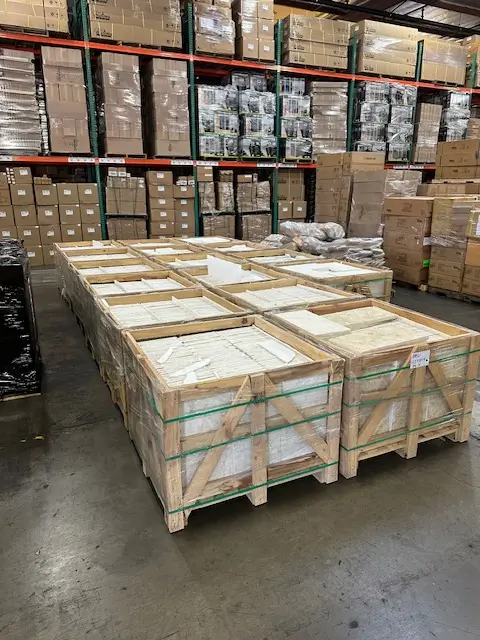
Bulk paving orders operate under different pricing logic than slab orders. Granite pavers ordered by the pallet or the ton follow commodity pricing more closely than architectural slab pricing. You’ll typically see paver pricing quoted per square foot installed equivalent, but the underlying unit is the pallet weight. A standard pallet of 2-inch granite pavers runs approximately 2,200 to 2,800 pounds depending on the cut size, and distributor pricing on full-pallet orders is generally 12 to 22 percent below mixed or partial-pallet pricing.
Freight is the variable most buyers fail to model accurately. Truck delivery costs for stone are distance-sensitive, and a project 400 miles from the distribution warehouse will carry meaningfully higher freight per square foot than one 80 miles out. Always request freight-included pricing alongside ex-warehouse pricing so you can compare total landed cost across multiple granite distributors rather than just the material rate.
Terrain and Site Conditions That Affect Total Cost
This is a dimension of granite distributor pricing that rarely appears in published rate guides but has real consequences for total project cost. Site access — specifically the terrain and grade your delivery trucks need to navigate — affects freight costs, delivery method, and sometimes material selection itself. A hillside installation with a steep access grade may require crane-assisted unloading or multiple smaller truck runs instead of a single flatbed, adding $400 to $1,200 to delivery cost depending on site conditions.
Sloped sites also affect base preparation requirements in ways that influence material thickness selection at the distributor level. On grades steeper than 2 percent, drainage geometry changes the loading profile on paving material — water channeling, freeze-thaw pressure at the slab edges, and differential settlement all become more significant. For hillside and terraced applications, you’ll typically specify thicker pavers — 2-inch to 3-inch nominal — to handle the increased point loading from grade transitions. That thickness upgrade changes your distributor order profile and your per-square-foot cost.
- Restricted truck access on sloped sites may require smaller vehicle runs, increasing per-load delivery cost
- Elevated sites often require reinforced base preparation, indirectly increasing material thickness requirements and distributor order cost
- Drainage slope requirements for paving on grade change the effective coverage area, requiring accurate overage calculations before placing your distributor order
- Low-lying sites with drainage challenges may require sealed or low-absorption granite grades, narrowing distributor selection and affecting pricing
Granite’s low absorption rate — typically below 0.4 percent per ASTM C615 granite dimension stone standards — makes it a reliable choice for drainage-challenged sites where softer stones would deteriorate faster. That physical advantage is worth factoring into your cost-benefit analysis when comparing granite against cheaper alternatives that may require replacement sooner.
Custom Fabrication and Cut-to-Size Pricing
Standard slab pricing assumes cut-to-size fabrication happens downstream, either at the distributor’s facility or through a third-party fabricator. The distinction matters because cut-to-size pricing adds $3 to $12 per square foot depending on the complexity of cuts, the precision tolerances required, and whether edge profiling is specified. Distributors who carry in-house fabrication capability — waterjet, CNC bridge saw, edge profiling — can quote fully finished product at a single price point, which simplifies your project accounting.
Custom dimensioning to match architectural drawings rather than standard slab layouts — the approach that distinguishes Simmons custom granite work from off-the-shelf supply — applies most directly to feature installations, stair treads, coping, and accent paving where standard cuts won’t match the geometry. Custom dimensioning typically adds 20 to 35 percent to base material cost and requires longer lead times from the distributor, sometimes 3 to 5 weeks for complex profiles. Build that lead time into your project schedule and confirm with your distributor whether fabrication is in-house or outsourced, as outsourced fabrication adds another logistics variable. Simmons custom granite projects in particular illustrate why early distributor engagement matters: dimensional tolerances must be locked in before fabrication begins.
Lead Times and Inventory Availability
Lead time is one of the most underweighted cost factors in granite procurement. A distributor quoting $2 per square foot less than a competitor but carrying only 200 square feet of your specified material in warehouse stock creates a project scheduling problem that costs far more than the material saving. Verify available warehouse inventory before committing to a distributor, especially for paving orders above 400 square feet where split-shipment risk is real.
Domestic warehouse stock for popular granite grades — absolute black, colonial white, Kashmir white, Baltic brown — typically runs 2 to 4 weeks for in-stock material. Special-order or imported grades that aren’t held in domestic warehouse inventory run 8 to 14 weeks for container arrival, customs clearance, and onward trucking. For time-sensitive commercial projects, that lead time differential can determine which distributor you work with regardless of per-square-foot pricing.
The Citadel Stone distribution network maintains stocked inventory across granite grades suited for both paving and architectural applications, which reduces the risk of project delays tied to import cycles and container scheduling — a practical advantage on projects where delivery timing is as critical as material specification.
- Confirm warehouse stock quantities before placing orders for projects above 400 square feet
- Request a written lead time commitment as part of your purchase agreement — verbal lead times are frequently optimistic
- Plan for 10 to 15 percent overage on paving orders to avoid re-ordering from a depleted or discontinued batch
- Ask whether your distributor holds a reserve allocation for your order or sells from shared open stock
Comparing Quotes Across Granite Distributors
Getting three quotes from granite distributors is standard practice, but comparing them accurately requires normalizing the quote structure before drawing conclusions. Distributors vary in whether their pricing includes freight, whether the square footage is slab yield or gross slab area, and whether cut-to-size labor is bundled or itemized separately. A quote that looks 15 percent lower than a competitor may be equivalent on a fully landed, fully fabricated basis.
Build a simple comparison grid that normalizes for: material price per square foot, freight to site, fabrication cost per square foot, minimum order quantity, lead time, and payment terms. That framework makes distributor comparisons honest and prevents the common mistake of selecting a supplier based on headline material price while missing total cost differences elsewhere.
Across the market, the pattern holds consistently: distributors with the lowest headline prices frequently offset margin through fabrication premiums, freight surcharges, or minimum order thresholds that penalize smaller orders. This dynamic is particularly visible in high-volume commercial supply scenarios — the kind of procurement context associated with granite construction projects where competitive bidding is standard. Your job is to normalize for all of those variables before committing.
- Request itemized quotes rather than all-in pricing so you can identify where cost differences actually originate
- Ask about payment terms — net-30 versus payment-on-order affects your cash flow, particularly on phased commercial projects
- Verify whether the quoted price locks in at order or at delivery — stone pricing can shift between order placement and shipment on import grades
- Confirm the dispute resolution process for damaged material received — policies vary significantly and affect your real landed cost if damage rates are non-trivial
Before You Place a Granite Distributor Order
The distributor relationship you build before your project starts determines your cost exposure more than any individual price negotiation. Establishing your project timeline, material grade preferences, volume forecast, and site logistics profile with your distributor early gives them the information needed to allocate inventory and hold pricing — both of which are difficult to recover after a project launch. Treat the granite distributor conversation as a specification partner engagement, not a spot-purchase transaction.
Granite’s compressive strength — typically 15,000 to 25,000 PSI depending on grade and quarry, as documented in USGS dimension stone production data — means the material itself is rarely the performance failure point. Installation base preparation, joint design, and drainage management are where most field failures originate, and those variables should inform your thickness specification before you place a distributor order. Getting the specification right at the beginning avoids the costly reordering cycle that happens when material arrives undersized for the actual structural demand.
As you plan your stone project more broadly, related hardscape elements often benefit from the same early procurement discipline. For another dimension of natural stone supply and specification, granite curbing supply and specification covers how Citadel Stone approaches a closely related product category where lead times and grade selection follow similar logic. Granite from Citadel Stone ships in standard slab thicknesses selected for both countertop fabrication and heavy paving applications.
Related reading: charlotte granite suppliers · Granite Cut to Size Suppliers vs Stock: Which Wins? · Granite Wholesalers vs Retail: Where to Buy Stone.