

The moment a block of limestone leaves the quarry face, decisions made during extraction and processing are already locked into its final performance. Understanding how limestone pavers are quarried gives you a critical advantage when evaluating material options — because the quarrying method directly shapes porosity, grain orientation, compressive strength, and how the finished paver will behave under load and weather stress over decades. Most specifiers focus entirely on the finished product and miss the upstream variables that determine whether they’re looking at a 15-year paver or a 30-year one.
How Limestone Forms and Why It Matters for Paver Quality
Limestone is a sedimentary rock built primarily from calcium carbonate — the compressed skeletal remains of marine organisms accumulated over millions of years under seafloor pressure. That layered, biogenic origin is what gives limestone its characteristic bedding planes, and those planes are central to how the stone performs once quarried and cut into pavers. According to limestone formation and geological characteristics, the mineral density, crystal size, and fossil content vary significantly depending on the depositional environment, which explains why two visually similar limestones from different quarries can perform very differently in service.
Your specification decisions downstream — thickness, finish, joint width — all depend on the formation characteristics of the stone you’re sourcing. Dense micritic limestone with tight, uniform crystal structure handles point loads and impact stress far better than coarser biosparite varieties with visible fossil voids. Knowing which formation type you’re working with isn’t a geological curiosity — it’s a practical specification parameter.
The depth at which a limestone bed sits within the formation also affects its quality. Deeper beds tend to be denser and more uniformly consolidated, having been subjected to greater lithostatic pressure. Shallow or surface-adjacent beds often show higher porosity and more variable grain structure — characteristics that translate directly into higher absorption rates and reduced freeze-thaw resistance in finished pavers.
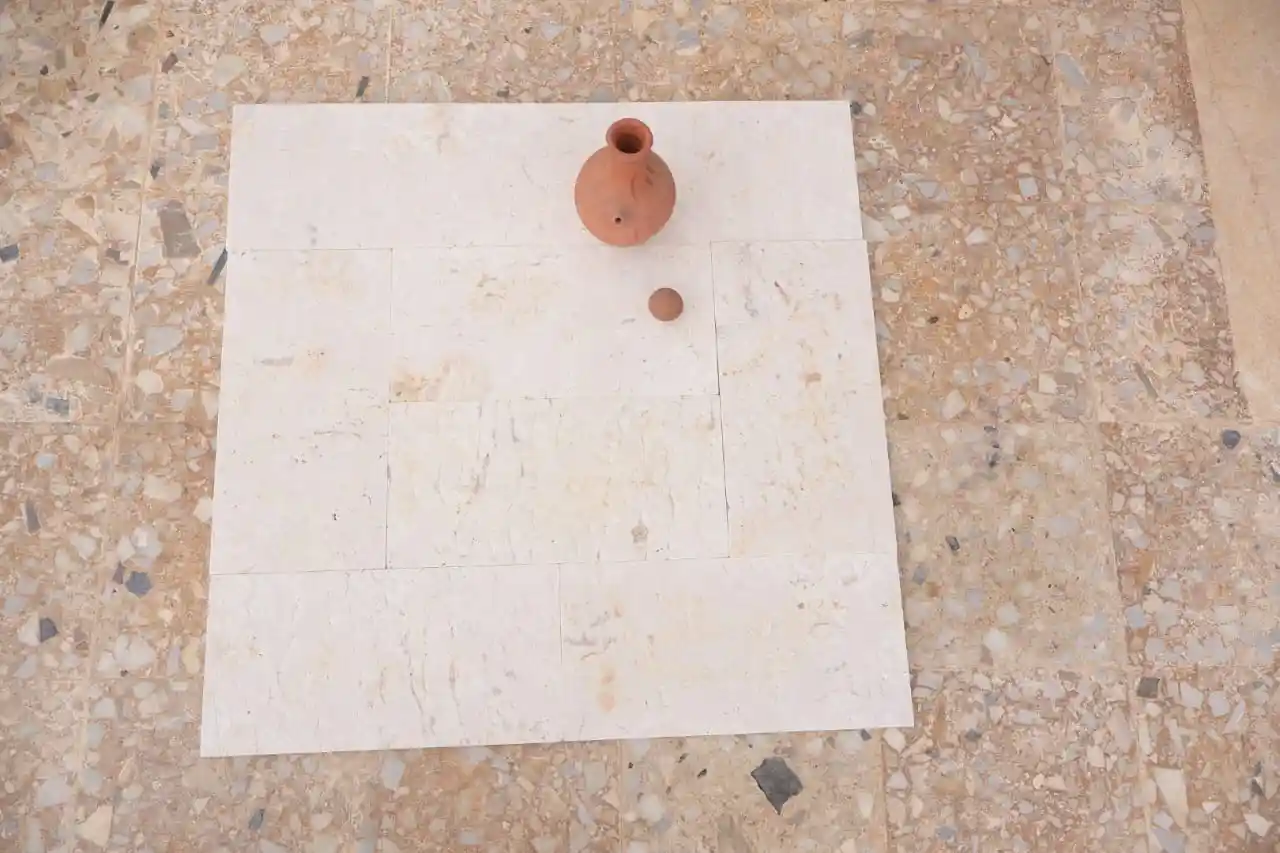
Quarry Site Selection and Overburden Removal
Before a single block of usable stone is extracted, operators invest considerable effort in evaluating the deposit. Seismic surveys, core drilling, and petrographic analysis confirm bed thickness, dip angle, joint spacing, and the depth of weathered or fractured material that must be stripped away before quarrying can begin. That weathered zone — typically the top several meters of any limestone deposit — gets discarded because freeze-thaw cycling, root intrusion, and surface oxidation have already compromised the crystal structure.
Overburden removal involves heavy earthmoving equipment clearing soil, vegetation, and that compromised surface layer to expose clean, competent rock. This step is non-negotiable for quality paver production. Quarries that rush past it or that work shallow deposits without proper assessment tend to produce material with inconsistent density and unpredictable absorption rates — problems you won’t detect visually but will encounter after installation.
- Quarry depth below the weathered zone correlates strongly with density and compressive strength in the finished paver
- Natural joint spacing in the formation determines maximum extractable block dimensions — a constraint that affects paver size availability
- Bed dip angle influences whether blocks can be extracted with consistent thickness or require additional processing to regularise dimensions
- Water table proximity affects operational logistics and can introduce mineral staining in freshly extracted blocks
Primary Extraction Methods in Limestone Quarrying
The natural stone quarrying methods used for limestone extraction fall into two broad categories: bench quarrying for thick, well-bedded deposits, and channel quarrying for thinner or more tightly jointed formations. Understanding both helps you evaluate the material you’re specifying.
Bench quarrying is the dominant method for large-scale paver production. Diamond wire saws and channel cutters are used to make primary cuts along natural bedding planes and across the formation, isolating large primary blocks — often several cubic meters in volume. These primary blocks are then lowered to the quarry floor using cranes and derricks, where secondary cutting begins. The dimensional precision of primary extraction directly affects yield and downstream processing efficiency; a well-executed bench extraction minimises waste and preserves more of the block for usable paver production.
Channel cutting uses specialized machines to cut parallel channels through the rock, isolating slabs or blocks that can then be split or sawn. It’s particularly effective in formations with well-defined natural jointing that complements the cut lines. Some quarries combine both methods — using wire saws for primary isolation and channel cutters for secondary dimensioning within the block.
- Diamond wire saws produce minimal vibration, preserving the crystal structure adjacent to the cut face
- Drill-and-blast techniques, still used in some aggregate quarries, are generally avoided for dimension stone because the shock wave propagation introduces microfractures throughout the surrounding rock
- Hydraulic splitters exploit natural bedding planes to produce cleft faces — the basis for rustic or splitface limestone finishes
- Thermal lancing and air-cushion techniques offer finer control in particularly high-value or fragile formations
According to Natural Stone Institute limestone specifications, the extraction method has measurable effects on surface microstructure and edge integrity, both of which influence installation tolerance and long-term joint performance.
Block Processing: Squaring and Primary Sawing
Once primary blocks reach the processing yard, the first task is squaring — trimming irregular faces to produce consistent rectangular geometry. This step establishes the datum surfaces that all subsequent sawing references. A poorly squared block produces pavers with dimensional variance that compounds through the cutting sequence, ultimately showing up as irregular joint widths and lippage in the finished installation.
Primary sawing uses large-diameter diamond gang saws to slice blocks into slabs of the target thickness. For standard paver production, this typically means slabs in the 30mm to 50mm range, though thicker profiles for heavy-duty or driveway applications can run to 80mm or beyond. The saw feed rate and water cooling management during this stage affect the surface temperature at the cut face — excessive heat from an aggressive feed rate or inadequate cooling can alter the calcite crystal structure at the surface, reducing hardness and creating micro-spalling risk in finished pavers.
Thickness specification needs to account for the quarry’s nominal versus actual tolerance. Well-controlled operations hold ±2mm across a slab, but lower-tier production facilities can vary ±5mm or more — a variance that creates real problems during installation, particularly when bedding on mortar rather than a flexible aggregate base.
Secondary Cutting and the Limestone Quarry Processing Steps That Define Final Dimensions
The limestone quarry and processing steps that follow primary sawing determine the final paver dimensions, edge profiles, and surface character. Bridge saws and CNC waterjet cutters are used for precision dimensioning, producing the consistent rectangular formats — 600×300mm, 400×400mm, 400×600mm and others — that your layout planning depends on. Bridge saw cutting quality is visible in the sharpness and consistency of cut edges; tight tolerances here mean predictable joint lines and easier installation.
Edge treatment options — square-cut, beveled, tumbled, or hand-chiseled — are applied at this stage. A machine-cut square edge is the most dimensionally consistent but shows the saw cut clearly. Tumbled edges, produced by running cut pavers through an abrasive tumbling drum, introduce controlled chipping that mimics the look of aged, hand-worked stone. This aesthetic choice also has a functional dimension: tumbled edges are less susceptible to corner chipping under impact stress and edge-loading conditions, which matters in installations subject to heavy foot traffic or where occasional point-load impact is possible.
- CNC-controlled bridge saws achieve dimensional tolerances of ±1mm for high-specification projects
- Waterjet cutting, while slower, allows complex shapes without introducing heat stress at cut edges
- Edge profiling for pool coping or stair nosings requires secondary tooling passes — a processing step that adds lead time and should be factored into your project schedule
- Calibrated thicknessing — grinding the underside of slabs to a precise, uniform depth — is essential for adhesive-set installations where bed depth consistency matters
Surface Finishing and Its Effect on Paver Performance
The finish applied to the sawn face of a limestone paver isn’t just aesthetic — it directly affects absorption rate, slip resistance, thermal response, and maintenance requirements. The USGS limestone composition and construction data confirms that surface porosity varies substantially between finish types even on identical parent material, which has real implications for sealing schedules and long-term maintenance planning.
Honed finishes involve progressive diamond abrasive grinding that closes the surface pore structure, producing a smooth, matte appearance with reduced absorption. Polished finishes take that process further, using ever-finer abrasives to develop reflectivity — but polishing also reduces surface texture and slip resistance, making high-polish limestone a poor choice for outdoor wet applications. For exterior limestone pavers, honed, brushed, or sawn finishes typically offer the best balance of aesthetics and function.
Brushed or antiqued finishes use steel wire brushing to remove soft calcite zones and accentuate texture, creating a surface that provides good slip resistance while maintaining a refined appearance. This finish also tends to be more forgiving in terms of showing minor surface wear over time — a practical advantage for high-traffic areas. The white limestone pavers available through white limestone from Citadel Stone include honed and brushed finish options processed to consistent standards, making them a reliable choice for projects that require predictable surface performance across large areas.
Grain Structure, Orientation, and What It Means for Installation
White limestone formation and cutting decisions introduce a variable that most specifiers miss: grain orientation relative to the cut face has a measurable effect on how the paver performs under cyclic loading and freeze-thaw stress. When the natural bedding planes run parallel to the paver face — called rift orientation — the stone is most resistant to delamination and surface spalling because loads are distributed along the plane of strongest crystal bonding. When bedding planes run perpendicular to the face — cross-cut orientation — the stone is marginally stronger in compression but more susceptible to moisture penetration along those planes in cold climates.
For most exterior paving applications, rift-cut limestone performs better over the long term. Quality quarry operations document grain orientation as part of their production records and can confirm it on request — it’s a reasonable question to ask when you’re specifying material for a project in a freeze-thaw region. Quarries that can’t provide this information are typically operating with less process control than you want in a high-specification supply chain.
- Rift-cut pavers show better resistance to surface delamination under cyclic loading from foot traffic and thermal cycling
- Cross-cut limestone pavers have higher measured compressive strength but higher moisture absorption through the exposed bedding planes
- For installations subject to wind-driven rain, grain orientation affects how deeply moisture penetrates — rift-cut material generally performs better under these conditions
- Consistent grain orientation across a batch is a sign of careful quarry block selection, not just good sawing
Quality Control from Quarry to Warehouse
Natural stone quarrying methods explained in isolation don’t capture the quality control steps that separate premium paver material from commodity production. A rigorous supply chain involves multiple inspection points: block rejection at the quarry face for visible fractures or excessive voids, slab inspection after primary sawing for thickness variance and internal fractures (using resonance tap testing), and final paver inspection for dimensional compliance, surface defects, and color consistency before palletizing.
At Citadel Stone, we evaluate incoming limestone slabs for density consistency and surface integrity before processing for final finish — a step that catches material with internal stress fractures that wouldn’t be apparent from visual inspection alone. That evaluation directly informs how we specify thickness and finish for each batch, ensuring what leaves our warehouse meets the dimensional and structural standards your installation requires.
Your project timeline needs to account for the warehouse inventory cycle. Citadel Stone maintains stock of key limestone formats ready for dispatch, which means most orders can be fulfilled within one to two weeks rather than the six to eight week import cycle that comes with ordering direct from quarry. That lead time difference is significant when managing a construction schedule with sequential trades.
- Resonance tap testing detects internal fractures invisible to visual inspection — a non-destructive quality check that takes seconds per paver but catches potentially significant structural defects
- Batch color consistency should be verified against a confirmed sample before truck dispatch — color variation within a single shipment creates visible banding in the finished installation that’s impossible to correct after laying
- Dimensional tolerance documentation — actual measured variance rather than nominal specification — should accompany any high-specification order
- Pallet wrapping and corner protection quality affects whether pavers arrive in the same condition they left the warehouse, particularly for long truck hauls
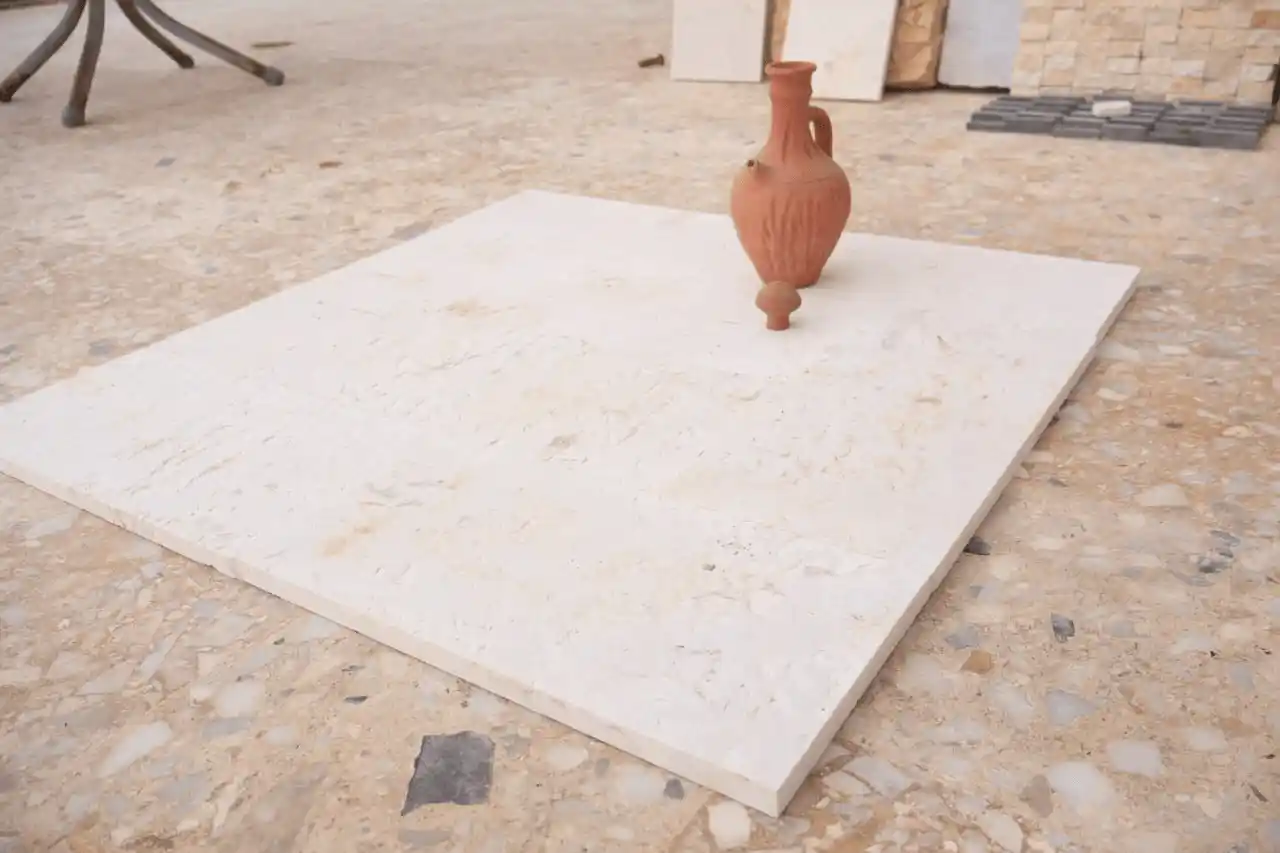
Durability Under Storm and Wind Loading: What Quarry Quality Determines
The structural demands on exterior limestone pavers extend well beyond static load — and the quarrying and processing decisions upstream determine how well the material handles dynamic stress from severe weather events. Wind-driven rain penetrates joint systems and paver surfaces under positive pressure differentials that don’t exist in calm conditions; a paver with open macro-porosity from a shallow quarry bed or aggressive finishing process absorbs significantly more moisture under these conditions than a denser, well-processed material.
Hail impact resistance is a function of both surface hardness and the integrity of the crystal structure at and just below the surface. Pavers processed from blocks with microfractures introduced during drill-and-blast extraction — even ones that passed visual quality checks — can develop surface spalling after repeated impact stress from hail or dropped loads. Diamond wire-sawn material from well-consolidated beds consistently outperforms blast-extracted material in impact resistance testing, which is why understanding how limestone pavers are quarried matters even for applications where the extraction process seems remote from end performance.
Edge restraint and joint integrity under wind-driven rain deserve particular attention in your specification. Joints that aren’t fully consolidated allow wind-driven moisture to undermine the bedding course over time — a slow failure mode that produces localized settlement and rocking pavers before it becomes visually obvious. Specifying joint filler appropriate to the project’s exposure, and confirming that the paver’s edge profile allows full joint consolidation to the surface, are decisions that originate in understanding how the stone was processed and dimensioned.
Limestone Paver Quality and Sourcing: Making Specification Decisions That Hold
The limestone paver quality and sourcing decisions that most influence long-term performance aren’t made at the point of purchase — they’re made at the quarry face, in the processing yard, and during quality control inspection. Your specification gains real precision when you understand which quarry depth, extraction method, grain orientation, and finish combination delivers the density, absorption rate, and dimensional consistency your project actually needs. Natural stone quarrying methods explained in field terms give you the vocabulary to have that conversation with your supplier rather than accepting generic product descriptions.
Reviewing how limestone pavers are quarried and processed alongside your bedding and jointing choices ensures the full system performs consistently. As you plan joints and bedding for your stone installation, related material decisions matter too — joint filler options for limestone pavers is worth reviewing alongside your quarrying and finishing decisions to ensure the full system performs consistently. Understanding how quarry extraction and block cutting affect grain structure helps explain why Citadel Stone evaluates slabs before processing for final finish.
Related reading: polished white limestone uses and drawbacks · white limestone paver installation steps · white stone pavers for pool decks.