

Materials overview — what is White Pearl limestone and why designers choose it
White Pearl limestone is a fine-grained sedimentary stone prized for its soft cream-to-ivory palette, subtle veining and ability to unify light-filled commercial interiors without visual weight. Quarried primarily in Mediterranean and European regions, it offers a warmer, more organic alternative to stark white marble or industrial porcelain while maintaining a cohesive, calm backdrop for merchandise displays, guest services and lounge seating.
Material character & finishes (honed, sawn, textured, flamed) — visual / tactile notes
White Pearl accepts multiple surface treatments. Honed finishes deliver a matte, smooth plane ideal for boutique floors where glare control and understated elegance matter. Sawn (wire-cut) finishes retain natural texture and improve grip, suitable for exterior terraces or transitional zones. Lightly textured or bush-hammered surfaces increase slip resistance for poolside decks or wet-service areas, though these finishes show wear patterns more visibly over time. Flamed finishes are rarely applied to limestone due to the risk of thermal fracture; verify fabricator capability if specifying.
Typical product formats for commercial use (large-format pavers, modular tiles, copings, bullnose)
Commercial projects typically specify White Pearl in large-format pavers (24″×24″, 24″×36″, 36″×36″) to minimize grout joints and streamline installation. Modular tiles (12″×24″, 18″×18″) suit smaller boutiques or feature walls. Copings, bullnose treads and custom thresholds are available for stair transitions, planter edges and terrace perimeters. Thickness ranges from ¾″ for interior dry-set applications to 1¼″ or thicker for mechanically anchored pedestal systems on plaza decks.
Durability for commercial use — wear, abrasion & impact
Commercial durability hinges on abrasion resistance (surface wear under foot traffic and wheeled loads), surface hardness (scratch resistance), edge retention (chip resistance at joints and thresholds), water absorption (staining and freeze-thaw risk) and the finish’s effect on wear visibility.
Abrasion resistance: Limestone is softer than granite or dense porcelain, making it more susceptible to surface scratching and polish loss in heavy-traffic corridors. Honed finishes mask micro-abrasion better than polished surfaces. For hotel lobbies with rolling luggage and retail floors with moving racks, specify protective walk-off mats at entries and verify abrasion performance against ASTM C241 or equivalent standards before final specification.
Surface hardness & scratch visibility: White Pearl’s calcite composition means keys, grit and metal furniture feet can leave marks. Darker accent furniture and disciplined maintenance reduce visible wear. Edge retention is generally good when professionally fabricated, but thin-edge profiles (⅜″ or less) chip more easily under impact.
Water absorption & staining: Limestone typically exhibits higher porosity than granite, increasing stain risk from coffee spills, oils and acidic liquids common in café settings. Impregnating sealers reduce but do not eliminate absorption; request water-absorption test results and sealer recommendations in your TDS.
Freeze-thaw performance: Relevant for outdoor terraces in cold climates. High water absorption combined with freeze-thaw cycles can cause spalling. Request ASTM C666 test data if specifying exterior applications in freeze-prone regions.
Effect of finish on wear: Honed finishes wear gracefully and can be re-honed on-site during lifecycle maintenance. Textured finishes hide wear longer but complicate deep cleaning. Polished finishes (rarely used on limestone pavers) lose sheen quickly under commercial traffic.
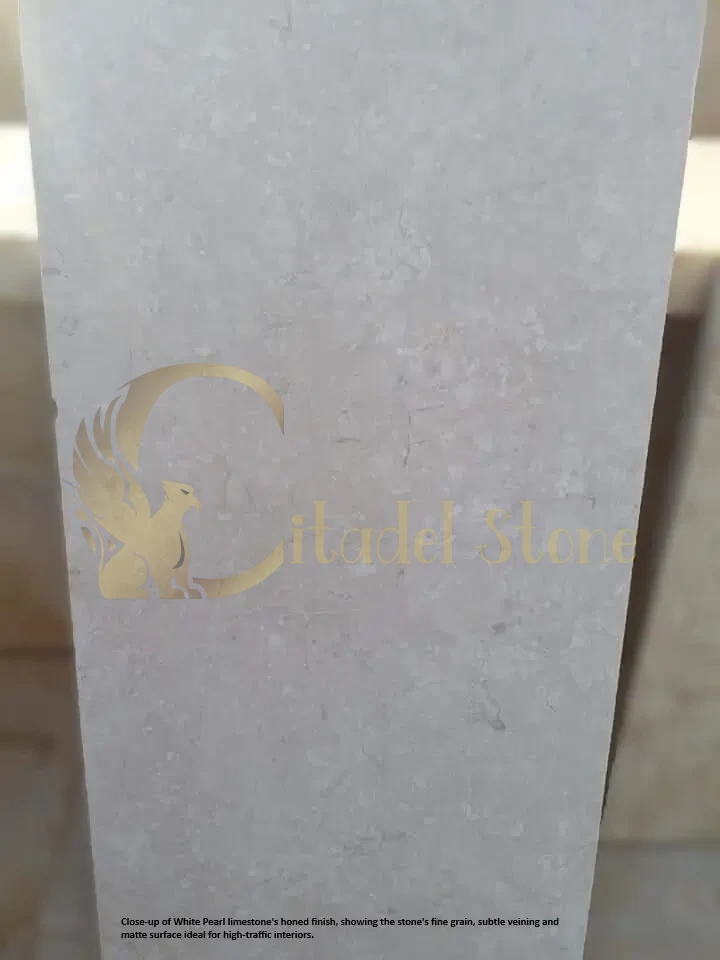
Durability comparison table
| Criterion | White Pearl Limestone | Porcelain Tile | Granite | Travertine |
|---|---|---|---|---|
| Abrasion resistance | Moderate; honed finishes mask wear | Excellent; engineered hardness | Excellent; dense crystalline structure | Moderate; porous surface wears visibly |
| Edge retention | Good when thick-format; thin edges chip | Excellent; fired edges resist impact | Excellent; minimal chipping | Fair; soft edges vulnerable |
| Water behaviour | Higher absorption; requires sealing | Near-zero absorption; stain-resistant | Low absorption; minimal sealing | High absorption; aggressive sealing needed |
| Maintenance intensity | Moderate; periodic resealing & re-honing | Low; routine cleaning sufficient | Low; occasional sealing | High; frequent sealing & stain intervention |
| Best commercial uses | Controlled-traffic lobbies, boutiques, covered terraces | High-traffic corridors, wet areas, outdoor plazas | Monumental lobbies, countertops, high-abuse zones | Decorative features, low-traffic hospitality zones |
Slip resistance & safety in public spaces
Slip resistance is quantified by coefficient of friction (COF), measured as static COF (SCOF) or dynamic COF (DCOF). Any paving can be slippery when wet. Finish, slope, drainage, sealer and footwear all play a part, so ask your designer to confirm local pool-deck and code requirements. White Pearl’s slip performance varies significantly by finish.
Finish-dependent grip: Honed finishes on limestone typically yield DCOF values in the 0.40–0.50 range when dry, dropping under wet conditions. Textured or sawn finishes improve wet-DCOF, often exceeding 0.50. Polished finishes are unsuitable for commercial flooring due to low wet-COF.
Anti-slip enhancement options: Specify kerfed grooves (shallow parallel cuts) for ramps or pool decks, apply topical anti-slip coatings (verify longevity and maintenance compatibility), or select factory-textured finishes. Always request slip test reports compliant with ANSI A326.3 for your chosen finish and wet/dry conditions.
ADA considerations: Accessible routes require verified slip resistance, detectable warnings at elevation changes, and level thresholds. Coordinate with accessibility consultants and code officials early in design.
Slip data & documentation checklist (request from supplier)
- Wet and dry DCOF test results for the specified finish, tested per ANSI A326.3.
- Test laboratory name and accreditation (independent third-party preferred).
- Sample identification linking tested samples to production lot.
- Maintenance protocol that preserves slip resistance (approved cleaners, sealer compatibility).
- Retest schedule recommendation if anti-slip treatments are applied.
- Warranty terms specific to slip performance degradation.
Maintenance, cleaning & lifecycle for high-traffic interiors
White Pearl limestone demands proactive maintenance to preserve appearance and performance in commercial settings. Daily cleaning removes abrasive grit; periodic deep cleaning and sealer recoating prevent staining and extend surface life.
Daily and weekly cleaning: Dust-mop or vacuum with soft-bristle attachments to remove grit. Damp-mop with pH-neutral stone cleaner; avoid acidic (vinegar, citrus) or alkaline (bleach, ammonia) products that etch or dull limestone. Use microfiber mops to prevent streaking.
Periodic deep cleaning: Schedule professional cleaning quarterly or biannually depending on traffic intensity. Hot-water extraction or rotary scrubbing with stone-safe detergents removes embedded soil. Avoid steam cleaning unless manufacturer-approved for your sealer type.
Stain management: Blot spills immediately. Poultice treatments (baking soda paste, commercial stone poultices) can draw out organic stains (coffee, wine) and light oil stains. For stubborn staining, consult stone restoration specialists rather than attempting aggressive DIY treatments that risk surface damage.
Sealer guidance: Impregnating (penetrating) sealers are standard for commercial limestone. Topical sealers create a surface film that may yellow or delaminate under UV or heavy traffic. Request sealer manufacturer TDS, application instructions and recoat intervals. Typical recoat intervals range from one to three years in high-traffic areas, though this varies by product, traffic and cleaning protocol—verify with your sealer supplier.
Recoat and recovery planning: Budget for light re-honing (diamond abrasive pads, 200–400 grit) after several years to restore uniformity to honed finishes. Plan downtime for major interventions (full re-honing, sealer stripping) during off-peak seasons.
Maintenance & inspection schedule
| Action | Frequency | Responsible party | Notes |
|---|---|---|---|
| Dust-mop / vacuum | Daily | Housekeeping | Remove grit before damp-mopping |
| Damp-mop with pH-neutral cleaner | Daily to 3×/week | Housekeeping | High-traffic zones daily; lower-traffic 2–3×/week |
| Inspect for stains, chips, grout damage | Weekly | Facilities manager | Document and address promptly |
| Deep clean (rotary scrub or extraction) | Quarterly to biannually | Contract cleaner or facilities | Adjust frequency based on traffic and visible soiling |
| Inspect sealer performance (water-bead test) | Quarterly | Facilities manager | Water should bead; if absorbed, schedule recoat |
| Reapply impregnating sealer | Annually to triennially | Stone contractor or trained staff | Follow manufacturer intervals; verify via water test |
| Light re-honing (surface refresh) | Every 3–7 years (typical) | Stone restoration specialist | Interval depends on wear and aesthetic standards |
| Full restoration (strip, re-hone, reseal) | Every 10–15 years (typical) | Stone restoration specialist | Major intervention; plan for area closure |
Installation systems & substrate considerations that determine longevity
Installation quality directly governs commercial limestone pavers durability. Substrate stiffness, proper bedding, expansion joints and load transfer mechanisms prevent cracking, lippage and premature failure.
Mortar-set vs dry-set on mortar bed: Thin-set mortar over stable concrete slabs is common for interior lobbies and boutiques. Use large-and-heavy-tile (LHT) mortars meeting ANSI A118.4 or A118.15 for pavers over 15 lbs. Dry-set on a full mortar bed (1–2″ thick) suits uneven substrates or where leveling is needed; verify substrate deflection meets or exceeds L/720 under live load.
Mechanically anchored pedestal systems: Rooftop and plaza terraces often use adjustable pedestals that support pavers above waterproofing membranes. This system accommodates drainage, utilities access and thermal movement but requires edge restraint and wind-uplift calculations by a structural engineer.
Substrate and subbase stiffness: Inadequate substrate stiffness causes differential movement, cracking pavers at grout joints. Concrete slabs should meet L/360 deflection limits (consult structural engineer for specific load cases). Reinforce or thicken slabs in hotel lobbies where rolling luggage, housekeeping carts and guest furniture generate concentrated loads.
Edge restraint and expansion joints: Perimeter restraints (metal angle, cast curbs) prevent paver migration. Place expansion joints every 20–25 feet in each direction (adjust per climate and substrate movement) and at transitions to other materials. Use compressible foam backer rod and color-matched sealant.
Coordination with mechanical and vertical loads: Lobby installations must accommodate floor boxes, utility chases and point loads from furniture or planters. Reinforce substrate under concentrated loads and detail pavers around penetrations to avoid field-cut weak points.
Waterproofing under terraces: Exterior terraces require continuous waterproofing membranes below the paver system. Coordinate membrane type (sheet, liquid-applied) with paver installation method and ensure drainage slopes (minimum ¼″ per foot to drains).
Installation QA checklist for commercial contracts
- Sample approval: Require client sign-off on full-size sample pavers (finish, color, veining) before production order.
- Substrate inspection: Document flatness (1/8″ in 10′), bond strength and moisture content before installation.
- Mock-up panel: Build 10′×10′ minimum mock-up on-site with actual substrate, setting materials and finish schedule; approve before proceeding.
- Witness testing: Specify that owner’s representative witness substrate prep, mortar mixing and initial paver placement.
- Batch verification: Photograph and log each delivery batch; compare against approved samples.
- Lippage measurement: Check with straightedge; limit to 1/16″ (or per project tolerance) between adjacent pavers.
- Joint width consistency: Maintain uniform grout joints (typically ⅛″–¼″) unless design specifies otherwise.
- Final cleaning and sealing: Contractor to deep-clean, apply specified sealer and provide maintenance instructions before owner acceptance.
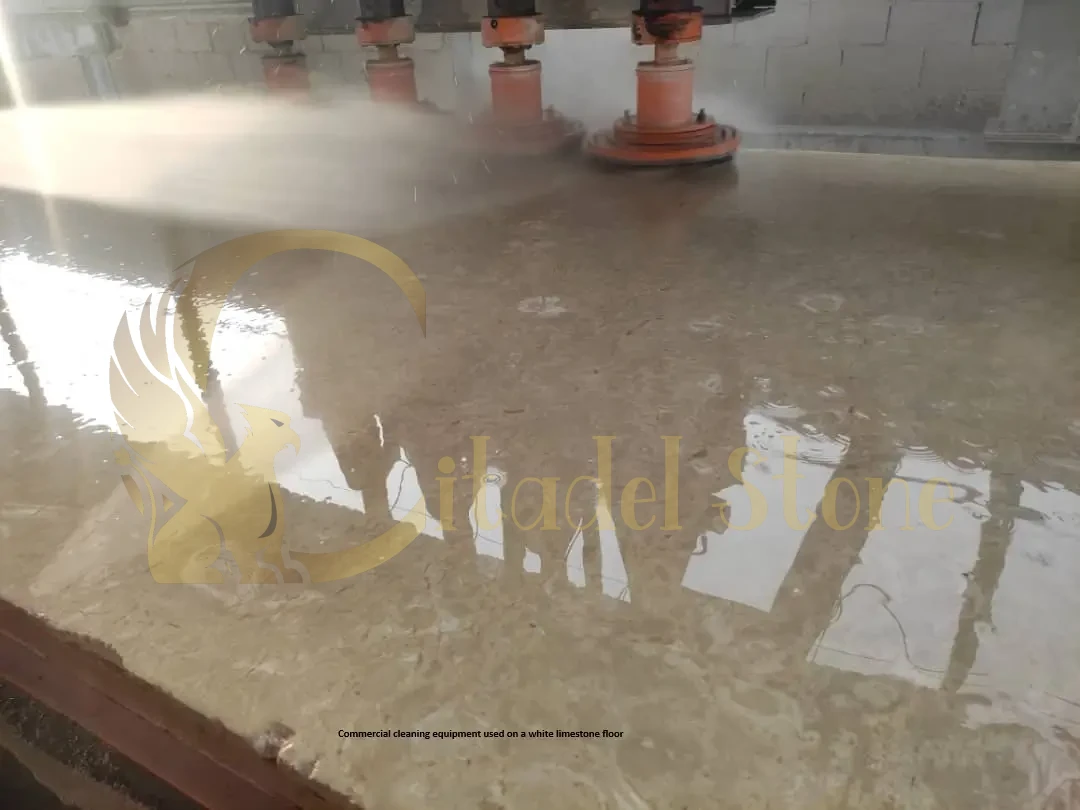
Design & aesthetic strategies for boutiques & hotels
White Pearl’s neutral warmth anchors sophisticated commercial interiors. Large-format installations minimize joint lines, creating seamless planes that showcase merchandise or frame lounge furniture. Vein-matching and bookmatching across feature runs (reception desks, gallery walls) add bespoke detail without overwhelming spatial calm.
Inset borders and transitions: Pair White Pearl fields with matte black metal inlays (steel, blackened bronze) at thresholds or as geometric border accents. Transition to warm timber flooring in adjacent seating areas using recessed metal or stone transition strips.
Accent materials: White Pearl pairs naturally with warm timber millwork, leather upholstery and brushed brass fixtures. In boutique retail, backlit stone feature walls or display plinths create premium focal points. In hotel lobbies, combine with textured plaster or fabric wall panels to soften acoustics.
Six layout & finish pairings for commercial typologies
- Hotel lobby — large-format honed: 36″×36″ honed pavers in running-bond pattern; minimal grout lines for seamless elegance; coordinate vein direction for visual continuity.
- Boutique gallery — bookmatched feature wall: Vertical slabs bookmatched at entry wall or behind cashwrap; honed or lightly polished finish; LED edge-lighting for drama.
- Café terrace (covered) — textured finish: 24″×24″ sawn-finish pavers for improved grip; wider grout joints (¼″) for drainage; seal aggressively for coffee-spill resistance.
- Rooftop pool terrace — kerfed anti-slip: 24″×24″ pavers with shallow parallel kerfs; mechanically anchored on pedestals; specify freeze-thaw testing if applicable.
- Hotel corridor — modular running bond: 12″×24″ honed tiles in offset pattern; durable and cost-effective for long runs; protective mats at elevator lobbies.
- Concierge desk area — inset border detail: White Pearl field with ½″ blackened steel inlay border; flush-set for accessibility; highlight desk zone without changing elevation.
Procurement, testing & specification checklist (8–12 bullets)
Rigorous procurement reduces risk in commercial projects. Demand documentation, samples and witness testing to verify performance before and during installation.
Procurement and testing checklist
- Technical data sheet (TDS): Request full TDS covering physical properties, absorption, recommended finishes, sealer compatibility and warranty terms.
- Certificate of analysis (COA): Verify batch-specific test results (water absorption, compressive strength, freeze-thaw if applicable).
- Batch sample photos: High-resolution images of the quarry block and cut slabs to confirm color and vein consistency.
- Slip test report: Independent lab report (ANSI A326.3) for wet and dry DCOF on the specified finish.
- Abrasion test: ASTM C241 or equivalent abrasion-resistance data; compare against project traffic assumptions.
- Freeze-thaw test (exterior only): ASTM C666 results if specifying outdoor terraces in cold climates.
- Full-size sample slab: Physical sample in specified thickness, finish and edge profile for design review and mock-up.
- On-site mock-up: Contractually require 10′×10′ minimum installed mock-up before full installation proceeds.
- Mock-up acceptance protocol: Define acceptance criteria (lippage, joint width, finish uniformity, color match) and approval signatures.
- Warranty terms: Clarify coverage period, exclusions (staining, wear, improper maintenance) and claim process.
- Lead times and staging: Confirm fabrication lead time, delivery schedule and on-site storage requirements to avoid project delays.
- Lot matching and reserve stock: Specify all pavers from same quarry block or matched lots; order 10% overage for future repairs.
Cost & lifecycle considerations — budgeting for commercial projects
White Pearl limestone tiles sit mid-range in commercial stone budgeting, more affordable than exotic marbles but costlier than standard porcelain. Total project cost includes material, fabrication, logistics, skilled installation and lifecycle maintenance.
Unit price drivers: Stone grade (premium select vs standard commercial grade), finish complexity (honed vs textured vs custom), and slab yield (waste factor for vein-matching or large formats). Request itemized quotes separating material, fabrication and freight.
Fabrication costs: Thick-format pavers (1¼″+) and custom edge profiles (bullnose, chamfer) increase fabrication expense. Wire-sawn finishes are less costly than bush-hammering or kerfing. Waterjet inlays or CNC detailing add premium charges.
Delivery and staging: Palletized stone is heavy; factor crane or forklift access, protected on-site storage and sequenced deliveries to match installation pace. Urban sites with restricted access or hoisting requirements drive logistics costs.
Installer skill and mock-up costs: Commercial limestone installation requires experienced setters familiar with LHT mortars, lippage control and slab handling. Budget for mock-up labor as a separate line item; it reduces rework and disputes.
Maintenance and lifecycle recoat: Annual or biennial sealer recoating costs (materials and labor) are modest compared to repair or replacement from deferred maintenance. Budget for light re-honing every 5–7 years to maintain appearance and avoid wholesale replacement.
Cost-driver checklist for comparing bids
- Material unit price (per square foot, itemized by thickness and finish)
- Fabrication charges (edge profiles, custom cuts, kerfing, inlays)
- Freight and delivery (FOB origin vs delivered, packaging, insurance)
- Installation labor rate and productivity assumptions (square feet per day)
- Mock-up cost (labor, materials, approval process)
- Sealer supply and application (initial and recoat intervals)
- Warranty coverage (material defects, installation workmanship)
- Maintenance training and documentation (handover package for facilities team)
Case vignettes — boutique, hotel lobby, rooftop terrace
Boutique retail (women’s apparel, SoHo)
A 1,200-square-foot boutique specified 24″×24″ White Pearl honed pavers to create a gallery-like backdrop for seasonal collections. The designer selected running-bond layout with tight ⅛″ grout joints and vein-aligned slabs along the main sightline. Matte black steel inlays framed the fitting-room threshold and cashwrap perimeter. Impregnating sealer was applied before opening; housekeeping damp-mops daily with pH-neutral cleaner. After two years, the floor shows minimal wear, and quarterly inspections confirm sealer performance. The neutral palette allows rotating visual merchandising without aesthetic conflict.
Hotel lobby (boutique property, 80 keys, Charleston)
The lobby renovation used 36″×36″ White Pearl honed pavers across 2,500 square feet to unify check-in, lounge seating and corridor transitions. The architect bookmatched feature slabs behind the reception desk for visual continuity and specified kerfed pavers at the exterior door threshold. A 10′×10′ mock-up was installed in the service corridor for client approval; the team adjusted grout color and sealer sheen before proceeding. The installer coordinated floor boxes for power/data and provided protective walk-off mats at entries. Post-occupancy, facilities staff re-hone traffic lanes every five years and reseal biennially, maintaining the serene aesthetic that anchors the property’s design narrative.
Rooftop terrace (office tenant amenity, Brooklyn)
A 3,000-square-foot rooftop terrace serves as tenant lounge and event space. The design team specified 24″×24″ White Pearl sawn-finish pavers on adjustable pedestals over a liquid-applied waterproofing membrane. The structural engineer calculated wind-uplift loads and specified perimeter ballast pavers. Freeze-thaw testing confirmed suitability for New York winters. Edge restraints and wide (¼″) joints accommodate thermal movement. The sawn finish provides slip resistance in wet conditions; the facility manager schedules seasonal deep cleaning and annual sealer recoat to combat urban soot and prevent staining from outdoor events.
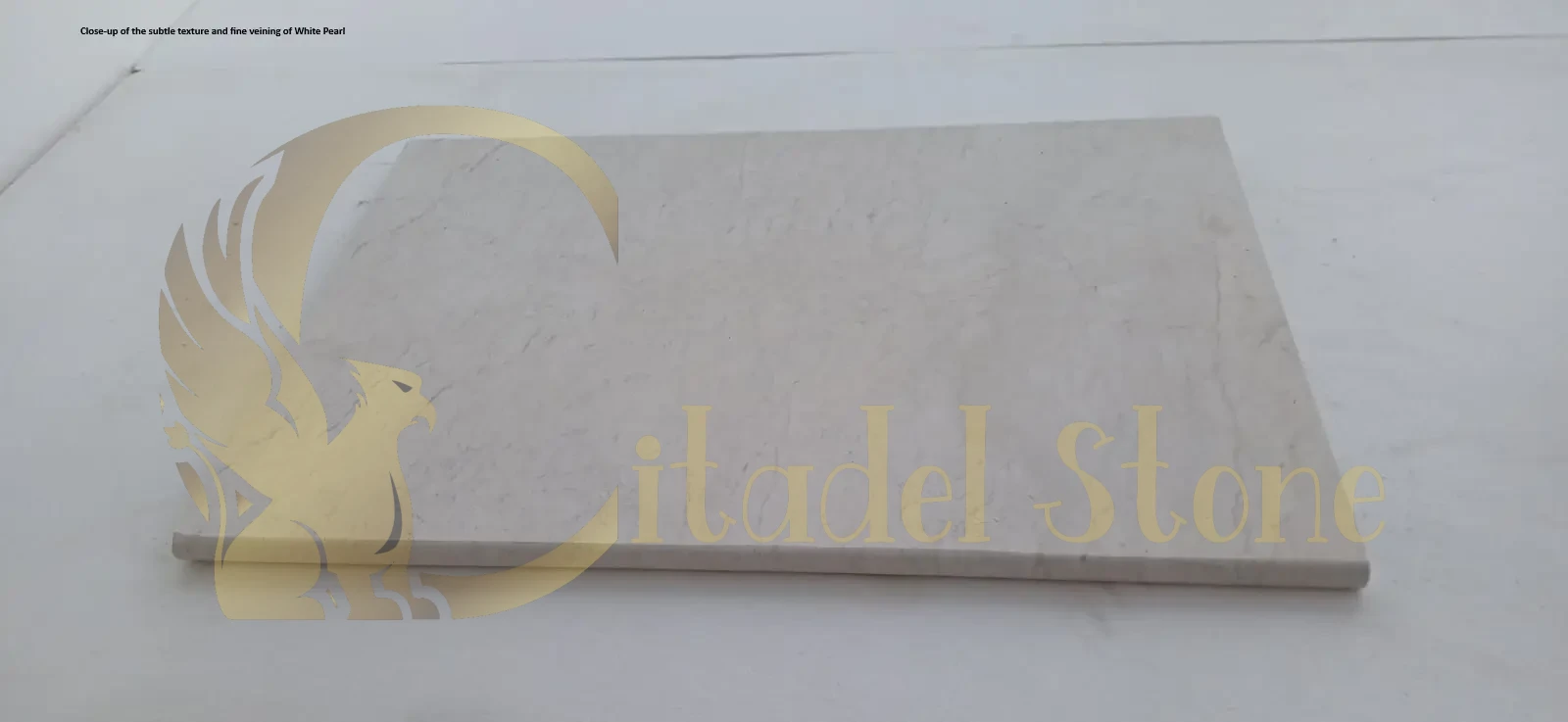
White Pearl Limestone — Light, Durable, and Designer-Friendly
White Pearl limestone is prized for its soft pearlescent tones, subtle veining, and natural ability to reflect light while keeping surfaces warm and inviting. It’s a versatile choice for interiors and exteriors where you want a bright, sophisticated finish that performs well in many climates.
Quick Technical Snapshot
| Attribute | Details |
|---|---|
| Color Palette | Off-white to pale cream with pearl highlights |
| Density | 2.48 g/cm³ (154.8 lb/ft³) — certified mill test. Use it for weight and freight calculations. |
| Water Absorption | 1.61% by weight — certified mill test |
| Compressive Strength | 4,850 psi (33.44 N/mm²) — certified mill test |
| Recommended Uses | Interior floors, façades, patios, pool surrounds (with proper finish) |
| Common Finishes | Honed, brushed, flamed, sand-blasted, polished (interior only) |
| Typical Thickness | 10–20 mm (tiles), 20–30 mm (pavers), 30–50 mm (large slabs) |
Northeast (CT, ME, MA, NH, RI, VT) — Freeze/Thaw Ready Choices
In the Northeast, freeze/thaw cycles and de-icing salts are your main concerns. You should specify low-absorption White Pearl and avoid polished exterior surfaces; instead choose flamed or textured honed finishes to improve traction and reduce freeze-related damage. Always request freeze-thaw test reports (ASTM C666) from your stone supplier and insist on a frost-proof base (4–6″ compacted aggregate plus geotextile).
Finish recommendation: flamed or sand-blasted for exterior decks; honed indoors.
Sourcing tip: ask for batch photos and same-lot shipping to avoid color shifts between deliveries.
Maintenance note: annual seal and quick post-winter joint inspection.
Midwest (IL, IN, MI, OH, WI) — Salt & Load Durability
The Midwest combines heavy snow, salt use, and vehicular/garden equipment traffic. Choose White Pearl with higher compressive strength and a closed-grain appearance. For driveways or commercial plazas use 30–50 mm pavers set on structural sub-bases; for pedestrian areas 20–30 mm with polymer-modified bedding works well. Ask suppliers for compressive strength and abrasion data.
Finish recommendation: honed with textured edge or brushed for walkways.
Installation tweak: polymeric sand joints resist salt-washout better than plain sand.
Buying hack: order spring stockpiles (March–April) to secure post-winter quarry discounts.
South (DE, DC, FL, GA, MD, NC, SC, VA, WV) — Humidity & Rapid Drainage
In the South, heavy summer rains and humid conditions make rapid drainage and mildew control top priorities. For pool decks and patios choose honed or brushed finishes—these balance slip resistance and ease of cleaning. Use permeable joint systems or drain channels under paver fields to prevent standing water and biological growth.
Finish recommendation: honed (pool surrounds) or brushed (terraces).
Sourcing tip: request water-absorption tests (ASTM C97) and supplier guidance on breathable sealers.
Maintenance note: rinse organic matter regularly and reseal annually in coastal zones.
West (AZ, CO, ID, MT, NV, NM, UT, WY, CA, OR, WA, AK, HI) — UV, Thermal Shock & Seismic Considerations
Western climates vary from high-UV deserts to seismic coasts and alpine freeze zones. In sun-intense areas, White Pearl resists heat buildup but you should use UV-stable sealers to protect color. In alpine sites increase slab thickness and use flexible grout to tolerate thermal movement. For coastal California and Hawaii, confirm salt-spray resistance and specify seismic-rated anchoring systems for elevated terraces.
Finish recommendation: flamed or sand-blasted for wet/exposed locations; honed for shaded patios.
Installation tweak: use expansion joints at 10–12 ft intervals and flexible mortar in seismic zones.
Buying tip: pre-book island shipments; ask suppliers about barge timing to avoid freight surcharges.
White Pearl Limestone pavers — Nationwide hubs & city services
Citadel Stone supplies pavers across the United States and supports projects from private patios to large public realms. We send sample panels, provide clear specification notes and coordinate delivery so design teams can confirm appearance and performance before committing to full orders.
Honolulu, HI — Saltwise, cool surfaces for tropical islands
Honolulu projects require materials that stand up to constant salt spray, intense sun and frequent rain; common uses include beachfront promenades, resort pool decks and restaurant terraces. For island conditions we recommend white limestone pool pavers with very low water absorption, UV-stable pigments and a textured finish that limits slipperiness when wet. Citadel Stone can supply coastal-grade sample panels, advise on recommended sealers and arrange island delivery with packing and handling suited to marine transit.
Milwaukee, WI — Freeze-ready paving for lake-effect winters
Milwaukee projects must tolerate heavy snow, de-icing salts and freeze-thaw cycles; typical applications include waterfront walkways, plaza refurbishments and institutional courtyards. For these conditions we suggest white limestone pavers that demonstrate frost resistance, low porosity and strong abrasion performance to resist spalling. Citadel Stone provides laboratory performance data, sample packs and guidance on jointing strategies and sealing regimes that reduce maintenance needs through northern winters.
St. Louis, MO — Durable, all-season paving for riverside and urban sites
St. Louis projects commonly face humid summers and variable riverfront conditions; typical uses include pedestrian zones, café terraces and mixed-use courtyard paving. For river-adjacent sites we recommend white polished limestone with solid compressive strength, low uptake and a finish that copes with runoff and occasional flooding. Citadel Stone can send comparative samples, offer specification assistance and coordinate timely deliveries to support phased urban installations.
Raleigh, NC — Balanced paving for humid subtropical landscapes
Raleigh projects often blend residential and civic uses—patios, community plazas and rooftop terraces—where humidity and summer storms are factors. For these sites we advise white limestone tiles that combine stain resistance, moderate texture for safe footing and a dense surface to limit biological staining. Citadel Stone supplies sample kits, maintenance guidance tailored to the Southeast and logistical options that fit both small contractor orders and larger municipal procurements.
Salt Lake City, UT — UV-stable, low-dust paving for high-altitude settings
Salt Lake City projects must account for strong sunlight, occasional freeze-thaw and windblown dust; common uses include civic plazas, hotel courtyards and residential terraces. For high-altitude exposure we recommend white limestone flooring with proven UV stability, low porosity and a finish that resists surface abrasion from grit. Citadel Stone provides technical comparisons, sample delivery and advice on jointing and cleaning regimes suited to arid-climate maintenance.
Anchorage, AK — Cold-climate paving engineered for durability
Anchorage projects demand materials that perform in prolonged cold, heavy freeze-thaw and snow-removal operations; typical applications include public plazas, commercial forecourts and hotel entries. For these extreme conditions we suggest white limestone paving tiles with exceptional freeze-thaw resilience, low water absorption and high abrasion resistance to tolerate snow clearing. Citadel Stone offers freeze-cycle test results, sample panels and logistical planning to ensure secure, timely shipments to remote or seasonal sites.
Buying Checklist — What to Ask Before You Order
Batch Consistency: “Can you guarantee same-lot shipping and provide photographs of the exact run?”
Test Reports: Request water-absorption, compressive-strength, and freeze-thaw data.
Finish Samples: Get three full tiles/pavers in the proposed finish for daylight testing.
Tolerance & Cut: Confirm thickness and flatness tolerances (±1–2 mm typical for tiles).
Lead Time & Staging: Ask about covered laydown storage and staged deliveries.
Sustainability: Request quarry reclamation policies and waste-minimization practices.
Installation & Design Essentials (Copyable Spec Snippets)
Sub-base: 4–6” compacted crushed stone for pedestrian; 8–12” for vehicular.
Slope: Minimum 1% slope for drainage; 2% preferred near pools.
Jointing: Use polymeric sand or resin joints in freeze/salt zones; breathable mortar for exterior tile.
Control Joints: 10–12 ft spacing to manage thermal movement.
Mock-up: Install a 10–20 sq ft test panel on site to verify color and finish before full install.
Maintenance (Practical Routine)
Daily/Weekly: sweep and rinse to remove grit.
Monthly: clean with pH-neutral detergent; avoid acid products.
Annually: inspect joints, reapply a breathable UV-stable sealer in high-exposure or coastal areas.
After Winter: check for joint washout and recompact polymeric sand if used.
Sustainability & Lifecycle
White Pearl’s long service life reduces embodied carbon over decades. For better environmental performance: source regional stone where possible, request quarry water-recycling reports, and specify reclaimed-cutoff use for landscape features. These steps support LEED credits and lower transport emissions.
FAQs — short answers
Can White Pearl limestone handle wheelchairs, rolling luggage and housekeeping carts?
Yes, when installed correctly over a stiff substrate with adequate thickness (¾″ minimum for interiors). Use honed or textured finishes to mask micro-scratches. Protective mats at entries reduce grit abrasion. Request abrasion test data (ASTM C241) to confirm suitability for your traffic profile.
Does White Pearl stain easily in café or bar settings?
Limestone is porous and vulnerable to acidic liquids (coffee, wine, citrus) and oils. Apply impregnating sealer before use and reseal per manufacturer intervals. Blot spills immediately. For high-risk zones (barista stations, bar tops), consider porcelain or sealed granite alternatives.
How often should I reseal White Pearl pavers in a hotel lobby?
Typical recoat intervals range from one to three years depending on traffic, cleaning protocol and sealer type. Perform quarterly water-bead tests: if water absorbs rather than beads, schedule resealing. Consult your sealer manufacturer TDS for specific guidance.
Can White Pearl be used around swimming pools?
Yes, with precautions. Specify textured or kerfed finishes for slip resistance and verify wet-DCOF exceeds 0.42. Seal aggressively to resist pool chemicals (chlorine, salt). Avoid polished or smooth-honed finishes in wet zones. Coordinate with pool contractor on drainage and waterproofing details.
What is the expected lifespan of White Pearl pavers in commercial use?
With proper installation, sealing and maintenance, White Pearl pavers can perform for decades. Plan for light re-honing every 5–7 years and potential full restoration after 15–20 years in high-traffic areas. Lifespan depends on traffic intensity, maintenance discipline and environmental exposure.
Is White Pearl suitable for exterior use in freeze-thaw climates?
Potentially, if freeze-thaw testing (ASTM C666) confirms low water absorption and resistance to spalling. Specify thicker pavers (1¼″+), textured finishes and aggressive sealing. Avoid in areas with standing water or inadequate drainage. Consult local stone contractors experienced with limestone in your climate.
Can I repair or replace individual pavers if damaged?
Yes. Order 10% overage from the same production lot for future repairs. Removing and replacing pavers in mortar-set installations requires cutting grout joints and chipping out bedding mortar—straightforward for skilled installers. Pedestal-set pavers lift out easily for access or replacement.
What color grout should I use with White Pearl?
Light gray or warm beige grouts blend naturally with White Pearl’s cream-ivory palette and mask minor soiling. Bright white grout shows dirt quickly and creates high contrast; test samples in context. Use epoxy grout in wet or high-stain-risk areas for superior stain resistance.
Conclusion & Citadel Stone CTA
White Pearl limestone pavers bring timeless elegance and tactile warmth to boutiques, hotel lobbies and covered terraces—spaces where controlled traffic, disciplined maintenance and thoughtful design converge. Success requires verifying slip resistance, abrasion performance and sealer compatibility through technical data sheets and independent testing, implementing robust installation QA with mock-ups and witness inspections, and committing to proactive lifecycle maintenance that preserves both beauty and performance.
Ready to specify White Pearl limestone pavers for your commercial project? Contact Citadel Stone to request technical data sheets, physical samples and a commercial technical briefing tailored to your traffic profile, aesthetic vision and budget. Our team provides specification support, fabrication coordination and post-installation maintenance guidance to ensure your project meets expectations from day one through decades of service. Schedule your consultation today and bring the refined character of White Pearl limestone to your next boutique or hotel interior.