Two numbers that outlast the photograph
Most paving decisions on the island begin with a photograph and end with a pallet count. The photograph shows the stone on the day it is laid. It says nothing about how that terrace reads after three wet seasons, after salt haze has worked into the surface, or after the kind of storm the island now builds for. Two laboratory figures carry that information: water absorption and bulk density. They sit on a test report, they cost nothing to request, and they separate paving that ages quietly from paving that stains or works loose inside a few years.
What absorption actually measures
Absorption is a ratio, not an opinion. A dried sample is weighed, saturated under controlled conditions, then weighed again, and the gain is expressed against the dry mass. A high figure means a large, connected pore network. On a terrace in Dorado that network is a road for salt, planter runoff, iron staining and barbecue grease to travel below the surface, where pressure washing never reaches. A low figure means the stone takes water in slowly. Neither result is automatically correct: a covered courtyard tolerates a more open stone than an exposed pool coping in Rincon ever will.
One island, two moisture climates
Puerto Rico is not a single specification. The dry southern coast around Ponce and Guanica and the wet northern belt below El Yunque put very different duty cycles on the same pallet, and a stone that behaves on one side of the cordillera can disappoint on the other.
- North coast and windward slopes: near-constant wetting, growth in shade, and long stretches where stone never fully dries.
- South coast: hard evaporation, salt crystallizing in the pore structure, and sharp thermal swings across one terrace.
- Metro San Juan: salt aerosol, heavy foot traffic and vehicle grime on driveway aprons, forecourts and the conten line.
- Vieques and Culebra: everything the main island sees, plus a barge leg out of Ceiba that rewards tight, dry, correctly banded pallets.
Density, thickness and a concrete island
Density is the companion figure. Denser stone carries load better, chips less at the arris and holds a sawn edge, which matters on an island that builds in reinforced concrete more thoroughly than almost anywhere in the hemisphere. Here stone is a finish layer over a structural slab rather than the structure itself, so the question is never whether it holds the building up, but whether it survives being walked on, parked on and scrubbed for twenty years.
- Roof terraces and amenity decks: thinner units set over a waterproofed slab, where dead load governs the choice.
- Ground-level patios and garden walkways: standard exterior thickness, mortar-set or laid on a compacted base.
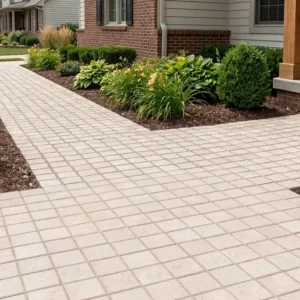
- Driveways and entry aprons in the urbanizacion: thicker units, tighter joints, and the denser end of the range.
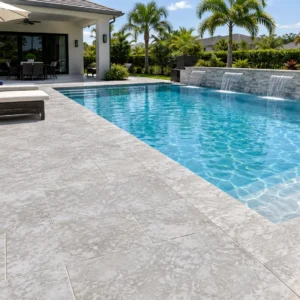
- Pool surrounds: density plus a surface texture that stays honest once it is wet.
Salt air and the wet-dry cycle
What damages paving here is rarely one dramatic event. It is repetition: wet, dry, hot, cool, salt in, salt out. Dissolved salt enters the pore network, evaporates at the surface and leaves crystals that grow a little with every cycle. That is why an absorption figure matters more in a marine climate than inland, and why calibrated limestone paving for Puerto Rico is worth choosing on data rather than on a showroom impression.
- Rinse salt-exposed paving with fresh water rather than leaving it to dry in place.
- Keep planters and irrigation lines off the paving surface where you can, or set them on feet.
- Treat efflorescence as a moisture message, not only a cleaning job.
- Check joints yearly, because open joints turn a surface problem into a bedding problem.
What to put on your submittal
Crews here are used to concrete submittals and less used to stone ones. Keep it short and in writing, so the pallet that lands in San Juan is the pallet you approved.
- The absorption and density results for the exact material and finish you are buying.
- Nominal thickness and the calibration tolerance the supplier works to.
- Finish name, plus a wet photograph of that finish, not only a dry one.
- Edge detail, since a sawn edge and a chiseled edge behave differently at a step nosing.
Landed cost without a duty line
Puerto Rico sits inside US customs territory, so mainland stone arrives as a domestic shipment with no federal duty line and no international clearance leg. The Jones Act requires US-flag, US-built and US-crewed vessels on that carriage, which lifts the freight number but delivers frequent scheduled sailings out of Jacksonville and Port Everglades into San Juan. What does apply is IVU sales and use tax at 11.5 percent, made up of 10.5 percent state and 1 percent municipal, calculated on total landed cost including freight and insurance, declared through Hacienda and the SURI portal, with use tax due at filing unless you hold a bond. Confirm the current rate with your accountant, and remember that density feeds that math directly, because you pay to move mass.
Samples before pallets
Numbers narrow the field; a small sample settles it. Put a piece in the exact spot it will live, wet it, walk on it barefoot at two in the afternoon, and leave it out for a month. The material notes across our Puerto Rico stone supply pages set out which finishes suit which exposure. Samples are small pieces, sized to judge tone and texture in your own light. Specify the stone by its data and the island will confirm your choice for you.