What Surrounds an Older Vincentian Property
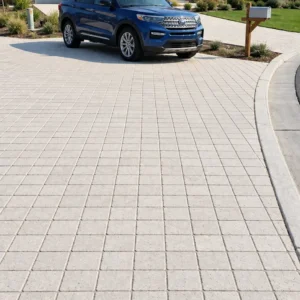
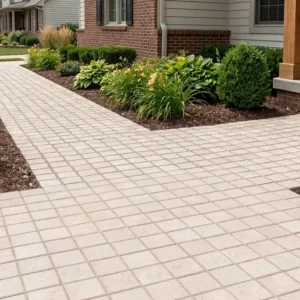
Most older buildings in St Vincent and the Grenadines are not stone buildings. Walls are usually block and render, or a concrete frame with infill. Verandas, shutters and rails are often timber. Yards and steps tend to be poured concrete, or compacted volcanic aggregate packed down hard over many seasons. That is the honest starting point for a sett project here, and a better one than a borrowed story about paving that was never laid. A cut stone surface set against render, concrete and painted timber is a deliberate addition to the property, and the detailing should read as an addition rather than an imitation.
Matching Tone and Scale to the Building
The building sets the brief. Before anyone opens a supplier’s range, look at what the walls, roof and joinery are already doing, then choose a unit that agrees with them.
- Unit size: small setts read as texture and suit tight yards, while larger units read as floor and suit open terraces.
- Tone: judge samples wet and in shade against the actual render, not on a bright board in full sun.
- Joint width: a slightly wider joint absorbs the fact that an old wall is no longer straight.
- Layout: quiet courses usually sit better beside a plain rendered facade than a fan or a circle.
- Sheen: keep polished faces away from a building whose other surfaces are matte and weathered.
Edges, Steps and Thresholds
On an older property the edge is where the job is won or lost. Walls are rarely square, existing flights are rarely consistent, and doorways sit at whatever level they were built at. Detail the perimeter first and let the field follow it.
- Run a cut course along the wall so the field pattern stays true and the taper is absorbed at the edge.
- Hold the finished surface below existing door thresholds and fall away from the building.
- Haunch the edge restraint in concrete where paving meets soft or eroding ground.
- Match a new step rise to the existing flight, not to the sett module.
- Leave a clean, sealed gap at the wall base so render is not bridged by wet bedding.
Setting Out on Steep Volcanic Ground
St Vincent is steep, and rain arrives in bursts that move a lot of water quickly. Setting out starts with levels and drainage and works back to pattern. Mature trees are usually the fixed point everything else bends around, and they should be, because they are worth more to an older property than any layout.
- Survey existing levels and agree falls before agreeing a pattern.
- Ring mature trees with a flexible edge and a permeable margin instead of paving to the trunk.
- Keep the field sand-set or grit-set where roots may move, so units can be lifted and relaid.
- Send runoff to a channel or planted bed, never toward the building or the back of a retaining wall.
- Run courses across the fall on slopes for slower water and better footing.
What Goes Under the Wearing Surface
A sett is a wearing surface, and almost everything below it is Vincentian. Sub-base, bedding, haunching and concrete are built from local aggregate, and on most sites that means Rabacca, screened and crushed on the island and bought by the load rather than by the pallet. The imported units are the finish over a structure built from island material, and a specification that says so is simply accurate. Sizes, thicknesses and pallet configurations for the sea leg are set out in our cobblestone options for Vincentian projects.
A Surface That Cleans After Ash and Rain
La Soufriere put fine volcanic ash across the island in 2021, and ash is abrasive, works into open textures and has to be swept and washed off rather than left to sit. Beside soft render and painted timber, that argues for a dense, low-absorption stone and for textured finishes that wash clean.
- Specify low absorption for salt, ash and repeated washdown.
- Keep texture grippy in heavy rain but closed enough that fine ash does not embed.
- Use jointing that can be flushed with water without washing out.
- Give every bay a fall, because a hosed surface that ponds will stain first.
Phasing a Courtyard That Stays in Use
Older properties are usually occupied, and in the Grenadines they are often let. Setts phase well because the module is small and a section can be closed, built and reopened without an obvious seam. Two points matter more than the phasing plan itself. Order the full quantity in one batch so later sections match, since stone shade shifts between production runs. Then plan storage: cargo lands at Kingstown or Campden Park, onward delivery to Bequia and the southern Grenadines moves by inter-island vessel, and pallet weight and footprint matter more on that leg than container price.
When Setts Are the Wrong Answer
Setts are not right everywhere, and saying so is part of specifying them. Skip them where heavy vehicles turn on a weak or unknown base, where a sound concrete apron only needs repair, or where the money would do more good on drainage, a wall or a roof first. Wind exposure is real on the low, open islands, as Hurricane Beryl showed in July 2024, so edge restraint and fixings deserve the same attention as the surface. Where the character comes from timber, render and trees, a small area of sett at the entrance often does more than a whole yard of it. Specify the surface the building can carry, detail the edges honestly, and the paving will look like it belongs there.