Why Curves Rule These Sites
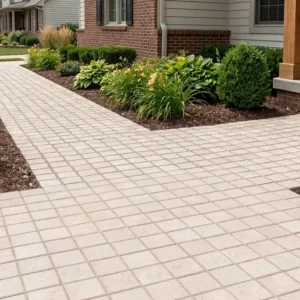
Villa work in the Grenadines almost never hands you a rectangle. Drives arrive at an angle because the land decided the route, entrance courts wrap around a planting bed, pool surrounds are shaped rather than square, and terraces follow a coastline instead of a property line. Large slabs fight that geometry and lose. Small units win it, but only when the pattern is chosen before setting out starts, rather than after the first pallet has been opened on site. Pattern selection here is really a structural decision about how much cutting a crew will do and where the weak closures end up, not a styling exercise picked from a mood board.
The Layouts That Actually Work on a Curve
Four arrangements cover almost everything a Vincentian site will ask for, and they behave very differently once the ground bends. Choosing between them at drawing stage, rather than on the day, saves a great deal of cutting.
- Fan or arc courses, which absorb a curve naturally and hide most of the closure cuts.
- Concentric rings, which suit a circular court or a feature set squarely at the center.
- Running bond, which is fast and calm to lay but needs cuts along anything curved.
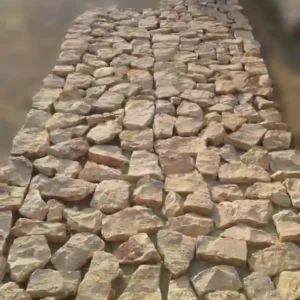
- Coursed random fields, which forgive irregular edges, old walls and awkward corners.
Fan and Arc Work in Practice
The fan layout exists because masons needed a way to turn a corner without cutting every unit. Each arc runs slightly longer than the one before it, and the joint width quietly takes up the difference. Laid well it looks inevitable; laid badly the arcs drift and the eye catches it immediately, usually from an upstairs window rather than from the ground. It rewards a mason who sets a string from a fixed center and keeps checking back to it instead of trusting the last course laid. Small units are what make the geometry possible, so small units for tight radii matter more here than almost any other decision on the specification.
Running Bond and Where It Stops Working
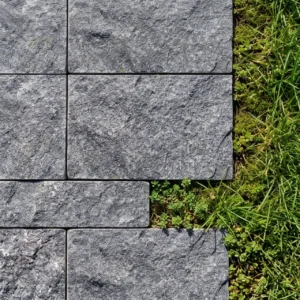
Straight courses are quicker to lay, easier to price and easier to keep flat, which is why they dominate paths and long terraces. The limit shows up as soon as the edge curves. Every course then meets the boundary at a different angle, and each one needs its own cut. On a gentle sweep that is manageable and barely noticeable. On a tight entrance court it becomes a day of cutting and a line of thin, fragile closures that will be the first units to break under a wheel. Where a client wants straight courses on a curved site, a curved header course is usually the compromise that saves the job.
Setting Out from a Center Line
Curved paving is decided in the first hour on site, long before any stone is bedded. An afternoon spent setting out properly saves a week of argument later, and it costs nothing but string and patience.
- Fix the center point or the primary radius and mark it somewhere genuinely permanent.
- Dry-lay one full arc or course and check it against the boundary before bedding anything.
- Work outward from the most visible line, not from the least visible corner of the plot.
- Agree in advance where the pattern will change direction rather than discovering it later.
Cuts, Closures and Honest Edges
Every curve produces offcuts, and how a crew handles them separates good work from average work. The cuts themselves are unavoidable; what matters is where they land and how much load they are asked to carry.
- Never finish a curve with a sliver; borrow width from the previous course instead.
- Use a header course along a curved edge so it can absorb the cuts cleanly.
- Keep cut faces away from the approach so the eye meets full units first.
- Order extra units for closures, because a curve eats far more than a straight run.
Pattern in Strong Island Light
Light here is hard and high for much of the day, which flattens tone while exaggerating texture. A pattern that reads clearly on a drawing can disappear at noon and return as a strong shadow grid in the late afternoon. That argues for letting texture and unit size carry the layout rather than relying on contrast between tones, which is the first thing hard sun takes away. Reviewing pattern choices before you order against a sample laid outdoors is far more useful than judging any of it from a screen, and it takes an hour rather than a week.
Ordering to a Pattern
Pattern decisions change quantities, and quantities change how a shipment is packed for the vessel leg out to Bequia, Canouan or Union Island. That last stage is small-boat work, so the packing list matters almost as much as the order itself.
- Fan and circular layouts need more units per square foot than straight courses do.
- Mixed sizes must arrive in the right ratio or the pattern cannot be completed.
- Pallets should be built so a court can be started without opening the whole load.
- Keep a reserve of full units, since a curve is difficult to patch convincingly later.
Choose the pattern with the mason in the room, because that is who has to make it land.