What a Landed Sett Price Is Made Of
A sett budget here has one fewer line than a budget in a tariff jurisdiction, and it helps to see the parts separately rather than as a single number per square foot.
- The stone itself, priced by format, thickness and finish.
- Ocean freight from the United States to Point Blanche, plus terminal handling.
- Inland delivery from the port to site, with any craneage or barrow work at the plot.
- Laying labor, bedding, jointing and edge restraint, which are a separate trade from supply.
Notice what is not on that list. There is no ad valorem duty line, and its absence changes the arithmetic in a way that is easy to miss when a budget is built on mainland assumptions.
The Line Your Budget Does Not Carry
Customs Sint Maarten states on the government’s own site that it is mainly a law enforcement agency and not primarily an import duty collecting organization, and that the only tax it levies is excise on unleaded gasoline. A pallet of paving landing at Point Blanche does not attract a tariff.
That does not mean goods walk off the quay. Declarations are made, consignments are cleared, and enforcement is exactly what the agency describes itself as doing. What disappears is the percentage a tariff jurisdiction adds to every line of the invoice.
Turnover Tax in Plain Terms
The island’s principal indirect tax is turnover tax, charged at a standard rate of 5% on realized revenue from the sale of goods or the provision of services. Returns are monthly, filed and paid by the fifteenth of the following month, with a 15% surcharge on default. A limited list of necessities is exempt.
Read that carefully, because it is regularly described wrongly. Turnover tax falls on a local business’s revenue. It is expressly not levied on imports. It is not a 5% import tax, and it is not a value added tax charged on arrival at the port.
Why Small Units Cost More to Lay
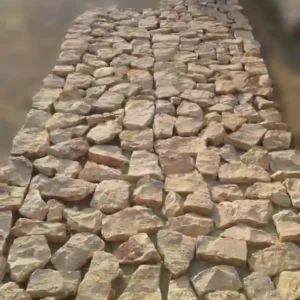
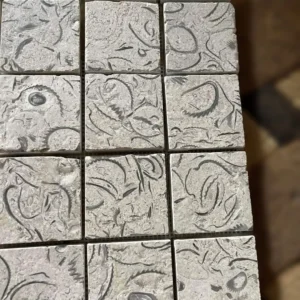
Setts are placed one at a time. A square yard of large format paving is a handful of pieces; the same area in small setts is a great many more, each aligned, each bedded, each jointed. That is geometry rather than a market observation, and it is the honest reason a sett budget carries a larger labor share than a slab budget.
The compensation sits on the other side of the ledger. Setts follow slopes and curves without heavy cutting, they can be lifted and reset in patches instead of whole panels, and they absorb irregular boundaries that would force expensive cuts in large format material.
Phasing a Sett Order
Few sites need every square foot at once. Phasing spreads cash flow and lets the first area be reviewed in real light before the rest is committed. It introduces one risk worth managing, which is lot variation between deliveries. Ask us to price a sett order split by phase if the work runs across a year.
- Order the whole quantity of one stone together where budget allows, even if delivery is staged.
- Where lots must differ, put the break at a natural boundary such as a step or a change of level.
- Blend from more than one pallet as you lay, rather than working pallet by pallet.
- Do the vehicle areas first, since they set the depth and base specification for everything else.
- Keep a written record of format, thickness and finish so a later phase can be matched.
Quantities, Waste and Spare Stock
Quantity errors cost more than unit price differences on a sett job, because a short order stops a trade rather than simply costing money.
- Convert area into units using the actual joint width, not the nominal one.
- Add waste for curves, closers and cuts against restraints, since radial work needs more than straight work.
- Keep spare stock for repairs after storm damage or a service trench.
- Count edge restraint separately, in linear feet, and order it with the paving.
- Allow for breakage in handling between the quay and the plot.
Currency and How Prices Are Quoted
The Caribbean guilder became the official currency of the Curacao and Sint Maarten monetary union on 31 March 2025, pegged at one US dollar to 1.79 guilders. Since 1 July 2025 it is the only currency accepted for cash payments. The US dollar remains widely used, and construction and hospitality routinely price in dollars.
For an import contract that matters mainly for clarity. Agree which currency the quotation, the deposit and the balance are stated in, and agree it in writing before the order is placed rather than at invoice stage.
What We Need to Price It
A useful quotation needs less information than people assume, but it needs the right pieces. With these in hand we can put numbers against the stone, the freight and the handling, and flag anything in the layout likely to drive waste.
- Areas by use: pedestrian, occasional vehicle, and daily vehicle.
- The pattern, or at least whether the work is straight or radial.
- The bedding intention, rigid or flexible, since it sets the depth.
- Site access at the plot, and whether a container can be stripped there or has to be transferred.
With those settled, ask for a quote written against your takeoff rather than a rate card. Send the areas and the access and we will price the stone, the freight and the handling in one document.