What Makes a Pool Deck Slippery Here
Slip is not one problem, it is three, and they arrive on different timescales. The first is the obvious one: a thin film of water between a smooth sole and a smooth stone. The second is chemistry, because pool water leaves salt or chloride residue behind as it evaporates, and that residue changes how a surface feels. The third is biology, and on a warm humid island it is the one people underestimate. Solve all three and a deck stays safe for years; solve only the first and it will feel treacherous by its second wet season.
Texture Depth Beats Texture Talk
Any supplier can call a finish textured. The useful question is how deep the texture is and whether it survives traffic. A surface that gets its grip from a shallow etched skin loses that grip as the skin wears away, while a surface whose grip comes from the structure of the stone face keeps working. Ask what the finish does to the top few millimeters of the unit, not what the marketing name implies. Ask also what it looks like after cleaning, because some textures hold dirt in a way that changes the appearance within one season.
The Finishes Worth Considering
Around water the shortlist is short, and each option trades comfort against grip.
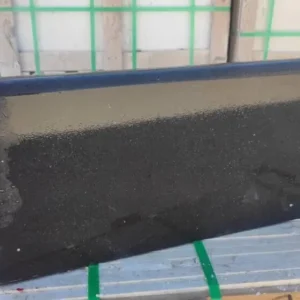
- Bush-hammered: an evenly pitted face with grip built into the stone rather than applied to it.
- Brushed or double-brushed: softened and slightly open, comfortable underfoot, gentler than heavy texture.
- Sandblasted: a uniform matte face that scatters light and reads well in very bright sun.
- Tumbled: rounded arrises and an irregular face, forgiving on bare feet and at step nosings.
- Honed or polished: handsome indoors, wrong beside water, and best kept off every wet route.
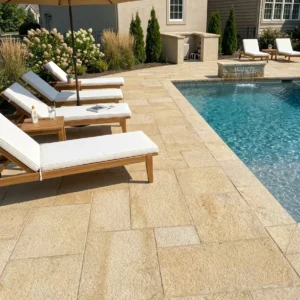
Comfort and grip pull in opposite directions, so decide area by area rather than picking one finish for the whole scheme. A heavier texture belongs on step treads and the wettest strip beside the pool; a gentler one suits the lounging area where people lie down and children sit.
Biological Growth Is the Quiet Culprit
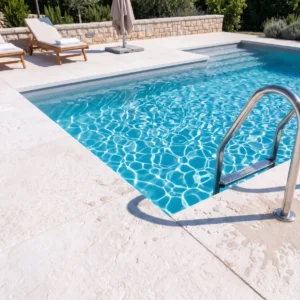
The deck that turns dangerous is usually the one in shade beneath planting, where damp lingers and a thin biological film builds up. That film is far more slippery than clean wet stone, and it forms whether the surface is textured or not, though a textured face keeps more usable grip once it does. Design against it: keep planting back from the busiest routes, let air move through shaded corners, and make sure water leaves the surface instead of sitting on it. A deck that dries quickly stays gripped. Choosing textured limestone for wet surrounds is the starting point, but drainage and airflow decide whether that texture is still working in year three.
Coping, Edges and Bare Feet
The pool edge takes more punishment than the field, and it is where hands and shins meet stone.
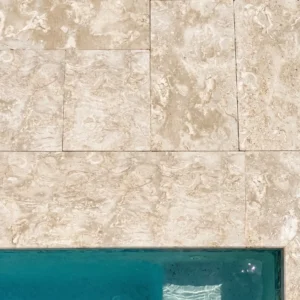
- Round or ease every exposed arris so the edge is kind to feet and forearms.
- Keep a consistent overhang so water drips clear instead of tracking back underneath.
- Grip every step tread, and consider a slightly heavier texture on stairs than on the flat.
- Use non-ferrous or stainless fixings only, because salt aerosol will find any ferrous cramp.
- Bed and bond units on exposed terraces, so nothing becomes airborne in a severe storm.
Salt, Chlorine and Cistern Runoff
Two extra constraints sit on top of the usual pool-deck decisions here. Salt crystallization replaces freeze-thaw as the mechanism that damages stone, so low absorption matters as much as grip. And because there are no permanent streams or rivers on either island, most properties collect and store rainwater, which makes the deck part of the catchment.
- Choose a low-absorption stone so salt has less pore structure to work in.
- Rinse splash zones with fresh water rather than letting residue build up and bloom.
- Keep cleaning chemistry off any surface draining toward a cistern inlet.
- Detail the falls so pool overflow and deck runoff stay separate from clean catchment.
Cleaning Without Polishing the Grip Away
Grip is lost through maintenance at least as often as through wear, and the damage is gradual enough that nobody notices until somebody slips.
- Avoid aggressive pressure washing at close range, which can smooth a textured face over time.
- Skip film-forming sealers on wet routes, since they are the thing feet actually slide on.
- Brush shaded areas regularly so film never becomes established in the first place.
- Re-check grip at the end of each wet season, starting on the shaded side.
Test It Wet, Then Order
No description of a finish is worth a wet sample under a bare foot. Get small pieces of the shortlist, wet them with pool water rather than tap water, tilt them slightly, and walk on them in the shade as well as in the sun. If you are shortlisting, ask us to send a small sample box, which is the cheapest step in the whole project. Then plan the logistics: Deep Water Harbour at St John’s takes direct sailings from the Port of Palm Beach, a broker is required once a shipment passes EC$5,000 or six lines, and Antigua and Barbuda Sales Tax has stood at seventeen percent since 1 January 2024 on landed value plus duty and other government charges. Choose the finish with your feet, then let the paperwork follow behind.