Start With Duty, Not With Room Names
Specifications go wrong when they begin with a label. Patio, driveway and courtyard describe where stone sits, not what crosses it. The useful questions are what the heaviest thing to touch that surface will be, how often that will happen, and whether it will happen while the surface is wet. On a steep island with a seven-month wet season those three answers move the specification much further than the room name ever does. Traffic duty is also the only language your engineer, your layer and your supplier all share, so writing it on the drawing removes an argument before it happens.
Foot Traffic: Terraces, Steps and Pool Surrounds
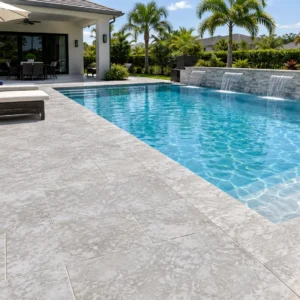
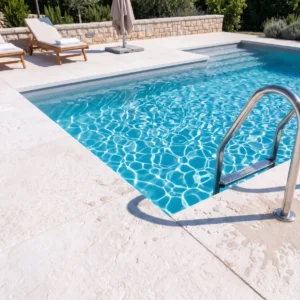
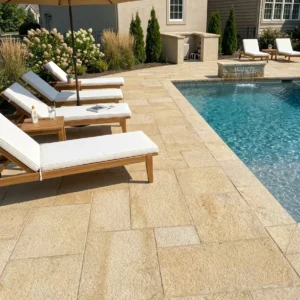
Pedestrian areas are the least demanding for load and the most demanding for surface behavior. Nobody thinks about a paving unit until it turns slick after an afternoon downpour. Here the priorities are texture, consistent thickness so units bed level, and honest detailing at every change of level.
- Pick the finish before the size, because texture is the thing people actually feel.
- Take treads and risers from the same batch so tone and texture stay consistent.
- Keep unit weight inside what one person can place, since terraces are rarely machine laid.
- Allow a wider joint on falls, where water needs somewhere to go rather than somewhere to sit.
Light Vehicles: Villa Driveways and Parking Bays
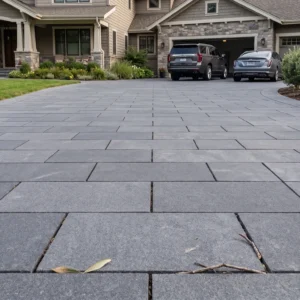
The moment a car is involved, the unit thickens and the base does the heavy work. A driveway at Lance aux Epines or True Blue sees the same vehicle every day, usually turning in the same place, and that repetition is what fails thin paving rather than any single heavy load. Ask us for the thickness against your intended duty, and ask your engineer for the base build-up that matches it, because the two decisions belong together and are routinely made by two people who never speak. Add the parking bay itself to the calculation, not just the run up to it, since a car standing in one spot for years is a static load the surface has to carry without complaint.
Turning, Service and Delivery Loads
Hotel service yards, marina aprons at Port Louis and any area a delivery truck reverses across are a different class again. This is where small-format units earn their keep and where edge restraint stops being a detail.
- Turning and reversing twist units in the bed far harder than straight running does.
- A smaller footprint spreads that movement across more joints and more edges.
- Edge restraint here is structural rather than decorative, so detail it that way.
- Keep falls away from thresholds where vehicles stand, drip and wear one patch.
The Base Course Beneath It All
Every paving unit is only as good as what sits under it, and on this island that base is very likely to be local. Grenada’s main quarry at Telescope in the parish of St Andrew, worked by the state-owned Gravel, Concrete and Emulsion Corporation, produces basalt described as a high-quality, durable rock used for high-strength concrete and asphalt road surfaces, with a smaller gravel operation at Mon Rush in St George’s. That material is the structural bone of Grenadian roads and buildings. Imported paving is a different product class altogether: a calibrated dimension-stone wearing surface that sits on top of a base course which, on most sites here, will be Grenadian basalt from Telescope. The two are partners in one build-up, not rivals.
Format, Joint Width and the Wet Slope
Format is where duty, drainage and appearance meet. Larger units read calmer and lay faster on flat ground; smaller units follow falls, curves and cambers without cutting. On sloping Grenadian sites the second consideration usually wins, and it cuts waste as well as improving the look, because every cut is labor and lost material at once.
- Large formats suit level terraces, wide landings and generous pool decks.
- Small units and setts follow gradients, radii and awkward boundaries with far less waste.
- Mixed-size layouts absorb site tolerances that a single repeated size will expose.
- Joint width should be set by the falls and the bedding method, not by taste alone.
A Masonry Town and Its Context
St George’s has been built in masonry by law since a municipal requirement passed after the fires of 1771 and 1775, and its historic district has sat on Grenada’s UNESCO Tentative List since 5 August 2004. It is a tentative listing rather than a World Heritage inscription, but the character is real and the Physical Planning Department has been developing a conservation zone around it. Paving inside that context calls for restraint.
- Favor small units and traditional coursing over wide contemporary formats.
- Keep tone quiet, so new work sits behind the Georgian frontages rather than in front of them.
- Check what consent your work needs before ordering, not after the crates land.
- Sample on site, in daylight, against the actual wall you are working beside.
Getting the Spec Right the First Time
Write the duty class beside every area on the drawing, then choose stone against it. That one habit removes most reorders. When you have formats sorted by traffic duty you can order a terrace and a turning apron in a single container without either area being over-specified or under-built. Send us the areas, the falls and the vehicle you expect, and stone sourcing for Grenadian builders becomes a short conversation instead of a long one. Specify by what crosses the surface and the rest of the decision follows naturally.