What the island is made of
Sint Maarten’s geology is dominated by volcanic rock. Andesite tuff and tuff breccia from the middle and late Eocene were intruded by hypabyssal basalt, quartz diorite and younger andesite, with tonalite and granodiorite plutons dated around thirty million years old. Limestone and marl were laid down later, on top of the eroded volcanics. The named local formation, Point Blanc, is a layered rock produced by the crystallization of limestone and dated to roughly fifteen million years; a sample of it sits in the Sint Maarten Museum. Point Blanche, where the commercial port stands, is characterized by that hard layered limestone. That layering is why volcanic rock and limestone both turn up within a short walk of each other here.
Two products, one rock family
It is worth being precise about categories, because the confusion causes bad arguments. Crushed and graded aggregate, and the concrete and blockwork made from it, is a construction material produced for structural performance in bulk. Dimension-sawn paving is a different product: individual units cut to a set thickness, sorted into repeatable lots and given a specified surface finish. Both can come from the same family of rock. The processing is the difference, and it is what makes a schedule repeatable across phases. They are not competing for the same line on a drawing, and neither one substitutes for the other.
Where each sits in the build-up
Draw a section through any paved area and the division becomes obvious. Each layer has a job, and the jobs are not interchangeable.
- Sub-base and base course: locally produced aggregate, compacted in layers.
- Structural slab or bedding, where used: local ready-mixed concrete and sand.
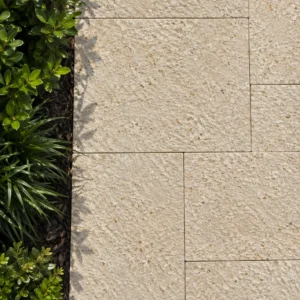
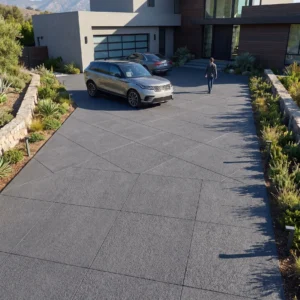
- Wearing surface: calibrated cut stone, sized and finished for the traffic it will take.
- Edges and restraint: cut units or in-situ concrete, depending on the detail.
What a small island cannot produce
This is a supply and processing argument, not a quality one. An island of roughly 34 square kilometers does not run a dimension-stone plant with gang saws, calibrating lines and finishing heads, because there is no volume to justify one. That is no criticism of the rock in the ground, which is hard and has been quarried here for aggregate. It means a schedule calling for consistent thickness, a repeatable color range and a named finish across several hundred square meters has to be filled from a processing operation somewhere else. That is what calibrated paving in repeatable lots means in practice.
- Thickness held to a stated tolerance so bedding depth stays predictable.
- Color and vein range sorted into lots rather than sold as it comes.
- A named finish applied consistently across the whole order.
- The same specification available again when a later phase starts.
Permits sit under the groundworks
Because the base course is local, the groundworks are local too, and that puts them inside the island’s permitting system rather than yours.
- The Ministry of VROMI covers public housing, spatial planning, environment and infrastructure, and its Department of Permits issues building-related permits.
- A building permit, or bouwvergunning, is required for new buildings and for extending or modifying existing ones.
- Civil works permits are required for activity altering terrestrial, coastal and marine terrain, including excavation, and are a prerequisite for a building permit.
- Approved permits are published biweekly in the National Gazette, with a six-week window in which citizens can object.
The landed cost picture
The commercial half of this comparison is unusually simple here. Sint Maarten is a free port: Customs Sint Maarten describes itself on the government website as mainly a law-enforcement agency rather than primarily an import-duty collecting organization, and says the only tax it levies is on unleaded gasoline. So an imported pallet does not carry an ad valorem tariff. The 5% turnover tax is charged on a local seller’s revenue and is expressly not levied on imports, which means it is not a border charge on your consignment. Clearance formalities and declarations still exist, and a clearing agent is still worth having. The practical effect is that comparing an imported wearing surface against a locally made one is a comparison of material and freight, not of tariff. It also makes phasing easier, since a crate ordered a year later carries the same arithmetic as the first.
Specifying both on one drawing
The cleanest schedules name the local and imported elements separately and say who supplies what.
- Name the base course, its compaction requirement and the local supplier’s grading.
- Name the paving unit, thickness, tolerance, finish and lot, and attach the test results.
- State the bedding method and joint width, because these decide how the two layers meet.
- State edge restraint explicitly, particularly wherever the ground falls away.
How to start a project here
Send the area schedule, the exposure of each zone and the finish you have in mind. Say who is responsible for setting out as well, because the interface between trades is where most paving arguments begin. We will come back with formats, thickness options, crate counts and a delivered price to Point Blanche, along with the absorption and density results for the lots we would ship. Where a figure is not verified, we say so instead of filling the gap. Background on routing and clearance sits in sourcing notes for the Dutch side.
Respect what the ground here already provides, and import only the layer it cannot make.