The biggest surface in the house
In a Jamaican house the floor is the surface people actually touch all day. Bare feet in the morning, wet feet from the pool, luggage wheels in a Rose Hall villa, children coming in from the yard. So when a client says a room feels hot, the floor is often carrying blame that the ceiling fan gets credit for fixing.
Stone refrigerates nothing. It stores and moves heat differently from a hollow ceramic body or a dark cement screed, and on an island where the sun sits high most of the year, that difference is easy to feel within seconds.
What makes a stone floor feel cool
Four properties do most of the work, and all are settled before a pallet leaves the port.
- Mass and density. A solid limestone tile draws warmth out of your foot faster than a thin body sitting over an air pocket.
- Surface tone. Pale stone throws back a large share of the sun that lands on it, while dark surfaces absorb it and release it late into the evening.
- Contact with the slab. Full mortar coverage lets the floor use the whole slab as a heat sink, whereas voids turn the same tile into an insulating skin.
- Shade history. A terrace shaded from ten in the morning never gets hot enough to argue about, whatever it happens to be paved in.
Kingston heat is not north coast heat
Kingston sits in a basin ringed by hard urban surfaces, so an apartment court or a commercial forecourt there banks heat all afternoon and hands it back long after sunset. Along the north coast belt, from Montego Bay through Rose Hall to Ocho Rios and Negril, sea breeze crosses the terraces most of the day and carries that heat off. The same tile in the same finish behaves like two different floors.
Upland sites are a third case again. The Blue Mountains wring heavy orographic rainfall out of the trade winds, and a floor that is soaked at four o’clock has no heat problem at all. It has a drying and traction problem, which is a different specification entirely.
Pale stone, glare and the verandah
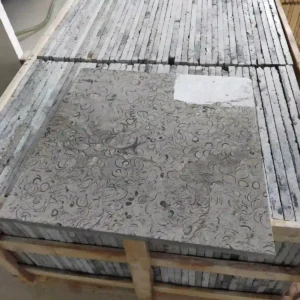
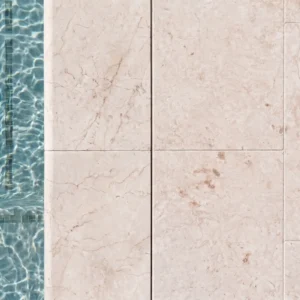
Very light stone is the obvious answer to solar gain and usually the correct one. But a fully exposed pale terrace at Negril in the middle of the day can throw back enough glare that people stop sitting on it, which is why we steer clients toward calibrated limestone tiles for Jamaica in a face that scatters reflected light instead of mirroring it.
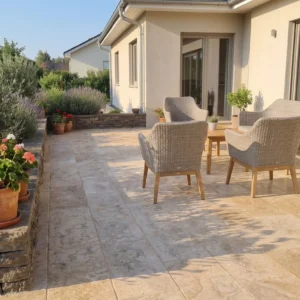
- Keep the palest tones for shaded verandahs, covered walkways and interior rooms with wide openings.
- Move to a brushed or lightly textured face where a terrace stands in full sun all day long.
- Let planting, timber louvers and deep eaves do the shading before you compromise on tone.
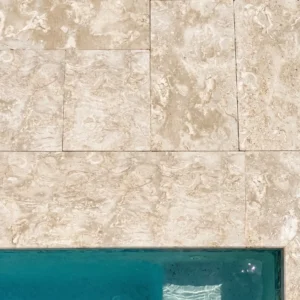
- Warm the tone slightly at pool copings and steps, where light bouncing off water doubles the load.
Thickness, bedding and thermal mass
Thickness is where the comfort argument meets the structural one. Interior floors over a sound slab need little, while exterior terraces, steps and any surface a vehicle crosses need considerably more, and the extra mass helps comfort as a side effect.
- Interior rooms over a level slab: a thinner calibrated tile bedded solid keeps door heights and thresholds sensible.
- Verandahs and open terraces: step up in thickness for impact resistance and for the thermal buffer it buys.
- Steps, copings and forecourt edges: heavier again, because these pieces take the loads and the knocks.
- Anything over a void or a raised deck: assume the floor is thermally on its own and detail accordingly.
Shade costs less than stone
The cheapest degree of comfort on any Jamaican terrace comes from shade rather than material. A pergola, a run of deep eaves, an almond tree in the right position, each removes more heat from a floor than any change of stone will. Specify shade first and let the stone handle what remains. Shade protects the floor too, since a surface that never gets extremely hot moves less and holds its sealer longer.
What the floor costs to land
Comfort is partly a budget question, since the landed number decides how much floor you can afford to get right. Containers reach the island through Kingston, where Kingston Freeport Terminal handles box traffic as part of a major regional hub port, or through Montego Bay when the job sits in the resort belt. Charges build on the CIF value, not the invoice alone.
- Import duty, commonly around twenty percent for goods of this kind under the regional common external tariff.
- General Consumption Tax at the standard rate of fifteen percent.
- An environmental levy of half a percent on the CIF value.
- A Standards Compliance Fee of three tenths of a percent, collected by the Jamaica Customs Agency for the Bureau of Standards Jamaica, along with the Customs Administrative Fee.
Rates move, so confirm the current rate with your broker before a budget hardens around them. If you want that stack modeled against a real packing list, our Jamaica stone supply desk will work through it with you.
Specify once, then live with it
Quarrying here is supervised by the Mines and Geology Division under the Mining Act and the Quarries Control Act, and it keeps the island supplied with aggregate, marl, fill, block stone and marble. What no local operation produces is factory-calibrated dimension flooring, and that narrow gap is the one imported tile fills. Everything else in this article is a decision made on paper before loading begins. A cool floor is designed rather than discovered.