
Black patio blocks in Arizona absorb UV energy at rates that concrete and lighter-toned materials simply don’t — and that distinction drives every specification decision from finish selection to sealing frequency. Installing black patio blocks in Arizona without accounting for UV-driven surface oxidation and color shift is the most common reason these installations look weathered at year three instead of year fifteen. The desert sun doesn’t just heat the stone; it breaks down the mineral surface bonds that lock in that rich, dark appearance you’re after. Getting this right from day one means understanding how UV exposure interacts with your material at a molecular level, not just how to set blocks in a bed of gravel.
Why UV Exposure Defines Black Patio Block Performance in Arizona
Arizona’s UV index routinely peaks between 11 and 13 across low-desert metro areas — among the highest sustained UV environments in North America. For black patio blocks, that intensity accelerates a process called photo-oxidation, where the iron and manganese compounds responsible for dark pigmentation in natural basalt and bluestone begin to oxidize toward grays and taupes. You’ll notice the shift first along south-facing edges and exposed horizontal planes, which see the most direct UV angle during peak summer hours.
The surface finish you choose matters enormously here. A flamed or brushed finish opens the stone’s pore structure slightly, which increases UV penetration depth. A honed or polished finish creates a tighter surface layer that reflects more UV and resists oxidation longer — but it also becomes more slippery when wet, which is a real safety trade-off you need to weigh. For most residential patios in Phoenix, a satin-honed finish hits the right balance between UV resistance and traction.
- Polished finish: highest UV reflectance, longest color retention, lowest slip resistance when wet
- Honed finish: moderate UV resistance, better traction, recommended for most Arizona patio applications
- Flamed finish: best traction, most porous surface, requires more frequent sealing in high-UV zones
- Brushed finish: textured, pedestrian-friendly, moderate UV exposure — seal annually in the Phoenix metro
Base Preparation Requirements for Arizona’s Ground Conditions
The desert soil profile under your patio matters more than most homeowners realize. Arizona’s native soils — particularly the expansive clays found across the Tucson basin — move with seasonal moisture changes in ways that crack a poorly prepared base within two or three monsoon cycles. Outdoor block paving preparation across Arizona must account for a minimum 6-inch compacted aggregate base using crushed granite or Class II road base, compacted to at least 95% of maximum dry density per ASTM D698. In areas with known expansive clay, extend that to 8 inches and consider a geotextile separation fabric at the native soil interface.
Caliche layers complicate things further. Where you hit caliche hardpan at 12 to 18 inches, you have two options: scarify and recompact it as your sub-base, or rip it out and replace it with imported aggregate. The scarify-and-compact route works well when the caliche layer is uniform and at least 4 inches thick — it actually provides excellent load-bearing capacity. Inconsistent or thin caliche layers should come out entirely, because differential settling across the patio surface will telegraph directly to your black patio blocks as cracking and joint separation.
For the setting bed, use a 1-inch screeded layer of coarse concrete sand (ASTM C33) rather than fine mason’s sand. Coarse sand provides better drainage through the bed and resists the migration that causes fine-sand beds to thin unevenly over time. Set your screed rails at a 1.5% slope away from the structure — that’s roughly 3/16-inch drop per linear foot — to carry monsoon runoff efficiently off the surface.
Black Stone Block Installation Steps Specific to Arizona Conditions
Laying out your pattern correctly before you cut your first block saves hours of frustration. Start with a dry layout across the full patio area to check your pattern, verify color consistency across your delivery batch, and identify any blocks with hairline fractures that Arizona’s thermal cycling will widen over time. Blocks that ping with a clear tone when tapped are sound; blocks with a dull thud often have internal micro-fractures and should be set aside for cuts along edges where the fracture zone will be removed.
Following the desert-rated patio block laying guide approach means staggering your joints by at least one-third of the block length — a running bond pattern distributes load far more effectively than a grid pattern across Arizona’s expansive soils. Set each block with a firm rubber mallet strike and check with a straightedge every fourth course. Don’t rely on eye-level sighting; the glare off black stone in Arizona sun makes small height discrepancies nearly invisible until you’re walking across an uneven surface.
- Dry-lay the full pattern before setting to verify color batch consistency
- Tap-test every block — dull thud indicates internal fracture, remove from field use
- Maintain 1/8-inch to 3/16-inch joint gaps for polymeric sand fill — tighter joints trap debris and prevent proper sealing penetration
- Use a rubber mallet, never a metal hammer — black stone chips at edges more readily than lighter-colored limestone
- Set expansion joints every 12 feet in both directions — not the 15 to 20 feet some generic specs recommend for cooler climates
- Check level every four courses minimum, not just at completion
Your truck delivery should be coordinated to arrive the day before you begin setting, not the morning of installation. Letting blocks acclimate to ambient temperature overnight means the block temperature at setting closely matches the anticipated service temperature, which reduces the minor dimensional variation that comes from thermal expansion during transit. Warehouse-stored blocks arriving on a hot truck bed can measure 0.5 to 1mm wider than their nominal dimensions — small enough to seem irrelevant, but cumulative across a 400-square-foot patio.
Sealing Schedules and UV Protection for Black Patio Blocks
Sealing is where most Arizona installations either succeed long-term or start degrading prematurely. For black patio blocks in high-UV desert environments, you need an impregnating penetrating sealer with UV inhibitor additives — not a topcoat or film-forming sealer. Film-forming sealers trap heat between the sealer layer and the stone surface, which causes delamination in Arizona’s summer conditions. Penetrating sealers bond with the stone’s mineral matrix and allow vapor transmission, which is critical when your patio sees afternoon surface temperatures above 160°F.
The initial seal should happen 28 to 30 days after installation, once the polymeric joint sand has fully cured. Apply two coats of penetrating sealer with UV inhibitors — the second coat going on within 2 to 4 hours of the first while the first is still slightly tacky. This double-saturation approach increases penetration depth by roughly 40% compared to a single-coat application. In Scottsdale‘s intense UV environment, the double-coat initial seal is the difference between a 12-month resealing cycle and an 18-month cycle.
- First seal: 28 to 30 days post-installation, two-coat penetrating application with UV inhibitors
- Subsequent sealing: annually in full-sun exposures, every 18 months for covered or partially shaded patios
- Best application window: early morning, below 85°F surface temperature — avoid midday application entirely
- Sealer type: silane-siloxane blend or fluoropolymer-based — both offer superior UV resistance over acrylic sealers
- Surface prep before resealing: pressure wash at 1,500 to 2,000 PSI, allow 48-hour dry time minimum
At Citadel Stone, we recommend testing your sealer on a scrap block before full application — apply the sealer, let it cure 24 hours, then observe whether it darkens the stone to a degree you find acceptable. Penetrating sealers range from zero color enhancement to moderate wet-look darkening, and getting the visual outcome right matters as much as the UV protection chemistry.
You can also reference Arizona block paving from Citadel Stone for product-specific guidance on sealer compatibility with different black stone varieties.
Joint Sand and Edge Restraint for Desert Conditions
Standard polymeric sand formulations designed for temperate climates tend to become brittle under Arizona’s UV and heat combination. The desert-rated patio block laying guide standard calls for polymeric sand rated for high-temperature service — look for products specifying stability up to 250°F surface temperature rather than the standard 140°F rating. The polymers in lower-rated products begin to degrade after the first full Arizona summer, causing joint sand to powder and blow out, which compromises both the block interlock system and your sealer’s effectiveness at the joints.
Edge restraints on outdoor block paving preparation across Arizona deserve more attention than they typically get. The monsoon season delivers intense short-duration rainfall — often 1 to 2 inches in under an hour — that generates significant lateral water force across patio surfaces. Plastic snap-together edge restraints are adequate for calm-weather installations, but for Arizona patios, steel spike-driven edge restraints at 12-inch intervals provide the lateral stability that keeps your border course from creeping outward under hydraulic pressure. This is especially relevant for any patio installed adjacent to a slope or drainage swale.
Color Retention and Long-Term Surface Appearance
Here’s what most specifiers don’t fully account for: black patio blocks don’t fade uniformly across a patio surface. The blocks in direct south and west exposure paths — where UV hits at the harshest angles during peak summer hours — will show color shift measurably faster than blocks under pergolas, shade structures, or adjacent to walls that cast afternoon shadow. This differential weathering creates a patchy appearance that’s difficult to correct without treating the entire surface.
The most effective strategy is to seal the full patio on the same schedule as your most-exposed section, rather than spot-treating only the visibly faded areas. Spot treatment creates visible sealer-sheen variations that are just as aesthetically disruptive as the fading itself. Planning for a whole-surface annual seal in full-sun Arizona patios — budgeted into your maintenance schedule from day one — prevents the uneven appearance that prompts expensive strip-and-reseal remediation down the line.
- Differential UV fading appears within 12 to 18 months in full-sun Arizona installations without proper sealing
- Color-enhancing penetrating sealers can partially reverse early-stage oxidation and restore visual depth
- Lithochrome or similar color-sealer treatments provide an additional UV barrier layer for severe fading cases
- Avoid pressure washing above 2,200 PSI — it strips sealer and microscopically roughens the surface, accelerating future UV penetration
- Light surface cleaning with a pH-neutral stone cleaner extends time between full resealing cycles
Material Thickness and Structural Loading for Arizona Patios
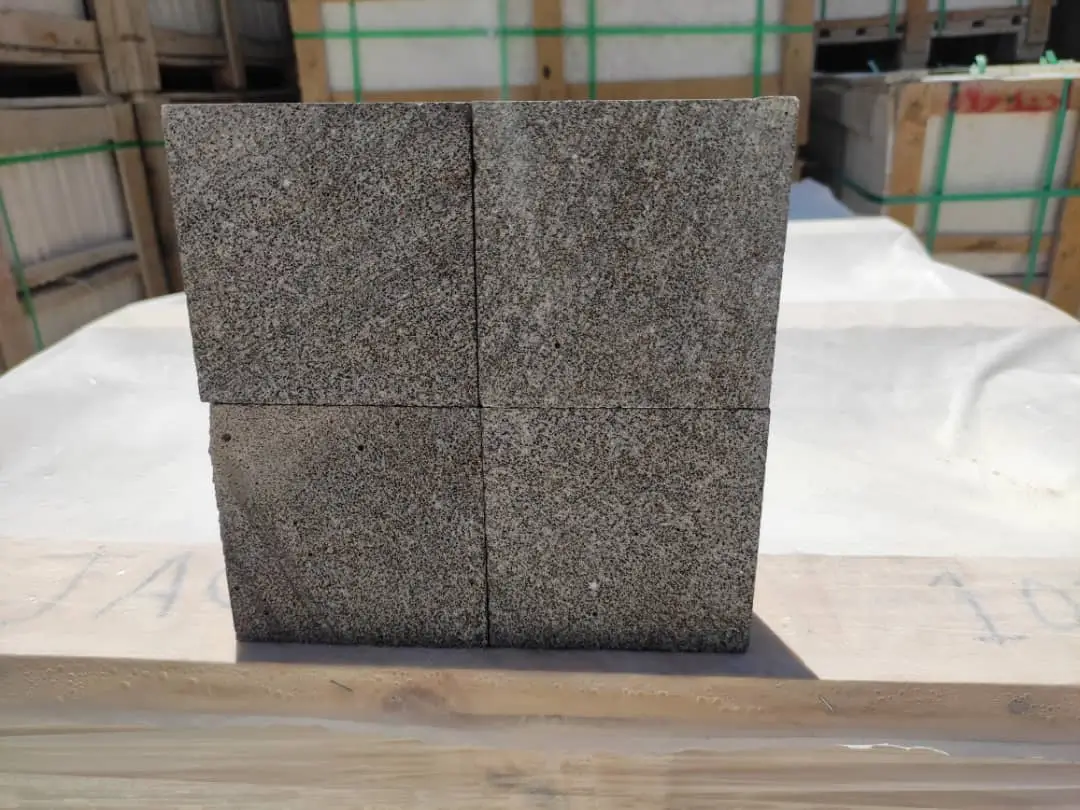
Residential patio applications in Arizona typically call for black patio blocks in the 1.5-inch to 2-inch nominal thickness range. The 1.5-inch thickness works for foot-traffic-only applications with a well-compacted base, but for any patio that sees occasional vehicle tire loads — even just a lawn tractor or utility cart — move to 2 inches minimum. The additional half-inch of material increases flexural strength by roughly 33%, which matters when you’re dealing with point loads on a sand-set installation.
Black stone block installation steps in Arizona also need to account for the weight of the delivery itself. A full pallet of 2-inch black stone blocks can weigh 3,000 to 3,500 pounds. Your truck delivery path and pallet drop location should avoid areas over soft native soil or recently disturbed ground — dropping a full pallet in the wrong spot creates compaction damage that radiates 18 to 24 inches around the pallet footprint. Citadel Stone’s warehouse teams pack pallets with block-weight distribution in mind, but the site logistics are the installer’s responsibility to plan in advance.
How Elevation Changes Arizona Climate Patio Block Base Requirements
The Arizona climate patio block base requirements shift significantly as you move from the low-desert valley floors to higher-elevation installations. Below 2,500 feet — which covers most of metropolitan Phoenix and the Tucson basin — freeze-thaw isn’t a meaningful factor, and your base design is driven primarily by soil expansion and drainage. Above 4,500 feet, freeze-thaw cycles become a real concern, and your aggregate base needs to extend below the frost line, which reaches 6 to 12 inches at higher elevations across Arizona’s plateau regions.
At mid-elevations between 2,500 and 4,500 feet, you’re in a transitional zone where periodic freezing events can occur without reliable freeze-thaw cycling. In these areas, use a 7-inch aggregate base minimum and make certain your drainage slope and edge restraint system prevents water ponding at any point across the patio — standing water in a freeze event is what causes heave and displacement, not the cold temperature itself.
- Below 2,500 ft elevation: 6-inch compacted base minimum, drainage the primary design driver
- 2,500 to 4,500 ft: 7-inch base minimum, enhanced edge drainage, monitor for occasional freeze events
- Above 4,500 ft: extend base below frost line, consider open-graded base for superior drainage during snowmelt periods
- All elevations: compact base to 95% density — no exceptions regardless of native soil type
Installing Black Patio Blocks in Arizona: What Gets It Right
Installing black patio blocks in Arizona rewards specifiers who treat UV exposure as the primary design variable — not an afterthought addressed at the sealing stage. Your finish selection, sealing chemistry, joint sand specification, and base depth all trace back to how the desert sun will interact with that stone surface over a decade or more. Get those variables right during the planning phase, and black patio blocks deliver genuinely striking, durable results that hold their appearance under conditions that compromise lesser-specified installations.
As you plan the longer-term care of your Arizona stone surfaces, How to Maintain Black Walkway Pavers in Arizona addresses the ongoing maintenance protocols that keep related black stone surfaces looking consistent with your patio investment. The principles overlap significantly, and coordinating your maintenance schedule across both surfaces simplifies your annual upkeep considerably. Homeowners in Tucson, Peoria, and Flagstaff rely on Citadel Stone for black patio blocks chosen specifically for base stability and jointing performance in Arizona’s high-temperature installation environments.