
Base movement — not surface weathering — is what ends large format paver installations prematurely in Arizona. To install large format pavers in Arizona with any confidence of long-term performance, you need to rethink the installation from the ground up, starting with how storm-driven mechanical stress interacts with your sub-base over time. Wind loads, hail strikes, and flash flood saturation cycles put compressive and lateral forces on oversized stone that most generic installation guides never account for. Get those variables right, and a 36×36 natural stone patio can perform for 25 years without structural remediation.
Why Storm Loads Drive Large Format Paver Decisions in Arizona
Arizona’s severe weather profile is more mechanically demanding than most installers expect. Monsoon season routinely delivers wind gusts exceeding 60 mph, and haboob events in the Phoenix basin have recorded particulate-laden wind walls capable of sandblasting unsealed stone faces and undermining poorly restrained perimeter edges. For large format pavers specifically, that translates into edge-lift risk at the perimeter and joint displacement along the leading edge of any exposed installation.
Large slab outdoor paving across Arizona faces a specific storm-load challenge: the greater the slab surface area, the higher the uplift force under sustained wind-driven rain. A 36×36 slab presents nearly nine square feet of continuous surface to lateral and vertical pressure. Compared to a 12×12 unit, that’s nine times the surface area per stone — which means nine times the reactive force when water infiltrates at speed beneath an inadequately restrained edge.
- Wind-driven rain infiltration can undermine unsettled jointing sand in a single storm event if joint depth falls below 1.5 inches
- Hail impact on natural stone at 1.5-inch nominal thickness produces surface micro-fractures that expand under subsequent thermal cycling
- Edge restraint systems rated below 3,500 lb/linear-ft are inadequate for perimeter containment in monsoon-exposed installations
- Sub-base saturation during flash flood events generates hydrostatic uplift that can displace slabs weighing 180+ lbs
The solution isn’t to avoid large format stone — it’s to engineer the installation for the forces that Arizona’s storm season actually delivers. When you choose to install large format pavers in Arizona, the specification work begins long before the first slab is set.
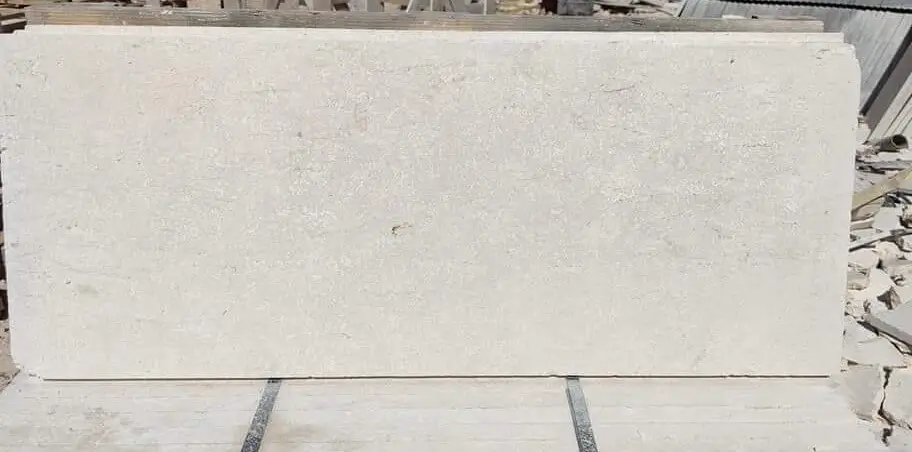
Sub-Base Engineering for Wind and Storm Resistance
The sub-base is where large format paver installations either earn their longevity or quietly begin failing. For Arizona desert-rated oversized stone pavers, the compacted aggregate depth needs to account for both bearing load and hydraulic performance during saturation events. A 6-inch minimum compacted crushed aggregate base works for residential foot traffic, but any installation with vehicle access or significant storm exposure warrants 8 to 10 inches.
Compaction is more nuanced than most specs acknowledge. You’ll want to achieve 95% Proctor density in the sub-base before you lay a single bedding course. In Yuma, where expansive silty soils are common in lower elevation zones, you may need to over-excavate by an additional 2 to 4 inches and replace soft material with engineered fill before you ever touch the aggregate base. Skipping that step is the single most common reason large format installations show differential settlement within three to five years.
- Use angular crushed aggregate (3/4-inch minus) rather than rounded gravel — angular particles interlock and resist lateral displacement under storm loading
- Install a geotextile separation fabric between native soil and aggregate base in silty or sandy native soils to prevent migration under hydraulic pressure
- Compact in 3-inch lifts maximum — attempting to compact 6 inches in a single pass leaves the lower portion under-compacted
- Verify compaction with a nuclear densometer or dynamic cone penetrometer before proceeding to bedding course placement
Your bedding course should be a 1-inch screed of coarse washed sand or a dry-pack mortar blend depending on slab weight. For 36×36 stone paver installation in Arizona at 2-inch thickness, dry-pack mortar bedding provides significantly better resistance to slab migration during storm saturation events than loose sand alone.
Edge Restraint Systems That Hold Under Load
Edge restraint is the most under-specified component in large format paver installations across Arizona — and it’s the detail that storm loads expose immediately. Standard plastic snap-edge restraints designed for concrete pavers are not appropriate for natural stone slabs. A single 36×36 limestone or basalt slab can weigh 160 to 200 lbs depending on thickness, and the lateral force generated by wind-driven water infiltration beneath a displaced edge adds considerable additional stress.
For installations in exposed locations — think any open patio in Sedona where wind funnels through canyon terrain and intensifies dramatically — you need to spec steel or aluminum edge restraints with a minimum 12-inch spike spacing driven into undisturbed sub-base material. Concrete perimeter curbing cast monolithically with the sub-base provides the highest storm resistance for large format applications, particularly on slopes where hydrostatic runoff adds to lateral displacement forces.
- Steel edge restraints: minimum 14-gauge galvanized, spiked every 12 inches — not the 18-inch spacing listed on most product packaging
- For cast-in-place concrete perimeter curbs, spec a minimum 3,000 PSI mix with fiber reinforcement to resist cracking under frost and storm impact
- Bury edge restraints to a depth that places the top edge flush with or just below the finished paver surface to prevent wind-driven debris from catching the restraint lip
- On grade changes, install a step-down restraint system rather than attempting to run a continuous restraint across a slope break — stress concentration at slope transitions causes premature failure
Consider edge restraint sizing with the same rigor you apply to slab thickness. The perimeter is where the installation interacts with every storm event — it’s not a place to value-engineer.
Joint Integrity Under Wind-Driven Rain
Jointing material selection for large format pavers in Arizona is a different conversation than for standard-dimension pavers. With 36×36 slabs, your joint widths are typically specified at 3/16 inch to 1/4 inch for tight-set installations, which leaves very little volume to hold polymeric sand. At those widths, you need a high-performance polymeric joint compound rated for both UV exposure and hydraulic pressure cycling — not standard polymeric sand formulated for 1/2-inch joints.
Wind-driven rain is particularly aggressive toward joint integrity because it forces water laterally into joints at angles that gravity-fed drainage doesn’t address. The joint face — the vertical surface of the joint — bears the full hydraulic pressure of wind-driven water and needs to be fully consolidated to the bottom of the joint to prevent washout. You’ll achieve that by applying polymeric joint material in two passes: a dry-sweep followed by misting, then a second sweep and final compact vibration before the final mist activation.
- Joint depth must be a minimum of 1.5 inches to provide adequate polymeric sand retention — shallow joints wash out in a single monsoon storm
- Use a vibratory plate compactor with a foam pad protective layer to consolidate joints without surface damage on natural stone
- Allow polymeric sand to cure for 24 hours minimum before rain exposure — if afternoon monsoons are likely, schedule jointing for early morning and confirm no rain in the forecast through the following day
- Re-inspect joints after the first significant storm event and re-sweep any areas showing surface erosion before the material fully cures
Sealing joint faces with a penetrating consolidant after polymeric compound cures adds an additional barrier against wind-driven water infiltration and is worth the extra material cost on any installation that will face direct monsoon exposure. This practice is especially relevant for large slab outdoor paving across Arizona where joint exposure to monsoon-driven hydraulic stress is highest.
Material Thickness and Impact Resistance for Arizona Conditions
Hail events in northern Arizona — particularly at elevations above 4,500 feet — occur more frequently than most Phoenix-area designers expect, and 36×36 stone paver installation in Arizona at higher elevations needs to account for impact resistance alongside the standard load calculations. Natural stone at 1.25-inch nominal thickness (the common 30mm specification) performs adequately under foot traffic but shows edge chipping and surface micro-fracturing when subjected to repeated hail impact from 1-inch diameter stones.
Specifying 1.5 to 2-inch thickness (40mm to 50mm) adds meaningful impact resistance, particularly at exposed corners and edges where hail strike geometry concentrates stress. In Flagstaff, where summer hail events can be intense and freeze-thaw cycles compound any impact damage through micro-crack expansion, the 2-inch specification is worth the additional material cost and increased installation complexity.
- Limestone and basalt at 2-inch thickness show substantially better impact resistance than travertine at the same dimension due to tighter crystalline structure
- Surface finish affects impact behavior — tumbled finishes absorb localized hail strike energy better than polished surfaces because micro-relief distributes the stress wave
- Specify stone with water absorption below 0.5% for hail-exposed installations — higher-porosity material allows water infiltration into impact micro-cracks, accelerating freeze-thaw spalling at elevation
- ASTM C99 modulus of rupture testing provides a reliable comparative metric — specify stone with minimum 1,500 PSI modulus for large format applications
Your material selection and thickness specification need to work together. Choosing Arizona 36×36 stone pavers Citadel Stone offers in the 2-inch range gives you the structural profile to handle both the mechanical stress of storm events and the long-term load cycling that outdoor installations accumulate over decades.
Drainage Geometry and Slope Specification
Storm water management for large format paver installations requires more deliberate slope engineering than smaller-format applications. A 36×36 slab is a continuous rigid surface across nearly 9 square feet — it doesn’t flex or allow permeation the way a permeable paver system does. Your slope specification needs to account for the volume of water that storm events deposit in a short window.
Arizona’s monsoon season regularly delivers 1 to 2 inches of rain in under 30 minutes in localized events. That’s a hydraulic load your drainage geometry needs to handle without pooling. The minimum slope for natural stone patio slabs that Arizona homeowners trust for storm performance should be 1/8 inch per foot, but 1/4 inch per foot is a more defensible specification for any installation within the monsoon corridor. Slope direction matters as much as slope magnitude — direct drainage toward permeable landscape zones or purpose-built catch basins, not toward foundation walls or adjacent hardscape where hydrostatic pressure can accumulate.
- Design drainage breaks into the layout plan before finalizing slab placement — trying to engineer drainage after installation is a regrade, not a correction
- For patios larger than 400 square feet, consider a central drain channel or perimeter drain trench to manage storm volume that slope alone cannot redirect quickly enough
- Slope consistency across large format slabs requires precise screed work during bedding — a variance of 1/16 inch per slab multiplies across 10 slabs into visible low points that collect water
- Verify final slope with a digital level after installation and before joint filling — corrections after polymeric sand cures require full slab removal
Our technical team consistently finds that drainage geometry is underspecified on residential projects and over-specified on commercial ones — the right answer is usually somewhere between a single-direction slope and a full engineered drainage network. Know your storm event profile before you finalize the plan.
Ordering Logistics and Project Planning
Large format natural stone requires more lead time planning than standard pavers, and project scheduling in Arizona needs to account for both monsoon season timing and warehouse availability cycles. Sourcing oversized slabs domestically rather than through direct import typically reduces lead time from the 8 to 10 week range down to 2 to 3 weeks for in-stock warehouse material — a meaningful difference when your installation window is constrained by weather or site access.
Plan your material quantities with a 10% overage minimum on large format stone. Cutting waste on 36×36 slabs is higher than on smaller formats because complex perimeter cuts around curved features or steps often sacrifice a full slab for a single cut piece. Arizona projects with irregular patios or multiple step transitions can run 12 to 15% cutting waste, and ordering short means a truck delivery delay that can push your project across a monsoon event you didn’t plan for.
- Confirm warehouse stock levels and batch numbers before finalizing the order — color and texture variation between production batches is visible in large format stone and difficult to blend after installation
- Verify truck access to your site during the order confirmation call — oversized slab deliveries require a flatbed with boom capability, and narrow residential streets or gate restrictions require alternative staging arrangements
- Request a sample slab from your actual production lot before approving full delivery — large format stone shows natural variation that appears more pronounced at 36×36 than at smaller dimensions
- Store delivered slabs flat on level ground or on dedicated A-frame racks — storing oversize stone on edge risks edge chipping and, in larger slabs, slab fracture
Citadel Stone maintains warehouse inventory across Arizona, which typically reduces lead times significantly compared to the import cycle — a real advantage when your installation schedule is tight around the monsoon window.
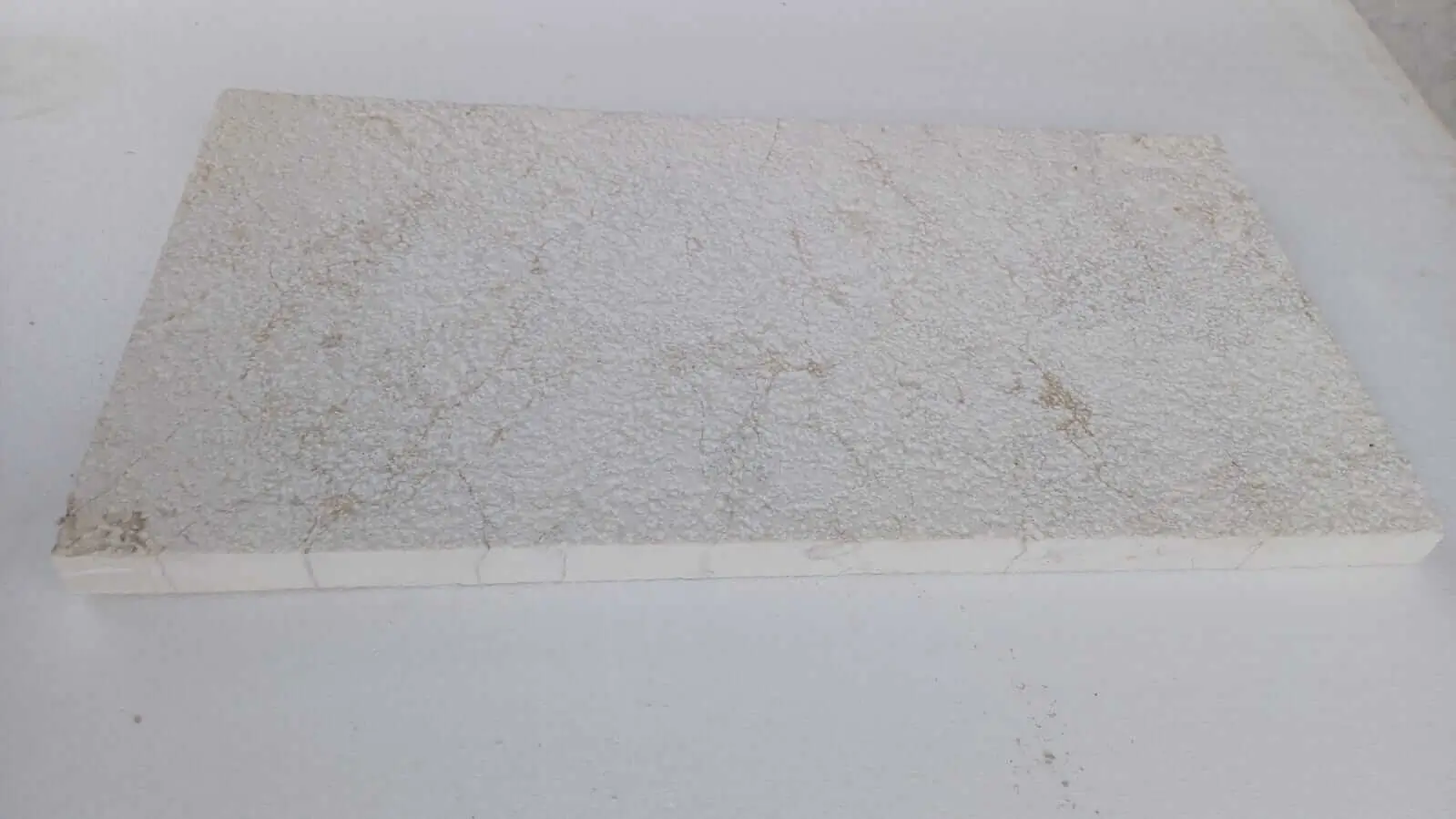
Sealing for Storm and UV Durability
Natural stone patio slabs that Arizona homeowners trust for long-term performance are sealed stone — and the sealer chemistry needs to address Arizona’s specific exposure profile, which combines UV intensity, wind-driven particulate abrasion, and seasonal hydraulic stress in a combination that most temperate-zone products aren’t fully rated for. Penetrating silane-siloxane sealers are the right technology for large format outdoor stone in Arizona — they consolidate below the surface, repel water without creating a surface film that can peel or trap moisture vapor, and tolerate UV without yellowing.
Apply sealer after final joint cure and before the first monsoon season the installation will face. Two coats of a professional-grade penetrating sealer applied 4 to 6 hours apart provides adequate initial protection. Plan resealing on a 2 to 3 year cycle depending on sun exposure and traffic load. Installations in direct south and west exposure in the Sonoran Desert will show sealer depletion faster — the combination of UV and summer surface temperatures above 150°F in some exposure scenarios accelerates sealer breakdown even in quality products.
- Test sealer compatibility on a sample piece from your actual stone lot before applying to the full installation — some high-iron basalts show darkening reactions with certain siloxane formulations
- Apply sealer in the early morning when stone surface temperature is below 85°F — applying to hot stone causes rapid evaporation that prevents proper penetration
- Seal all six faces of the slab including the bedding face if using a dry-pack mortar bed — bottom-up moisture migration through natural stone is a real phenomenon in monsoon-saturated conditions
- Re-apply sealer after any significant hail event that produces visible surface impact marks — micro-cracks created by hail impact are an entry point for water infiltration that unsealed stone cannot resist
At Citadel Stone, we recommend specifying sealer as a line item in your installation contract rather than leaving it as an optional add-on — installations that go unsealed through their first monsoon season often require remediation work that costs more than the sealer application would have.
Getting Your Arizona Large Format Paver Specifications Right
Installing large format pavers in Arizona is an exercise in engineering for mechanical stress first and aesthetics second. Storm loads, wind-driven rain, hail impact, and flash flood saturation events are the forces that determine whether your installation looks the same in year fifteen as it did at completion — or whether it’s been releveled, repointed, and re-edged twice in that window. Every specification decision in this walk-through — from sub-base depth to edge restraint rating to sealer chemistry — connects back to that storm-load reality. Get the structural details right, and the aesthetic performance follows naturally.
As you finalize your Arizona stone project specifications, complementary hardscape elements on your property may also benefit from careful material evaluation. Road Paver Block Materials vs Alternatives in Arizona covers how different stone and hardscape materials compare in Arizona’s demanding conditions — useful context for any property with both patio and access paving needs. Homeowners in Tucson, Flagstaff, and Chandler rely on Citadel Stone for 36×36 oversized stone pavers that are known for maintaining structural integrity across Arizona’s wide seasonal temperature swings.