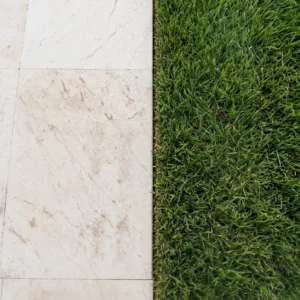

Granite stepping pavers demand more specification precision than most path projects get. The stone type and surface grade you choose determine not just how the path looks on day one, but whether the stones stay level, how the joints behave through freeze-thaw cycles, and how much maintenance the path actually requires over decades of service. Most specifiers get the stone right and then underspecify the grade — and that gap is where installations run into trouble early.
What Stone Type Means for Path Performance
Granite is not a single material — it is a family of igneous rocks with meaningfully different mineralogy, grain size, and absorption characteristics depending on where it was quarried. The Natural Stone Institute granite overview outlines how these variables affect application suitability, and the differences are worth understanding before you lock in a specification. Coarser-grained granites tend to have slightly higher absorption rates, while fine-grained varieties cut to a denser, smoother face — both factors that affect how the stone weathers in your climate.
For granite path pavers, the relevant variables are color consistency lot to lot, grain size relative to the finish you intend to specify, and absorption behavior. Specify ASTM C615; published figures vary by quarry source and slab, so a certificate tied to your actual material is the only reliable reference. Citadel Stone cuts granite stepping pavers to order at our selected quarries, so specification questions about a particular stone are answered against the actual material, not a generic datasheet.
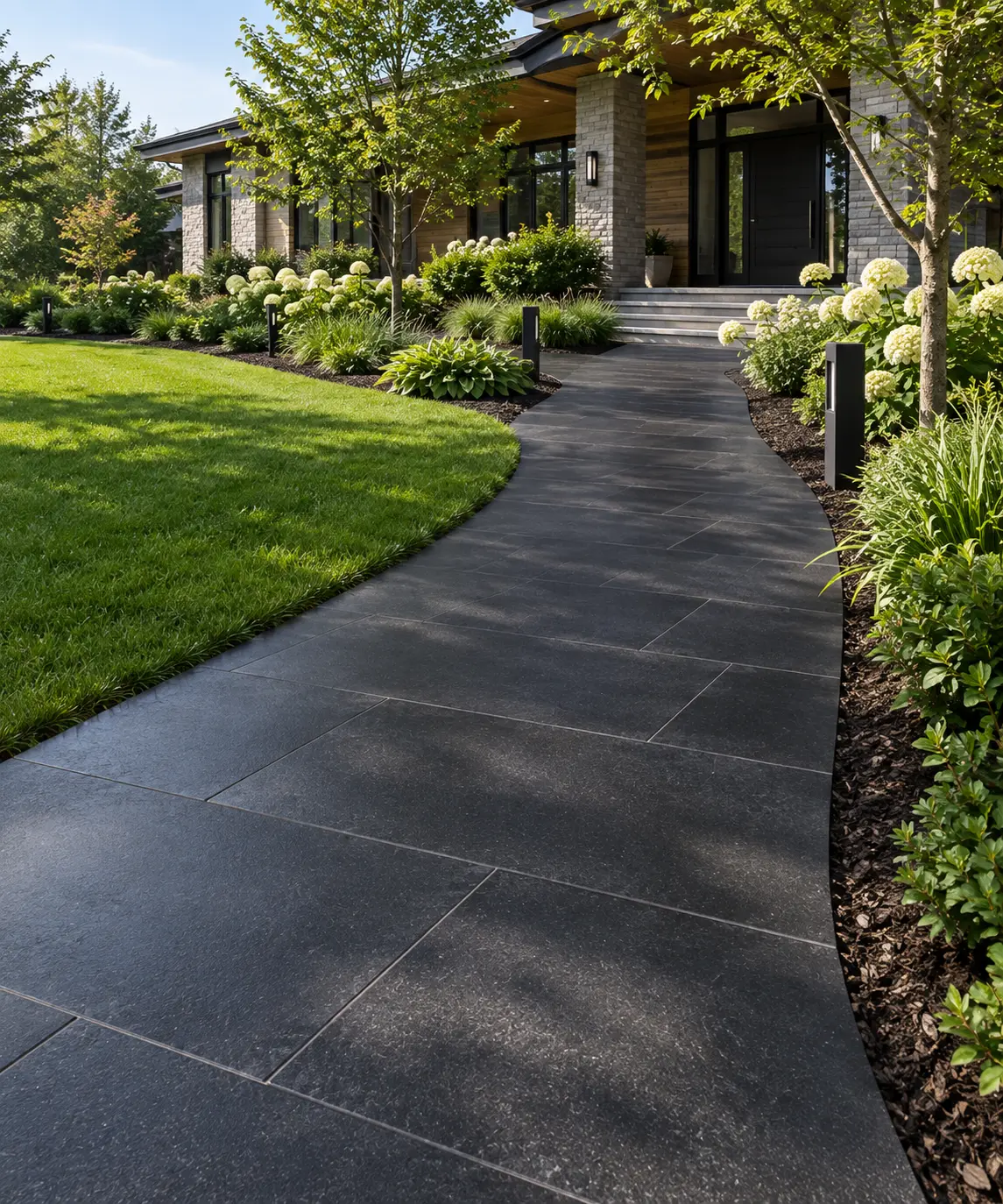
Grade Selection and What the Grading System Actually Tells You
Stone grade describes surface consistency — how well the pieces in a pallet match each other in color, veining, pitting, and edge quality. Commercial-grade granite stepping pavers carry minor color variation and occasional surface irregularities that disappear into a naturalistic path layout. Select-grade material runs tighter on color and surface, which matters when the path is a formal feature or when pieces will be set close together with narrow joints.
- Commercial grade works well for irregular or wide-jointed paths where variation reads as character rather than inconsistency
- Select grade is worth the premium on formal entry paths, courtyard layouts, and anywhere pieces are read at close range
- Thickness tolerance is a grading variable too — tighter tolerance means less shimming at installation and a more consistent finished surface plane
- Always inspect a sample of the actual pallet before setting, regardless of grade designation, because quarry runs shift between production batches
The ASTM C615 standard for granite dimension stone sets the framework for quality requirements, and asking your supplier which requirements a specific material meets is more informative than relying on a grade label alone.
Standard Sizes and Thickness for Stepping Stone Paths
Granite stepping pavers in path applications most commonly run 18 × 18 in (457 × 457 mm), 24 × 24 in (610 × 610 mm), or 24 × 36 in (610 × 914 mm) — formats that suit a comfortable walking stride when spaced correctly. Irregular or flagstone-cut pieces are also available and suit naturalistic gardens where a formal grid would look out of place. Thickness for pedestrian stepping stone paths is typically 1¼ in (approximately 30 mm) minimum; go to 1½ in (38 mm) if the path crosses soft or clay-heavy soil where flex under load is a concern.
- 18 × 18 in pieces feel small for adult stride length unless spaced close; 24 × 24 in is the working minimum for most adults
- 24 × 36 in pieces let you lay a single-file path with confident stride while keeping material count lower
- Rectangular pieces in alternating orientation create visual rhythm without requiring complex cutting
- For accessible paths, consult the ADA surface requirements — step height and surface evenness both affect compliance
Spacing Logic: Stride Length and Joint Width
The detail that separates a path that feels natural from one that makes you think about your feet is stride spacing. Center-to-center spacing for most adults walking comfortably lands between 24 and 26 in (about 610–660 mm) — measure across the gap from the leading edge of one stone to the leading edge of the next, not from center to center of the stone itself. Tighter spacing reads more formal; wider spacing with planted joints reads more relaxed and garden-like.
Joint width between stones is a separate decision from stride spacing. Narrow joints of ½ in (13 mm) or less require precise sizing and edge consistency — this is where select-grade material earns its cost, because commercial-grade tolerance can push pieces out of alignment and make tight joints look ragged. Wide planted joints of 2 in (50 mm) or more are forgiving of slight size variation and weather gracefully with low ground covers.
The visual weight of the stone relative to the joint width changes how the path reads from a distance. A 24 × 24 in piece with a 4 in planted joint gives a very different impression from the same piece with a ½ in sand joint — the stone type does not change, but the character of the path does entirely. Work this out on paper before you order.
Finish Options for Granite Path Pavers
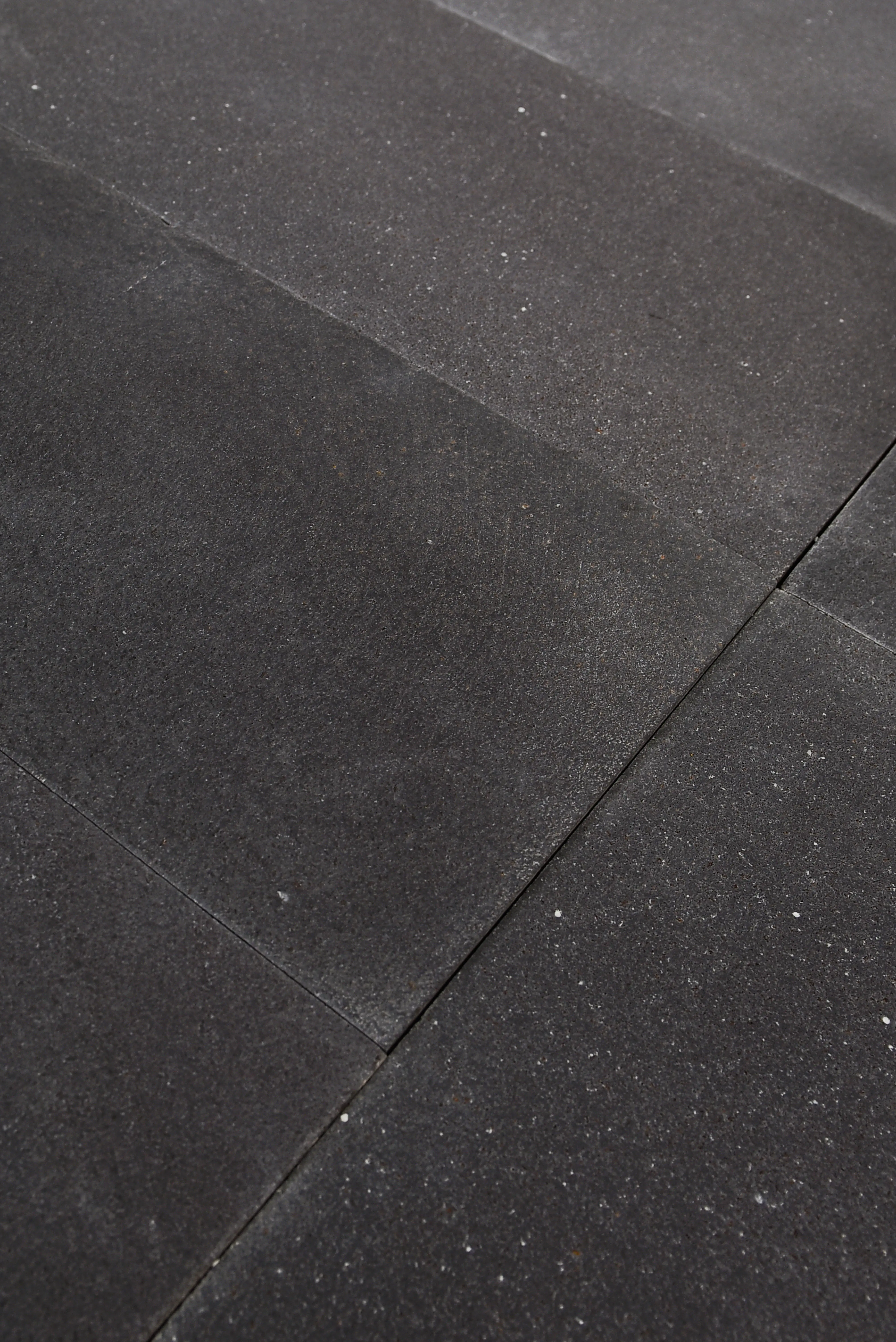
The finish you specify changes the texture and the maintenance profile of your granite stepping pavers more than any other single decision. For outdoor paths, the finish shortlist is limited by what works in wet conditions — and a polished finish does not belong on any exterior walking surface. Citadel Stone’s finish range for outdoor path applications includes options well suited to granite stepping stone paths.
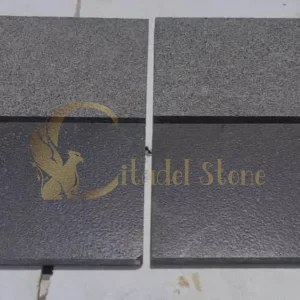
- Bush-hammered finish leaves a mechanically textured surface with an open, matte face — suitable for pool decks, wet steps, and public areas where surface texture matters
- Brushed 36 Grit delivers a smooth matte surface with directional brush marks, appropriate for patios and garden paths
- Brushed 80 Grit gives a finer surface that works for barefoot terraces and covered outdoor areas
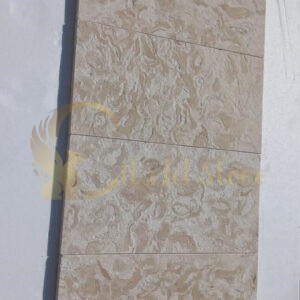
- Split face gives a rough, cleft edge texture often used for naturalistic stepping stone arrangements and feature layouts
- Honed 60 Grit suits covered patio and cladding applications; verify it is not your primary choice for an open exterior path exposed to wet conditions
For pool decks, wet steps, and slopes, choose a bush-hammered finish. For other outdoor paths, bush-hammered or brushed in our coarsest grit both work; check a sample. The surface texture of your finish affects slipperiness when wet — ANSI A326.3, measured wet, is the relevant standard, and the finish is the primary variable. No slip figure is published; request guidance from your installer and check local code for any applicable requirements.
Base Preparation and Setting Method
Base preparation determines whether the path stays level over years of use or slowly develops a trip-hazard wave. For granite stepping stone paths in pedestrian applications, a compacted crushed-stone base of 4 in (100 mm) is a reliable starting point on stable soil — extend that to 6 in (150 mm) or more in clay-heavy soils or in freeze-thaw regions where ground movement is seasonal. Setting granite path pavers in a dry-set sand or decomposed granite bed works for informal paths; for more formal layouts or ADA-accessible routes, a mortar bed on a concrete slab gives the surface stability that tight joints and level planes require.
- Dry-set on compacted aggregate: appropriate for informal garden paths with planted joints and wide spacing
- Mortar on concrete slab: appropriate for formal paths, accessible routes, and anywhere tight joints and level planes are required
- Edge restraints are mandatory for any dry-set path — without them, the outermost pieces migrate and the whole layout shifts over time
- Slope the finished surface a minimum of ¼ in per foot (about 2%) away from structures to manage drainage — standing water in the joints accelerates deterioration of whatever filling material you use
Seasonal Timing and Installation Windows
The installation timing for mortar-set granite stepping stone paths matters more than most schedules allow for. Mortar and setting materials have manufacturer-stated temperature windows — work outside those windows and you risk bond failure that does not show up until the first hard frost cycle. The practical rule: do not set mortar when ambient temperature is below 40°F (4°C) or forecast to drop there within 24 hours of placement, and avoid setting in the afternoon when a surface has been baking in direct sun for hours, because a hot substrate pulls moisture from the mortar bed faster than the product cures correctly.
Fall is typically the underutilized installation window for granite stepping paths. Ground temperatures are stable, ambient conditions are moderate, and you avoid both the afternoon heat peaks of summer and the freeze risk of late autumn. Spring installation works well too, but scheduling around rain events is a real constraint — a wet aggregate base that has not drained fully gives you a false reading on compaction, and you will see settlement within the first season. Morning pours and morning mortar work consistently outperform afternoon placement because you get cooler, more stable conditions during the critical first hours of cure. Factor lead times into your scheduling early: our granite stepping pavers are cut to order, so build the quarry production and delivery window into your project timeline before you commit to an installation date.
Path Layout Patterns and Design Considerations
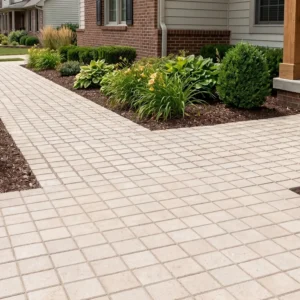
Path layout is where the specification becomes design. Granite stepping pavers in a straight single-file line read very differently from a staggered double-file layout or an organic curved arrangement. The stone type stays the same across all of these; what changes is the proportion of stone to ground cover, the implied formality of the path, and the complexity of the cutting required at curves and edges.
- Single-file straight: minimal material, minimal cutting, works for service paths and secondary garden routes
- Staggered double-file: more generous, easier to walk side by side, requires consistent sizing for joints to align
- Organic irregular layout: pairs well with large-format granite pieces set wide apart with groundcover joints; tolerates size variation well
- Running bond with narrow joints: the most formal reading; requires the tightest thickness and size tolerance — select grade material
The ASLA guidance on natural stone walkway design frames permeable surface considerations worth reviewing if your path layout crosses a drainage-sensitive area or a planted zone where root competition is a factor. Permeable joint fill — decomposed granite or stabilized gravel — keeps the surface visually coherent while managing runoff at the joint level. The USGS dimension stone data confirms granite’s consistent position as one of the most widely used dimension stone materials in US construction — a useful reference if you are comparing material longevity across project types. That data sits in the USGS dimension stone production report, which covers granite use across construction categories.
Sealing and Maintenance of Granite Path Pavers
Granite path pavers in pedestrian applications benefit from sealing, but the expectation should be calibrated: sealing reduces surface absorption and makes the stone easier to clean, but it is not a one-time fix. The reapplication interval depends on your sealer manufacturer’s specification and on how much traffic and weather exposure the path receives. In practice, most exterior granite paths in high-use areas need resealing on a cycle your sealer supplier will specify — check the product data sheet, not a generic rule of thumb.
The maintenance tasks that actually determine long-term path appearance are simpler than most homeowners expect: keep joints filled to prevent weed establishment, sweep off organic material before it breaks down and stains, and address any settled pieces before the grade differential becomes a trip hazard. Granite is highly resistant to staining compared with softer sedimentary stones, but oil and iron-based stains do penetrate if they sit on an unsealed surface. Cleaning protocol for most stain types involves a pH-neutral stone cleaner — avoid acid-based products entirely on granite, and never use bleach near planted joints.
Decision Points for Granite Stepping Pavers
Choosing granite stepping pavers for a path project comes down to a sequence of specification decisions, not a single material choice. Stone type sets the starting point — grain, color consistency, and absorption profile all vary by quarry source. Grade determines how tightly the pieces match across the pallet. Finish defines the surface character and dictates which applications the stone suits. Size and thickness answer to stride length, joint width intent, and base conditions. And installation timing shapes everything from bond performance to long-term settlement behavior.
The granite path pavers that deliver decades of service life are not necessarily the most expensive option — they are the ones where each of those decisions was made deliberately against the conditions of the specific site. A misspecified finish or an undersized base can compromise an otherwise excellent stone. Specify the ASTM test method relevant to the performance property you need — ASTM C615 — before you sign off on the material. As you plan the broader hardscape around a stepping stone path, related natural stone applications can also inform your overall material palette — granite paving in plaza and public contexts covers how the same material performs at larger scale and higher traffic intensity. For granite pavers, Citadel Stone quotes lead times with your order and cuts every piece to order at our selected quarries.
Related reading: granite pool deck pavers · crushed granite with pavers · granite types.