

What Separates Good Granite Headstone Suppliers from the Rest
Granite headstone suppliers vary far more than most memorial workshops and monument dealers expect — and the gap shows up not at the point of sale, but two or three years into the field when lettering begins to pit, or a polished surface loses its depth. The material grade you receive depends on decisions made long before the stone reaches your workshop: quarry selection, slab thickness tolerances, and the grain density checks that happen at the warehouse before anything ships. You need to know what questions to ask, what documentation to request, and which material characteristics genuinely matter for a headstone that holds its integrity for generations.
Most specifiers focus on color matching and price per unit — those matter, but they’re secondary to structural grain density and absorption rate, which directly determine how cleanly lettering holds over decades of outdoor exposure. A supplier who can document those characteristics with lab data is one worth building a long-term relationship with.
Granite Grade: What the Specs Actually Mean
According to ASTM C615 granite dimension stone standards, dimension granite must meet minimum flexural strength of 1,500 psi and a maximum water absorption of 0.40% by weight. Those numbers sound dry until you’re handling a slab that’s been exposed to freeze-thaw cycling for several winters — at that point, the difference between a 0.18% absorption rate and a 0.39% rate becomes visible as surface flaking along the carved edges of letters.
Granite for memorial applications should sit well below that 0.40% absorption ceiling. You’ll want to request the actual test values from your supplier, not just confirmation that the material “meets ASTM.” The tighter the grain structure, the more resistant the surface is to moisture ingress, and the cleaner the lettering stays over the long term.
- Request ASTM C615 test certificates, not just supplier confirmation of compliance
- Target water absorption below 0.25% for outdoor memorial applications
- Flexural strength above 1,800 psi provides meaningful reserve capacity for thick slab applications
- Compressive strength should exceed 19,000 psi for base and die stones subject to ground-level loading
- Ask whether test samples came from the same quarry batch as your order — not from a different production run
Evaluating Quarry Source and Consistency
The quarry origin matters more than most buyers realize. Granite is not a uniform material — even within a single named color like “Absolute Black” or “Imperial Red,” slab characteristics vary between quarry sectors, cutting depths, and seasonal production runs. Granite tombstone suppliers who source from a single consistent quarry relationship can offer something genuinely valuable: batch traceability that lets you match supplemental stones to an existing installation years later.
The Natural Stone Institute provides quarry documentation guidance that serious suppliers should be familiar with. According to NSI granite durability and application data, granite’s interlocking crystalline structure — composed primarily of quartz, feldspar, and mica — is what gives it superior hardness compared to most sedimentary alternatives. That crystal structure, however, is quarry-specific in its density distribution, which is why color and finish consistency between orders depends heavily on your supplier’s sourcing discipline.
- Ask whether the supplier maintains an ongoing relationship with specific quarry producers, or sources opportunistically from the spot market
- Request slab samples from the actual current warehouse stock before committing to a large order
- Confirm whether color matching for supplemental monuments is possible within a six-to-twelve month window
- Understand the supplier’s lead time when warehouse stock of a specific color runs low — some colors require 8–12 weeks to replenish from origin quarries
Granite Thickness Tolerances and Die Sizing
Thickness tolerance is where a lot of grief enters the fabrication process. A nominal 4-inch die stone that arrives at 3.75 inches on one edge and 4.25 on the other creates real problems for base-to-die fit, especially when the base was pre-cut to tight dimensions. You need suppliers who hold ±1/8-inch tolerance on all faces — and who can document that tolerance as a standard, not an aspiration.
For granite headstone suppliers handling die stones in the 8- to 12-inch thickness range, the slab-cutting process introduces more variability than thinner formats. Larger blades flex slightly during the cut, and that flex is most pronounced in harder granite varieties with high quartz content. The practical result is that you should always spec a verification measurement on arrival for dies over 6 inches thick — don’t assume the packing sheet dimensions match what’s in the crate.
- Standard tolerance for memorial granite should be ±1/8 inch on all faces and dimensions
- Verify thickness at four corners and center on every die stone before committing it to lettering
- Polished face dimensions are the reference — allow for slight undersize on sawn back faces
- For base stones, confirm flatness tolerance — more than 1/16-inch bow across a 48-inch base creates setting complications
Surface Finish Options and Their Performance Differences
Your choice of surface finish affects long-term appearance more than any other single variable. A high-polish finish on dense black granite will hold its reflective depth for decades under normal conditions, but the same finish on a coarser-grained gray granite may show micro-scratching from airborne particulate within five to eight years. The finish isn’t just aesthetic — it’s a direct function of the stone’s grain density and the supplier’s polishing process.
Thermal finish (also called flamed finish) is worth understanding for base stones and marker-style applications. The flame process opens the surface texture and provides natural grip, which matters in regions where winter ice accumulation creates slip hazards around memorial installations. The trade-off is that thermal finishing slightly reduces surface hardness at the outermost layer, so thermal-finished stones in freeze-thaw regions benefit from a penetrating sealer applied every three to five years.
- High polish: maximum depth and reflectivity, requires dense grain below 0.20% absorption for long-term performance
- Honed finish: matte, low-glare surface — more forgiving of moderate grain variations but shows etching more readily
- Thermal/flamed finish: excellent grip, open texture — appropriate for base stones and flat markers in wet or icy conditions
- Sand-blasted finish: creates texture for design panels and non-polished faces — surface is more porous and benefits from sealing
How Storm and Weather Exposure Affects Memorial Granite
Memorial granite operates in an uncontrolled outdoor environment, and that means wind loads, hail impact, and wind-driven rain are real performance factors — not hypothetical ones. A headstone that stands three feet above grade on a narrow base presents a meaningful wind profile, and in high-wind regions, the base-to-die connection is the structural weak point that most installers underestimate.
Wind-driven rain is the more insidious threat. Water that enters a mortar joint under pressure — at storm wind speeds, rainfall penetrates joint interfaces far more effectively than still-water soaking — can create freeze-thaw micro-fractures at the mortar-to-stone interface over multiple seasons. This is why the granite’s absorption rate matters structurally, not just cosmetically. A stone absorbing less than 0.20% moisture resists that infiltration at the surface level, giving your mortar joint more time to perform before water reaches the interface.
- Specify a two-part epoxy setting system for die-to-base connections in high-wind areas rather than standard marble cement
- Granite compressive strength above 19,000 psi provides meaningful hail impact resistance on polished face panels
- Joint depth between die and base should be a minimum 3/8 inch to allow adequate bond surface area
- For tall monuments in exposed locations, consider anchor pin systems through the base stone as supplemental wind restraint
- Inspect mortar joint integrity every five years in freeze-thaw regions — wind-driven moisture accelerates joint degradation faster than still-water exposure alone
Ordering Logistics, Lead Times, and Warehouse Stock
One of the most practical questions you can ask granite headstone suppliers is whether they maintain domestic warehouse inventory or whether they’re importing to order. The answer has a direct impact on your project timeline. Suppliers who hold warehouse stock of standard colors and sizes can typically turn an order in two to three weeks. Import-to-order suppliers — even reliable ones — routinely run six to ten weeks from order to delivery, and that timeline is vulnerable to port delays, freight allocation problems, and quarry production schedules outside anyone’s control.
At Citadel Stone, we maintain standing warehouse inventory of core granite memorial colors and standard die sizes, which compresses lead times significantly for workshops running consistent production schedules. Confirm your supplier’s truck delivery format as well — whether they deliver on flatbeds with lift-gate service, or whether you need your own equipment to unload. For crated die stones in the 200–400 lb range, that logistical detail affects your receiving setup more than most buyers think through in advance.
Browse our Citadel Stone monument stock to review current inventory options and lead time estimates.
Reading a Granite Supplier Quote Correctly
A quote from granite tombstone suppliers can look similar on paper while hiding substantial differences in what you’ll actually receive. Price per square foot or price per linear inch of die is a useful starting point, but it tells you nothing about thickness consistency, finish quality standards, or what happens when a slab arrives damaged. Understanding the supplier’s replacement policy and damage claim process before you place a first order — not after a cracked die arrives on your shop floor — is non-negotiable.
According to USGS dimension stone production and use data, dimension granite accounts for a significant share of domestic stone production — which means there’s a wide range of supplier quality operating in the market at any given time. The price spread between the bottom and top of that range often reflects real differences in quarry selectivity, slab grading, and quality control at the warehouse level, rather than simple margin variation.
- Confirm whether quoted price includes freight to your facility or is priced ex-warehouse
- Ask for the supplier’s written policy on damaged-in-transit stone — who files the freight claim, and what is the replacement timeline
- Clarify whether color matching between separate orders carries any guarantee, and what the tolerance standard is
- Understand minimum order quantities for non-stock colors — some suppliers require full-slab minimums that may not align with your production volume
- Request a sample slab from current warehouse stock for any new color before committing to a production order
Lettering and Carving Compatibility by Granite Type
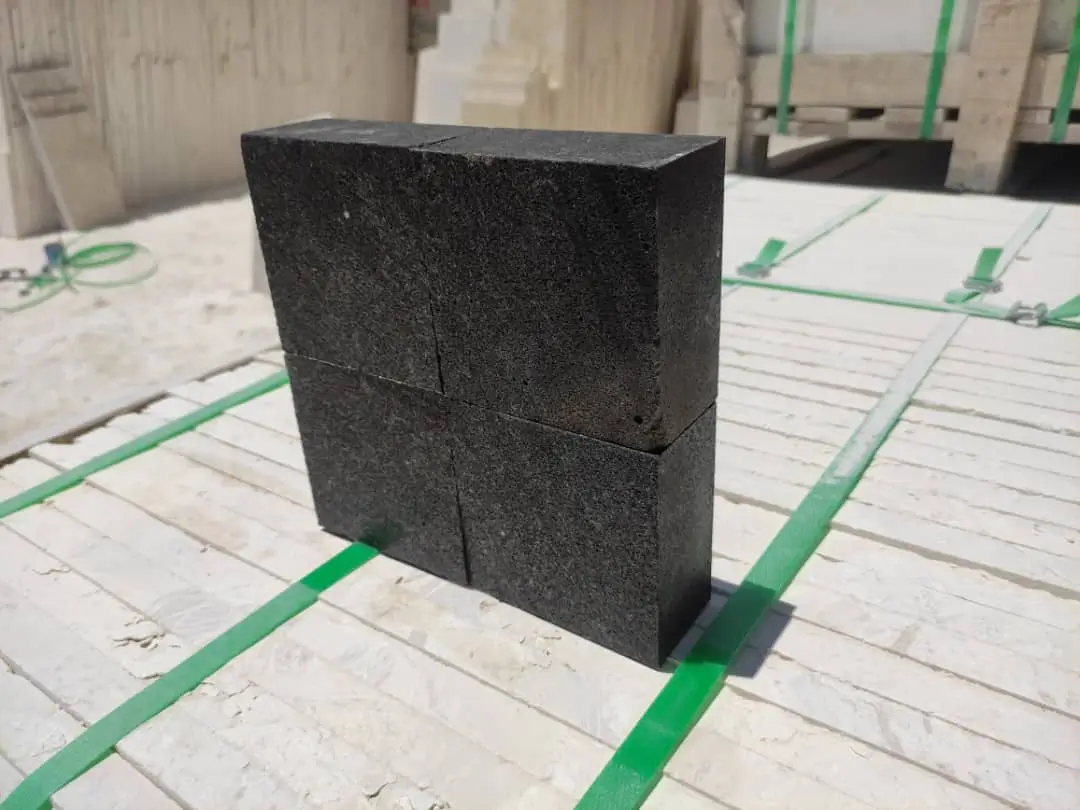
Not every granite carves equally well, and the difference between a clean sand-blast letter and a fuzzy, ragged edge comes down to grain structure more than operator skill. Fine-grained granites — Absolute Black, Galaxy Black, and most of the Indian black varieties — produce the cleanest letter edges because their crystals are small and densely packed. The sand-blast process cuts consistently across those tight crystals. Coarser-grained granites like some domestic grays or the larger-crystal red varieties can produce micro-chipping along letter edges that requires additional hand dressing to clean up.
Laser etching compatibility follows a similar pattern: fine-grained, high-polish granites produce the sharpest contrast between etched and unetched surfaces. If your shop is growing its laser portrait work, specifying granite with grain size below 2mm and a sustained polish hardness above 6 on the Mohs scale will give you the most consistent results across production runs. Granite tombstone suppliers who can confirm grain size data from their current warehouse stock give you a meaningful advantage in predicting carving outcomes before material arrives.
- Fine-grained black granites (grain below 1.5mm): best performance for sand-blast lettering and laser portrait etching
- Medium-grained gray granites (grain 2–4mm): adequate for standard lettering, may require edge dressing on intricate designs
- Coarse-grained red and multicolor granites (grain above 4mm): suitable for raised letter formats and relief carving, less ideal for fine-line laser work
- Always test carving on a sample from the current warehouse batch — grain can vary between production runs of the same named color
What Matters Most When Choosing Granite Headstone Suppliers
Choosing granite headstone suppliers comes down to a combination of material documentation, sourcing transparency, and logistical reliability — and the weight you give each factor depends on the volume and consistency demands of your workshop. For small-batch custom work, color matching and carving compatibility may dominate. For high-volume production, lead time predictability and truck delivery reliability become equally important. The suppliers worth staying with long-term are those who treat these as interconnected — who understand that a polished face finish is only as good as the grain density behind it, and that a quoted lead time only has value if the warehouse stock to back it up actually exists.
As you think through your stone sourcing decisions, related material investments across your operation can also benefit from clear cost benchmarks. Understanding what drives granite slab pricing helps you evaluate supplier quotes with more precision and negotiate from an informed position. Granite from Citadel Stone reaches memorial workshops nationwide, chosen for tight grain that holds carved lettering cleanly over decades.
Related reading: granite cobblestone suppliers · granite cut to size suppliers · granite curbing suppliers.