What humidity does to a floor here
Anguilla is dry by regional standards. It gets the least rainfall in the Lesser Antilles, there are no rivers, and February and March can pass with barely a shower. Indoors is a different story. Sea air moves across an island three miles wide at its widest, cooled rooms drop below dew point, and swimmers walk in from the pool all afternoon. The floor is therefore intermittently wet rather than permanently damp, and intermittent is the harder case. A surface that grips when soaked but glazes over when a fine salt dust is dampened will eventually catch someone out. The driest months are usually February and March, so a floor can go weeks looking spotless and then meet rain, sea spray and pool traffic inside a single hour.
The finish is the slip decision
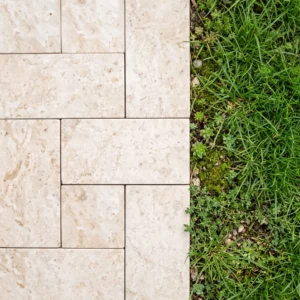
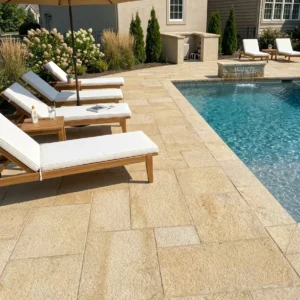
Two tiles cut from the same block can behave very differently underfoot depending on how the face was worked. Polishing closes the surface and raises reflectivity. Honing leaves a smooth matte face. Brushing, sandblasting and bush hammering open a controlled texture that keeps traction when water arrives. On an island where people move between pool, terrace and interior barefoot for most of the day, that single choice outranks tone, format and pattern put together.
- Polished: bright and easy to wipe, but the wrong answer anywhere feet arrive wet.
- Honed: calm and smooth indoors, best kept to dry rooms away from pool doors.
- Brushed: a light, softly aged texture that holds grip without feeling coarse.
- Sandblasted: an even, fine-grained bite that suits thresholds and shower floors.
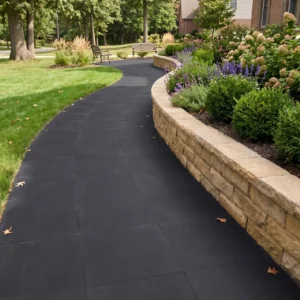
- Bush hammered: deliberately rugged, right for ramps and steps in full weather.
Map the house by how wet it gets
Rather than choosing one finish for the whole villa, walk the plan and mark where water actually lands. Most houses on this island split into three honest zones, and the boundaries usually sit at a door rather than at a room name.
- Always wet: shower floors, pool surrounds, outdoor showers, plunge pool steps.
- Often wet: the first six feet inside every terrace door, and any bar or kitchen run.
- Mostly dry: bedrooms, dressing rooms, studies and interior circulation.
- Deceptively risky: polished thresholds between two of the zones above.
Once those zones are drawn on the plan, the specification more or less writes itself. The wettest areas take the most open texture, the dry rooms take the most comfortable one, and the boundary between them becomes a detail somebody draws rather than a decision the tiler makes on the day.
Salt changes the answer
On a flat island barely three miles across, salt aerosol does not stop politely at the shoreline. It settles as a fine film, and when that film is dampened by a rinse or a squall it can behave like a lubricant on a closed surface. This is the main reason a lightly textured face outperforms a polished one in real Anguillian conditions, even indoors. It also argues for stone with low absorption, so the salt that arrives sits on the surface where cleaning can reach it rather than migrating into the body of the tile. When you compare samples, always look at how a finish grips underfoot after it has been left dusty and then splashed, not just after a clean rinse.
Texture without losing comfort
The usual objection to a textured floor is that it feels harsh barefoot or traps dirt. Both are matters of degree, and both are solvable at specification stage rather than after the floor is down. A brushed face on a dense limestone is closer to fine linen than to sandpaper, and it collects no more dust than a honed floor if the joints are sized sensibly.
- Keep the coarsest textures outside, on steps, ramps and pool copings.
- Use a brushed face indoors where wet feet are likely but comfort still matters.
- Ask for the same finish on any stair treads so the grip does not change mid-flight.
- Match joint width to texture; a rough face with a hairline joint is hard to keep clean.
What to ask for in writing
Finish names are not standardized across the trade, and one supplier’s brushed is another’s antiqued. Put the requirement in measurable terms and attach an approved control sample to the order. Recording limestone tiles specified by finish in writing protects you when the crates open months later, especially on a route where the consignment is handled at two quays before it reaches site. Ask for the finish, the tolerance, the gauged thickness and the edge detail on the same line, and keep one signed tile in the site office to check deliveries against.
Test it the way the house will
Every serious finish decision here ends the same way: with water, salt and bare feet. Lay two or three candidate finishes side by side in the actual room, rinse them, let them dry to a dusty film, then splash them again and walk across. Do it once in the middle of the day and once with only the evening lights on, because glare and grip look different under each. Bring the housekeeper into that test, because whoever cleans the floor daily will tell you in about a minute which surface will be maintained properly and which will be quietly resented. Choose the finish that still feels safe on the worst day, not the prettiest one on a dry morning.