Irma Rewrote the Brief
On 6 September 2017 Hurricane Irma crossed the northern Leeward Islands and left Barbuda with roughly 95 percent of its structures destroyed. The entire population was evacuated to Antigua, and the mandatory order was not lifted for about three weeks. Nobody who builds in Antigua and Barbuda needs that explained, but it is worth stating plainly in a paving article, because hardscape is usually the part of a project that gets detailed last and reviewed least. A terrace is not a decorative afterthought in this country. It is the surface that either stays put or becomes debris.
Zone One: Windward and Salt-Blasted Frontage
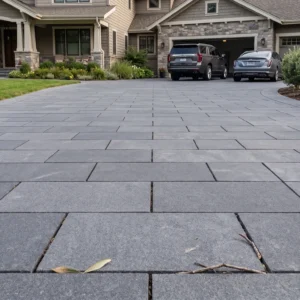
Exposed north and west frontage, marina edges and anything with an open fetch takes continuous salt aerosol on top of the obvious wind and water loading. Detail this zone as a marine environment and the rest of the project becomes easy by comparison.
- Choose dense, low-absorption stone; porous material carries salt into its structure.
- Use non-ferrous or stainless fixings throughout, and never ferrous cramps or ties.
- Bed and bond units fully rather than laying them loose on exposed terraces.
- Anchor edge restraints properly, because an unrestrained edge unzips a whole field.
Freeze-thaw performance is meaningless here. Salt crystallization and corrosion are the real tests, and they run all year.
Zone Two: Sheltered Courtyards and Inland Terraces
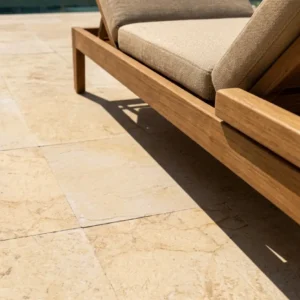
Inland and leeward areas are a genuinely different specification, and treating them as though they sit on an open shoreline wastes money. Salt loading falls, so lighter tones and softer finishes become practical, and larger formats behave well because they are not being worked by constant wind-driven spray. This is where the interior of a villa can carry outside without a jarring change of material. Detailing still has to respect the storm season, but the driver shifts from corrosion toward water management, shading and comfort underfoot in strong sun. The geology of the country gives a useful mental model here: the volcanic south-west and the limestone north-east are two different landscapes, and a courtyard sitting in one of them rarely wants the same palette as a shoreline terrace in the other. Let the setting choose the tone rather than repeating a single specification across the whole site.
Zone Three: Pool Decks and Wet Circulation
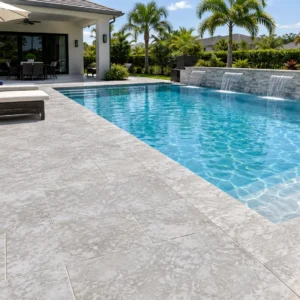
Pool surrounds, outdoor showers and shaded circulation stay wet longer than anything else on a site, and they are walked barefoot. The failure mode is not structural; it is a slip, a stain or a biological film that arrives quietly over one wet season.
- Test the finish wet, with a real sample, before it is signed off.
- Keep coping and step nosings in a texture that stays grippy when soaked.
- Fall water away from the deck rather than letting it pond at joints.
- Design for shade and airflow so surfaces dry between showers.
- Plan how the deck will be washed down without harsh chemicals.
Paving That Has to Feed a Cistern
This is the detail that separates a local specification from an imported one. There are no permanent streams or rivers on either island. Fresh water comes from surface storage, groundwater and domestic catchment, the country is classed at extremely high water stress, and new houses are fitted with rainwater collection and storage. Around 86 percent of households sit on the public supply and the rest rely on cisterns and wells. Hard paving is part of that catchment whether you planned it or not, so storm-ready paving for island decks has to deliver clean water downstream.
- Avoid sealers, coatings and jointing compounds that could taint stored water.
- Never use de-icing type products; they have no place on these islands.
- Route deck runoff deliberately, either to the cistern or clearly away from it.
- Size drainage for short, intense bursts rather than steady rainfall.
What Becomes a Missile
In a major event, loose-laid units are not paving; they are projectiles aimed at the glazing behind them. That single sentence should govern every exposed terrace detail on the drawing, and it is worth saying out loud to a client who wants a dry-laid look on a headland. Bond exposed areas, restrain every free edge, keep planters and loose furniture off the critical elevations, and design so that stripping a deck for storm preparation is never required. The correct surface for this climate is one nobody has to think about when a watch is issued. It is also worth agreeing early who owns storm preparation for the hardscape on a managed property, because a resort with a written routine loses far less than one improvising with a day of warning. Write the routine while the drawings are still open, not during a season.
Permits, Heritage and the Code in Progress
Hardscape is not outside the planning system. The Development Control Authority operates under the Physical Planning Act 2003, amended in 2024, and building without permission is an offense with real consequences. English Harbour and Falmouth Harbour sit within a designated World Heritage area, where paving work carries additional heritage review and cannot be treated as a routine specification. The national building code, legislated in 1996 and based on CUBiC, is being replaced: a draft adapted from the revised OECS code has been out for public comment, and Cabinet has said an updated code goes to Parliament in the first quarter of 2026, with added resilience provisions. Choosing surface finishes for wet decks early gives your submission fewer moving parts. Detail for the season you know is coming, not the one you hope for.