A Jamaican driveway fights two forces: vehicle weight and tropical downpours. Design for both and stone driveways outlast everything else on the property; design for neither and no material will save the job. Here is what actually matters.
Stone choice: density first
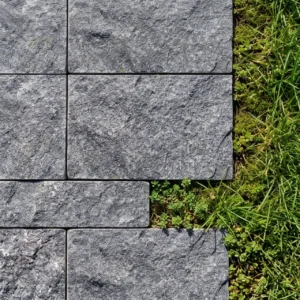
Under wheels, density is non-negotiable. Black basalt pavers is the benchmark — an extremely dense volcanic stone that laughs at axle loads — and dense limestone in driveway thickness performs superbly while keeping the light, heat-reflecting surface. Porous, soft stone has no business under cars.
Thickness: 5 cm and up
Pedestrian rules do not apply. Vehicle areas want 5 cm (2 in) minimum on a properly built base; heavier service vehicles argue for more. The freight math still matters — at roughly 80 kg per square meter per 3 cm, driveway stone is heavy cargo — which is why driveways are quoted precisely rather than guessed.
The base is the driveway
Stone rides on its base, and the base is the actual structure:
- A compacted, well-graded sub-base with adequate depth for the soil
- Laid to falls, so water never sits under the surface
- The stone above it doing one job only — wearing surface
Skimping here is how driveways fail regardless of surface material, so insist your contractor details the build-up in the quote.
Rain: design for the deluge
Jamaican rain arrives in volume. Driveways want generous falls (1.5–2% minimum), and on slopes, texture: a bush-hammered or coarse brushed finish keeps tires and feet gripping when water sheets. Where runoff concentrates, a drainage channel beats hoping. Permeable-jointed designs — wider joints with open-graded aggregate — let water soak between units and take pressure off drains entirely.
Edges hold everything together
Vehicle turning forces migrate pavers sideways unless the perimeter is locked: a concrete haunch below grade, a soldier course, or a curbstone edge doing the visible version of the same job. Edge restraint is the difference between a driveway at year ten and a spreading one at year three.
Installation method matters as much as the stone itself. Industry guidance separates mortar-set work, sand-set exterior paving and pedestal systems, and stresses that drainage, movement and substrate condition drive long-term performance more than the material name does — the detailing guidance is worth reading before you specify.
Pattern under pressure
Herringbone is not just decorative on driveways — its interlock distributes braking and turning forces better than running bond. Save stack bond for terraces; under wheels, interlock wins.
Send the driveway dimensions and slope situation and Kareem will quote stone, thickness and quantities to Kingston or Montego Bay — samples first, escrow available, details in the Jamaica supplier guide.
The water ledger of a sloped drive
Do the water arithmetic once and drainage stops being abstract. A 100 m² driveway in a 50 mm/hour tropical cell receives five cubic meters of water an hour — five metric tons trying to go somewhere. Three details move it:
- A 2 percent crossfall, pushing it sideways into a planted swale or channel drain before it accelerates downhill
- Permeable joints, drinking a share into the base
- An interceptor channel across the run, catching what the crossfall misses
Base construction, specified so you can check it
Hold your contractor’s quote against this checklist: topsoil and organics stripped to firm formation; formation compacted and shaped to falls; geotextile separator on clay or soft ground; granular sub-base (well-graded crushed stone) laid and compacted in lifts of no more than 150 mm — total depth to suit soil and loads, commonly 150–250 mm for cars on decent ground and more on clay; then the bedding layer and the 5 cm stone. Ask to see the compactor on site and the lifts as they go in. A contractor happy to show the layers is a contractor building them.
Jamaica quarries a great deal of its own rock, and it is licensed rather than informal. The Mines and Geology Division issues quarry licenses under the Quarries Control Act covering limestone, marl, shale, andesite and aggregates across the parishes, and separately evaluates high-purity limestone deposits — the division publishes its license register. What that industry supplies is aggregate and fill rather than calibrated dimension stone, which is the gap imports fill.
The apron: where your drive meets the public road
The first meters at the road take the worst punishment — turning lorries, refuse trucks, delivery vans cutting the corner. Detail the apron accordingly:
- Full-thickness stone, or a discreet concrete apron dressed in stone
- Laid in herringbone, which spreads turning load across many joints
- Edges restrained on both sides
- A gentle transition lip that neither scrapes low cars nor invites the road’s water in
Gates, gradients and grip
Automated gates add two stone considerations: a dead-level threshold band for the gate track or swing clearance, and discipline about falls immediately around it so water never ponds against the mechanism. On genuine gradients — common in Jamaica’s hills — favor the coarser textures (bush-hammered over fine brushed) for the sloped run even if the flat sections go finer; tires and sandals will cash that texture in every wet season.
Maintenance the driveway actually needs
Stone drives ask little:
- Sweep, and wash occasionally
- Top up jointing sand where tires turn
- Walk the edges yearly, looking for the first hint of restraint movement
- Blot and lift oil drips with a stone-safe degreaser
Budget an hour a season. Compare that with resealing cycles and crack-chasing on the alternatives.
Costing a driveway like a builder
Driveway budgets split roughly into thirds, and knowing the split prevents false economies:
- A third below ground — excavation, base materials, compaction: the part that decides longevity
- A third in the stone itself — area by thickness by material grade
- A third in labor and details — laying, edges, drainage, apron
Owners tempted to trim usually attack the visible middle third, when the invisible first third is what fails.
Shared lanes and neighbor realities
Many Jamaican drives begin as shared lanes, and stone brings out the property-line questions: agree in writing who maintains what, keep your restrained edge inside your boundary, and where heavy neighbor traffic (trucks to a farm plot, a guesthouse’s deliveries) crosses your surface, size thickness for their vehicles, not yours. A drive built to the heaviest user’s axle load is a courtesy that protects your own investment — and a documented one prevents the classic lane dispute five years on.
Integrating services along the run
The drive is usually the property’s service corridor — water, power and comms all want the same route downhill. Coordinate once:
- Trenches dug and sleeved before base works
- Marker tape at code depths
- Spare conduit laid while the trench is open, the cheapest meter of ducting you will ever buy
- Chamber covers specified as recessed trays that accept the field stone, so inspection points vanish into the surface
Specifying driveway stone for Jamaican rain
Expect and welcome the settling-in signs: jointing sand seats under the first months of tires (top up once, then it stabilizes); the surface sheds its factory brightness toward its permanent tone within a season of sun and rain; and micro-adjustments — one proud edge, one low corner at the apron — announce themselves early, while the installer’s return visit is a courtesy rather than a callout. By month twelve the drive has stopped being a project and become geography — which is the whole idea.