What an Apron Has to Survive
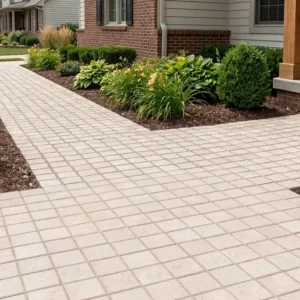
The apron is the piece of a driveway that meets the public road, and it takes punishment nothing else on the property takes. Vehicles arrive at an angle, brake, turn and accelerate across it. Delivery and service vehicles use it whether or not the design allowed for them. In the US Virgin Islands it also has to survive storm runoff coming off the road itself, which is why an apron detailed to the same build-up as the rest of the driveway is being asked to do a harder job than the drawing allows for.
Turning Loads Are Not Rolling Loads
A wheel rolling in a straight line pushes down. A wheel turning under load pushes sideways as well, and it is the sideways force that moves paving.
- Steering torque drags at the top of every unit it crosses, so joints open before the units themselves show wear.
- The forces concentrate in a small area, usually where drivers turn in from the road every single day.
- Small units share that load between many pieces instead of levering one large slab.
- Deeper units are harder to tip, and tipping is what causes rocking under a turning wheel.
- Restraint at the road edge decides whether the field stays tight or slowly spreads outward.
Left-Hand Driving Changes the Geometry
The territory drives on the left. That is unusual for a US jurisdiction and easy for a mainland designer to miss, but it decides which way vehicles swing into a property and therefore where the wear falls. The turning arc, the sight line and the side of the apron that takes the tightest lock all shift. It affects delivery too, because which side of a truck can open against a bank or a wall is not the side a mainland site plan would assume.
Depth, Bedding and the Base Question
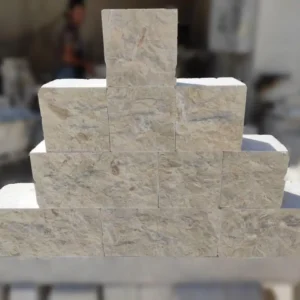
Vehicle areas are a base problem before they are a stone problem. A wearing surface can only be as stable as what sits under it, and on an apron that means a properly built, properly compacted base with drainage designed in from the start. Specifiers choosing sett depths rated for vehicle crossings should fix the base build-up in the same conversation, because a deep unit over a thin base still moves.
- Set base thickness from the heaviest vehicle that will actually use the apron, not the family car.
- Hold bedding to a single depth and correct level in the base beneath it.
- Restrain the road edge with a curbstone or a haunched detail that cannot be pushed outward.
- Keep joints tight and filled, because open joints are where turning loads begin their work.
Basalt, Aggregate and Two Different Products
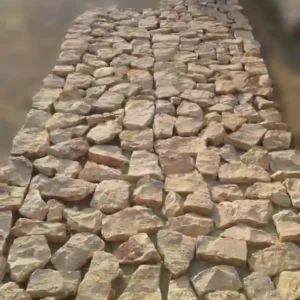
Basalt is an obvious question on a USVI driveway, and the distinction needs stating plainly rather than glossed over. Aggregate Inc. operates the Ham’s Bluff Quarry on St. Croix, producing bluestone basalt construction aggregate for road base, asphalt and ready-mixed concrete, and moving it by tug and barge to other Leeward islands. That is a different product category from what a dimension-stone supplier ships. Citadel supplies dimension-sawn, calibrated architectural paving: units cut to a set face size and a set thickness so they can be laid as a wearing surface. A driveway generally needs both, with locally supplied material building the base and cut units forming the surface on top.
- Base course, sub-base and concrete are supplied locally, and that is the sensible way to buy them.
- The wearing surface is a dimension product, cut and calibrated before it ever ships.
- Ask for face size, thickness tolerance and finish on any unit going into a vehicle area.
- Keep the two lines separate on the schedule so nobody prices a wearing course against a base material.
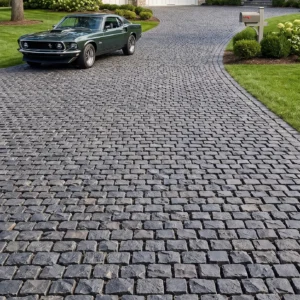
Where a darker surface is wanted, our basalt paving in calibrated thicknesses is sold with published face sizes and depths.
Edge Restraint and the Scour Case
Water arriving off the public road hits the apron first. In heavy rain it runs along the edge looking for a way under the bedding, and once it finds one it carries fines away with it. Scour under an apron edge is a slow failure that shows up as a dip near the road months after the work is finished. A restrained edge, a defined drainage path and jointing that stays in place are the three details that prevent it.
What 2017 Left Behind
Two Category 5 hurricanes crossed the territory within roughly two weeks in September 2017. Irma struck St. Thomas and St. John on 6 September, and Maria struck St. Croix on 19 and 20 September, with winds of 99 to 104 mph recorded on St. Croix and gusts to 137 mph. Officials reported that 90 percent of buildings in the Virgin Islands were damaged or destroyed. Post-2017 reconstruction is one of the main categories of current work, and FEMA-funded rebuild work carries floodplain-management conditions administered by the DPNR Division of Permits. Apron work near the shoreline can also fall under Coastal Zone Management, a separate DPNR division.
Pricing and Delivering the Apron
An apron is small in area and disproportionate in cost, so it deserves its own lines on the schedule.
- Measure the apron separately from the driveway, since it often needs a deeper unit and a heavier base.
- Price the edge restraint as its own line rather than folding it into a paving rate.
- Confirm which port the material lands at and who clears it before you fix a start date.
- Allow for a sample panel laid on site so the client approves the pattern under real light.
Tell us the vehicles, the turning geometry and the island, and we will size the apron units around them.