What an apron actually takes
Ask most people what a driveway carries and they will tell you the weight of a car. That is the easy part. The apron carries something more destructive: the horizontal force of a tire scrubbing sideways while the vehicle is barely moving. Every delivery van that swings in off the road, every SUV that reverses out in three movements, every landscaping trailer that pivots at the entrance loads that small area in a direction the surface was never designed to resist. On Cayman lots, where wall-and-gate entrances are narrow and the turn happens in a short space, the apron absorbs nearly all of it. The rest of the drive sees the same vehicles traveling in a straight line at walking pace, which is a far gentler duty. That is the argument for spending money on the first few yards and being economical everywhere behind them.
Why turning is worse than driving
Straight-line traffic pushes down. Turning traffic pushes down and sideways at once, and the sideways component is what moves paving units.
- A steered tire under load drags the surface rather than rolling over it.
- Braking at the gate concentrates that drag in the same square yard every time.
- Reversing repeats the load in the opposite direction, so nothing settles into place.
- Delivery vehicles arrive heavier and turn tighter than the owner’s own car.
- Rain fills the joints and lubricates any unit that is not fully restrained.
Unit depth and joint width
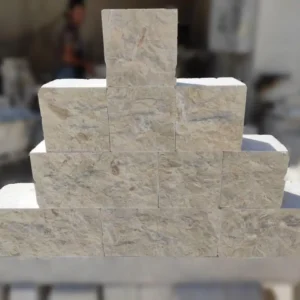
Depth is what resists rotation. A shallow paving unit under a turning tire behaves like a tile; a deep one behaves like a small pier locked between its neighbors. That single difference is why vehicle areas get specified in thicker material than terraces do, and why the conversation about cobblestone sett depths and sizes belongs before layout rather than after it. Joint width matters just as much. A joint that is too wide lets units rock; a joint starved of filler collapses under wash. Keep them consistent, keep them full, and top them up through the first season while the surface beds in.
Edge restraint at the road
An unrestrained edge is where nearly every apron failure begins. The units at the boundary have nothing on one side, so they migrate outward under turning load and open the joints behind them. From there the failure walks inward.
- Restrain the road edge with a buried haunch or a proper stone edge, never with soil alone.
- Carry the restraint around the full radius of the turn, not just across the straight face.
- Keep the top of the edge slightly below the surface so vehicles do not clip it.
- Match the edge material to the paving so a later repair is not a visible patch.
Where a defined line is wanted, matching curbstone edge restraint does the structural job and the visual job in one component.
Bedding choices for vehicle areas
There are two honest approaches and one bad habit. The bad habit is laying vehicle paving on the same shallow build-up used for a patio and hoping the stone carries the difference. The honest approaches are a properly compacted flexible construction with a deep base and restrained edges, or a rigid construction with the units bedded and jointed in mortar over concrete. Rigid work is common at Cayman entrances because so many properties already have a concrete apron that can serve as the base, which turns a rebuild into an overlay and keeps the site working while the job runs. Whichever route you take, the decision belongs before the stone is ordered, because unit depth follows the construction rather than the other way around. Ask whoever is laying the work which method they have priced, and get the answer in writing.
Delivery weight and the barge leg
Thicker stone means fewer square feet per ton, and that changes logistics before it changes budget. George Town is a lighterage port, so cargo transfers from ship to barge and comes ashore that way rather than across a container berth. Every pallet is handled more often than it would be on the mainland, and heavy vehicle-grade units are the least forgiving thing to handle badly.
- Confirm pallet weights early so island-side trucking is booked correctly.
- Ask for packing that survives several lifts rather than one clean quay transfer.
- Allow standing space at the gate, since single-lane roads leave no room to improvise.
- Sequence the apron last if the entrance is also the site access route.
What goes wrong, and how it gets fixed
Aprons fail in a recognizable order: joints empty, edge units creep outward, a wheel path dishes, then water finds the low spot and accelerates everything. Caught early the fix is small, and that is the quiet advantage of unit paving over a poured surface. You lift the affected stones, correct the base, and relay the same material with no color mismatch and no saw line across the entrance. Keeping a small stock of spare units from the original delivery turns that repair into an afternoon rather than a shipping exercise, which matters on an island where the nearest replacement piece is a container away. The character of a driveway is decided at the entrance, and the entrance is decided by depth, restraint and joints. Build the apron for the turn and the rest of the driveway takes care of itself.