A plan built around two seasons
Most maintenance advice written elsewhere assumes four mild seasons and a slow calendar. Jamaica runs on a different clock: a drier stretch when dust and salt film dominate, and a wet stretch when rain, humidity and biological growth take over. A floor care plan that ignores that split will be wrong for roughly half the year.
The practical response is to think in two routines. One handles daily and weekly work regardless of season. The other is a short seasonal pass, done twice a year, that deals with whatever the last few months have deposited on the stone. Write both down. A routine that lives only in one person’s head disappears the week that person goes on leave.
What actually lands on the floor
Before choosing a product, be clear about what you are removing.
- Airborne salt on coastal properties, which leaves a fine film and pulls moisture out of the air.
- Fine grit and road dust tracked in from streets and driveways, the main abrasive agent in urban work.
- Organic litter from planting, which stains where it sits wet against stone for days.
- Pool chemistry carried on wet feet, which is far more concentrated at the coping than anywhere else.
- Biological growth in shaded, poorly drained corners, especially through the wet months.
Daily cleaning without damage
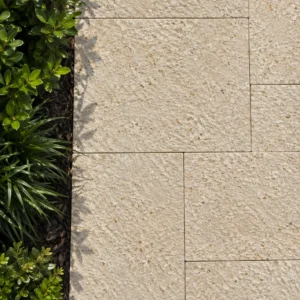
Limestone is a calcium carbonate stone, which settles the chemistry question immediately: acids attack it. That rules out most supermarket bathroom cleaners, descalers and vinegar remedies, however well they work on other surfaces. The routine that keeps a floor looking right is unglamorous and cheap, and it is the single biggest factor in how Jamaica limestone tile specifications perform over a decade of use.
- Sweep or dust mop first, because grit left underfoot does the scratching, not the mop.
- Use a pH-neutral stone cleaner diluted as directed, never an acidic or strongly alkaline product.
- Change the water when it turns gray, since dirty water simply redistributes what you lifted.
- Deal with spills quickly, particularly citrus, wine and pool chemicals near copings.
What sealers do and do not do
An impregnating sealer soaks into the stone and slows liquid absorption, buying you time to wipe a spill before it becomes a stain. That is the whole promise. It is not a coating, it does not stop physical wear, and it will not prevent acid etching if somebody attacks the floor with the wrong product. Reapplication intervals depend on traffic and exposure rather than on a fixed number of years, so test rather than guess: drop water on the surface, watch whether it beads or darkens the stone within a few minutes, and reseal the areas that fail. Do that test zone by zone rather than room by room. A pool coping and the corridor twelve feet behind it wear at completely different rates, and treating the whole floor on the coping’s schedule wastes material while treating it on the corridor’s schedule leaves the coping unprotected.
Salt on the coast, growth in the hills
The two halves of the island’s maintenance problem are geographically split. On coastal terraces from Negril round to Ocho Rios, salt film is the constant, and the answer is plain fresh water rinsing on a regular cycle before the film builds. Inland and upland, where the Blue Mountains pull heavy orographic rainfall out of the trade winds, the constant is dampness and shade, so the priority becomes drainage, airflow and cutting back planting that keeps stone permanently wet. Very few properties have only one of these conditions. A house above Kingston can have a salt-washed roof terrace and a damp shaded courtyard within thirty steps of each other, and the two need different visits on different intervals rather than one blanket cleaning day.
After a storm passes
Hurricane season is a maintenance event, not just a structural one. Gilbert in 1988 remains the national reference point, and design wind speeds were subsequently raised from 120 mph to 150 mph; Beryl’s pass along the south coast in July 2024 was a reminder that the exposure is current.
- Clear organic debris quickly, since leaf litter left wet on stone stains within days.
- Rinse salt spray off exposed terraces with fresh water once it is safe to work outside.
- Check joints for washout and re-point before the next system arrives.
- Look for movement at edges and steps, where undermining shows up first.
Hotel floors and commercial duty
Resort and commercial floors need a written routine rather than a habit, because the people doing the work change.
- Post the approved cleaner and dilution where housekeeping can see it, in plain language.
- Ban acidic products from the store cupboard entirely, rather than relying on memory.
- Schedule sealer testing by zone, since pool decks and corridors wear at very different rates.
- Keep matched reserve tile for damage repairs so patches do not stand out.
If you want that written up against a specific property, talk to our Jamaica team and we will draft it around the actual layout.
The routine beats the rescue
Almost every ruined stone floor we are called to inspect was ruined by products, not by weather. The climate is demanding but predictable, and predictable problems yield to routine. Sweep, wash with the right cleaner, rinse the salt, test the sealer, repair the joints. None of that is expensive, and none of it needs a specialist visit. Stone that is cleaned correctly simply does not need rescuing.