Start with the load, not the look
The simplest way to overspend on a villa or resort plot is to choose one unit depth for the whole site. One depth is easy to order and easy to price, and it is nearly always wrong somewhere, because a barefoot pool surround and a turning circle for a delivery van are not the same engineering problem. Sort the site by what will cross each surface, then specify against that. The Building Decree BES, the BES Bouwbesluit, is the reference your design team works to for structural safety, and your engineer sets the numbers. Making that decision on paper costs nothing; making it after the units are on a pallet costs a great deal.
Duty bands worth sorting a site into
Walk the plot and mark it up before anything is priced. Colored pencil on a printed plan is enough; the discipline is that every square foot ends up in one band and only one. Four bands cover most residential and small resort work.
- Interior floors, where units are thin, gauged and laid in a bonded bed on a solid slab.
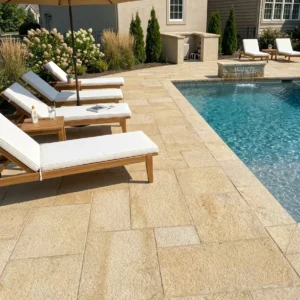
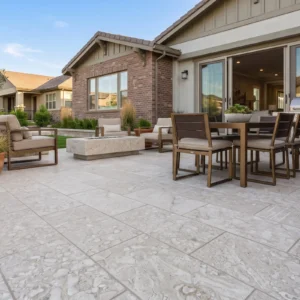
- Terraces, pool surrounds and walkways carrying foot traffic and furniture only.
- Shared paths and service routes taking barrows, carts and occasional light wheels.
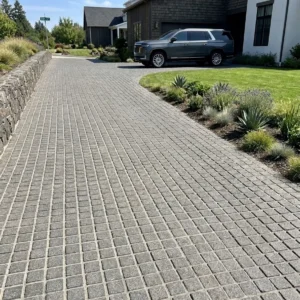
- Driveways, aprons and turning areas where vehicles brake, steer and stand.
Format and thickness move together
A large slab is a beam. The wider the unit, the more it has to resist bending across an unsupported spot in the bed, so generous formats want generous depth. Small units behave differently: a sett carries load by bearing on its neighbors and by friction in the joint, which is why heavily worked areas move toward smaller plan sizes and deeper units at the same time. Depth also governs how much material there is to arrest a crack once one starts, which is why a marginal unit can look sound for a season and then fail suddenly under one heavy load. Choosing a big format and then trimming depth to save money is the combination that breaks.
Where stone meets a turning wheel
Steering loads are the real test. A wheel turning while stationary works a horizontal shove into the surface that straight-line driving never applies, and it finds every weak joint and every soft edge. That is where deeper units held for vehicle areas earn their place, and where edge restraint stops being an afterthought. Point loads deserve the same attention: a jack, a trailer leg or a skip corner concentrates weight onto an area smaller than a single unit, and a surface designed only for distributed load has nothing to spread it into.
Bedding decides more than thickness
The same unit performs very differently depending on what it sits on, so the bedding decision belongs alongside the thickness decision rather than after it. Settle both at the same meeting.
- A bonded bed over a concrete slab spreads load and allows shallower units than an unbound build-up.
- An unbound bed over compacted base wants more depth in the unit and disciplined compaction underneath.
- Base thickness and compaction matter more to long-term levels than the last few millimeters of stone.
- Edge restraint has to be designed for the same duty as the field it holds.
- Joint width and filling material affect how load moves between units, so specify them rather than leaving them to the day.
Ask for gauged units and check tolerance
Nominal depth on a price list is not the same as the depth that arrives on site. Consistent depth is what makes a crew fast, because every unit that has to be packed up or bedded down on its own costs minutes. Ask the questions that make laying predictable.
- Is the unit calibrated on the underside, or split and variable?
- What tolerance applies to depth, and what to plan dimensions?
- Are edges sawn or hand-worked, and how does that change the joint you draw?
- Will a repeat order match, and from which batch will it be picked?
Basalt for the hardest worked ground
Where wheels concentrate and a pale surface would show every tire mark, a dense dark stone is the practical answer. Look at basalt cut for heavy duty areas for aprons, service yards and the strip where vehicles cross a lighter terrace, and keep pale limestone for the areas people walk barefoot. Tone matters as well as strength: a dark surface runs hotter underfoot in full sun, which is a reason to place it carefully rather than a reason to avoid it. Two materials on one plot, each doing the job it suits, is easier to justify than a single compromise depth used everywhere.
Write the spec so nothing is lost
Set dimensions out in millimeters with the inch equivalent alongside, so a US price list and a local drawing set describe the same unit and nobody converts twice. Money needs no such care, because Bonaire uses the US dollar throughout. Give each duty band its own line on the schedule and a supplier can price it without a round of guesswork.
- Area for each band, stated in one unit of measure and not two.
- Format and depth per band, with the tolerance you expect noted beside it.
- Finish per area, including any different finish on steps and thresholds.
- Bedding method and joint width, since both change the unit choice.
A schedule sorted by duty is the cheapest drawing you will ever produce.