Humidity here is coastal, not rainforest
Curacao sits in a hot semi-arid belt, so the moisture problem is local rather than general. Rain is limited, with published records varying between roughly 450 and 650 mm a year, and the wetter months fall from October to December instead of through the middle of the year. What produces damp underfoot is not really the weather; it is the building. Shower rooms, pool surrounds, outdoor kitchens, a gallery that catches driven rain, and the steady traffic of wet feet from the water back into the house. Those zones are where a finish earns its keep, and they can be marked on a plan before anything is ordered.
What a finish actually changes
A finish is not decoration applied to stone. It is the shape of the surface at a small scale, and it moves several things at once. Weigh them together rather than one at a time:
- Grip while the surface is wet, which is the entire point beside a shower or a pool
- How much light the floor throws back into the room
- How visible fine scratches and dried salt marks become
- How easily a mop, brush or squeegee travels across it
- How the stone feels against a bare foot in the afternoon
Every face trades one of these against another. An open texture grips well and hides marking but asks more effort at cleaning; a flat face wipes clean in seconds and returns far more light.
Sawn and honed faces indoors
A sawn face comes off the saw with a fine, even flatness. A honed face is worked smoother again, and it is the usual choice for interior floors that stay dry most of the time and are cleaned with a mop. Neither is polished, and that distinction matters here: polishing puts a reflective skin on stone that glares under a high sun and dulls under blown grit. In bedrooms, living rooms and hallways set back from the water, a honed face gives a calm floor that is easy to keep. The moment that same floor runs toward a shower or a pool door, the argument changes completely.
Brushed, tumbled and bush-hammered faces
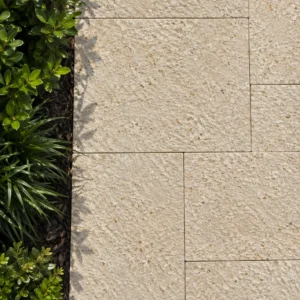
Break the surface and it behaves differently under water. Brushing leaves a fine, consistent texture. Tumbling rounds the edges and gives a softer, older-looking unit. Bush-hammering pits the face harder and produces the most grip of the three. Choosing among them is easier once you know where each is going:
- Brushed for interior wet rooms and covered galleries
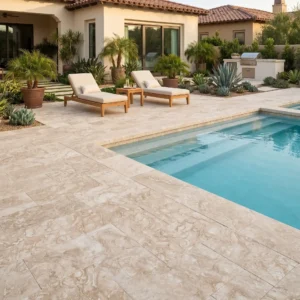
- Tumbled for pool surrounds and terraces that should read softer
- Bush-hammered for ramps, steps and surfaces that stay wet
- Sawn or honed for dry interior rooms cleaned with a mop
Work from limestone flooring picked by its texture rather than from a photograph, because a photograph flattens the exact property you are trying to choose.
Wet feet and the two doors that matter
Two thresholds cause most slip complaints: the shower door and the door in from the pool. Both carry water onto a surface that was chosen for a dry room, so detail them deliberately:
- Change the finish at the junction rather than trusting a bottled product
- Set a run of textured units into the same stone on the wet side
- Keep that textured zone continuous, not a strip children can jump over
- Allow for spray on the windward side, where a terrace is rarely dry for long
Salt film is the hidden variable
On the east and north-east coasts the trade wind blows more or less constantly, in the range usually quoted as 15 to 25 knots, and it carries salt aerosol inland. Salt dries as a fine film. On a flat surface that film can feel slick underfoot until it is washed away, which is why an indoor finish that seemed safe sometimes disappoints in a sea-facing gallery. A dense, low-absorption stone helps, because less of the salt solution is drawn into the surface to begin with, and a broken face means the film never forms one unbroken plane. Rinsing exposed areas with fresh water after a windy spell clears it before anyone notices the difference underfoot.
Testing grip without a laboratory
Published slip figures are useful for narrowing a shortlist, but the honest test is physical and takes a few minutes:
- Wet the sample and stand on it barefoot, then again in a flip-flop
- Tilt it slightly to imitate the fall you intend to build
- Leave it a week in the position it will occupy and look again
- Scatter a little sand across it, because that is what the wind delivers
Read what each surface treatment does before you shortlist, then confirm the shortlist underfoot. Descriptions narrow the field; only the sample settles it.
Matching the finish to the room
Write the finish into the schedule room by room instead of picking one face for the whole house. A villa can reasonably run a honed face through the dry interior, a brushed face in the bathrooms, and a tumbled or bush-hammered face outside, all cut from the same stone so the tone stays consistent throughout. Decided before the lot is cut, that approach adds nothing at order stage, and it removes the compromise where a single face has to serve a bedroom and a pool step at once. Pick the stone once, then pick the face four times.