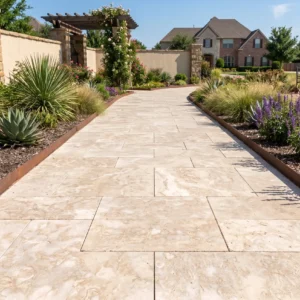
Start from the room, not the sample board
Tile schedules go wrong at a predictable moment: somebody falls for a face, orders it in whatever size the photograph showed, and then discovers the room needs cutting on three sides. Format is a plan decision. On an Aruban project it is worth making that decision before the finish, before the tone, and certainly before the quantity.
The rooms themselves vary more than the island’s size suggests. A Palm Beach apartment, a low-rise unit on the Eagle Beach corridor, a villa in Noord and a commercial floor in Oranjestad each want a different module for reasons that have nothing to do with taste.
The words you will meet on an Aruban specification
Aruba is a constituent country of the Kingdom of the Netherlands, and four languages are in everyday circulation. A drawing set can arrive with Dutch trade terms sitting beside English dimensions, and a site conversation can move between Papiamento, Dutch, English and Spanish inside a single sentence. None of this causes trouble so long as the order sheet itself is unambiguous.
- Tegels: tiles, the word most likely to appear on a Dutch-language schedule.
- Klinkers: pavers, generally the outdoor units rather than interior floors.
- Cunucu: the traditional Aruban country house, a term you may meet.
- Write final quantities in one agreed unit system on the purchase order.
Format against room size
Large units suit large uninterrupted floors and quiet, continuous surfaces. Smaller units suit broken plans, falls, curves and anywhere the floor has to be cut around fixed obstacles. The answer usually begins with limestone tile in repeatable sizes rather than with one-off dimensions, because a repeating module lets a tiler set out cleanly and lets you order accurately.
- Open living floors: larger modules, fewer joints, calmer visual field.
- Corridors and stairs: modules that divide the width without a slim cut.
- Terraces with falls: smaller units follow a gradient more forgivingly.
- Bathrooms and wet zones: smaller formats, more joints, better drainage detail.
- Mixed schemes: one shared module family across zones, varied by finish.
Condominium and renovation floors
Aruba’s resort corridor runs renovation work on a cycle, and refurbishment inside an occupied building carries constraints a new villa never faces. Access runs through service elevators and loading bays with real size limits. Deliveries land in staged lots rather than as one drop. Substrates are whatever the original build left behind, which usually means the leveling allowance matters more than the tile does. Plan the format around what can physically be carried to the door, and confirm crate dimensions before the order is placed rather than after it lands. It is worth agreeing where material will be stored between drops as well, since an occupied building rarely has spare floor area to lend and stone parked in a corridor is stone at risk. A staged delivery plan drawn before the order goes in removes most of that friction.
Villa floors and the indoor-outdoor line
Villa country in Noord and Malmok tends to blur the line between inside and outside, with a living floor running to a slider and a terrace continuing beyond it. That detail is worth drawing properly. The two floors face different conditions, need different falls and may want different finishes, yet the design intent is usually that they read as one continuous surface. Keeping the module identical across the threshold and changing only the finish is the tidiest way to achieve it. Pale material helps the illusion, and pale white limestone in tile form carries the tone through the glass without a visual break.
Set-out, joints and waste
Set-out is where a good format earns its keep. Start the grid from the sight line that matters most, usually the main entry view or the longest wall, and push the cuts toward the least visible edge. Agree the joint width early, because it changes the coverage calculation. And order a genuine surplus rather than a token one.
- Set out from the primary view, not from the most convenient corner.
- Agree joint width before the coverage is calculated, not afterward.
- Carry extra material for cuts, breakage and future repairs.
- Keep spare tile from the same lot on site once the job is finished.
Crates, pallets, and the invoice line that costs money
Aruban cargo is consigned to Barcadera, the island’s cargo port since it opened on 12 April 2016; Oranjestad now handles cruise and passenger traffic only, so the bill of lading needs to say Barcadera. One invoicing detail is worth more than most negotiating: Aruba Customs values imports on a CIF basis, and where freight and insurance are not itemized on the invoice, a surcharge of 16.5 percent is added to the invoice value on shipments from the Americas.
- Itemize freight and insurance separately on every commercial invoice.
- Name Barcadera as the discharge port on the shipping documents.
- Confirm crate sizes against the site access before production begins.
- Ask your broker to confirm the duty classification for your product.
Getting the schedule right first time
Send a plan with room names, dimensions, thresholds and finishes marked, and the format conversation becomes a short one. Ambiguity is what costs money on an island order, because a correction means another shipment rather than another trip to the yard.
Draw the module before you choose the stone, and the rest of the order falls into place.