Heat that never really lets up
Aruba does not have a hot season so much as a hot year. The island sits in the arid southern Caribbean, below the main Atlantic hurricane track, and the trade winds cross it more or less without pause. That gives a floor an unusual job. It is not being asked to survive a storm season. It is being asked to stay comfortable under strong sun, day after day, while a dry wind carries salt and fine grit across every surface it touches.
So the useful question on an Aruban project is not which floor photographs coolest. It is which floor holds a sensible surface temperature in a room that takes sun for most of the day, and keeps holding it once the newness has worn off.
What actually makes a floor feel cool
Surface temperature comes down to three things: how much solar energy the face absorbs, how quickly it moves heat away from the point of contact, and how much mass sits beneath it to soak that heat up. A pale, dense stone does respectably on all three. It reflects a larger share of the light that lands on it, it draws heat away from a bare foot instead of holding it at the contact point, and the slab beneath gives that heat somewhere to go.
- Lighter tones absorb less solar energy than dark ones in identical sun.
- Density carries heat away from skin rather than storing it at the face.
- Bedded stone borrows thermal mass from the structure below it.
- Shade remains the single strongest variable on any terrace.
Why pale limestone reads cooler underfoot
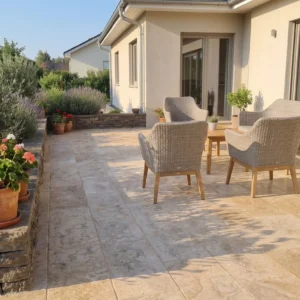
This is where stone tile chosen for heat comfort pulls away from a material picked on looks alone. Pale limestone is not a trick. It starts from a lower absorbed load, and it carries no polymer surface layer to trap warmth the way some manufactured products can. Honed faces and lightly textured faces both work here. What you are steering around is a dark, glossy, heat-holding surface on a floor that people cross barefoot between the pool and the door.
Orientation, and what the trade wind is doing
Wind is a comfort asset on this island, and it should change your floor decisions. A terrace open to the breeze sheds heat faster than an enclosed courtyard of the same size and finish, and it also collects more airborne salt and dust, which is a maintenance question rather than a comfort one. Work through the plan zone by zone instead of specifying one tile for the whole property.
- Wind-facing terraces: cooler in use, dirtier by the week.
- Enclosed patios and light wells: warmer, calmer, less rinsing required.
- Palm Beach and Eagle Beach balconies: sun, wind and salt arriving together.
- Noord and Malmok villa yards: long unshaded runs between house and pool.
- Interior rooms: governed by air conditioning rather than by sun load.
The island’s own building memory
Aruban building did not historically run on cut stone floors. The traditional cunucu house was made from what the island had to hand: caliche from the hills of the south-east, and dry-laid coral rock walls fitted so closely that they held without mortar, many of them still standing today. That walling craft is now largely a lost art, and it was never a floor-paving tradition. On an older or sensitive property that inherited fabric is walling rather than flooring, so imported tile arrives as a new floor rather than as a restoration match.
Indoors, the sums change
Inside a conditioned room the sun load mostly disappears and the floor becomes a comfort surface rather than a thermal one. Stone reads cool to the touch in an air conditioned house. Some households want exactly that, and anyone who does not can put rugs in the seating zones. What matters more indoors is that the tile is flat enough to lay with tight joints, and stable enough not to shift as a room swings between a closed, cooled afternoon and an open, wind-washed evening.
- Flatness matters more indoors than either tone or texture does.
- Tight joints depend on gauged thickness across the whole lot.
- Rugs answer anyone who finds stone too cool underfoot.
- Sun through large glazing still loads an interior floor.
Thickness, bedding and what sits below
Comfort is only half a specification. The rest is whether the floor stays flat. Aruba hands you one genuine scheduling advantage: with no hurricane season to design around, installation runs on a twelve-month calendar and there are no storm-prep stand-downs to work around. Freight, duty and landed cost are set out on our Aruba stone sourcing page, and they belong in the budget before anyone picks a tile.
- Interior floors: gauged tile in thinner sections, laid on a level prepared bed.
- Terraces and pool surrounds: heavier units with falls set away from the building.
- Vehicle areas: a different decision entirely, since depth and bedding both change.
- Movement joints: drawn on the plan rather than improvised on site.
Specifying it without guesswork
Send us the room-by-room use, the sun exposure of each area, and which surfaces are walked barefoot. Local pricing sits against the Aruban florin, pegged at 1.79 to the US dollar, so agree early which currency the quotation is written in. Turnover tax has been collected at the border since 1 August 2023 and import duty varies by product classification, so confirm the current rates for your tariff line with your customs broker before you commit.
Choose the stone for the way the floor is actually walked on, and Aruban heat stops being a design problem.