Where the Curves Come From on Hilly Ground
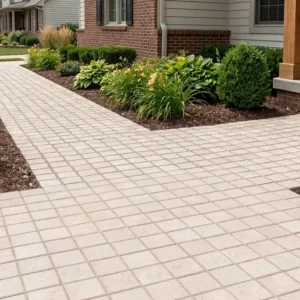
Hillside ground shapes the plan more than the plan shapes the ground. A driveway that climbs has to loop rather than run, a boundary wall follows an old plot line rather than a grid, and a courtyard between buildings takes the shape those buildings left behind. Curves arrive whether or not the design asked for them.
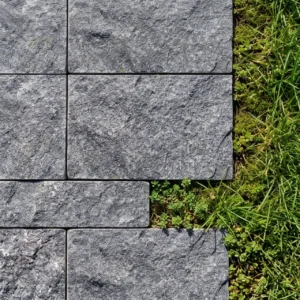
Large format paving is at its worst in that situation. Every curve becomes a series of cuts, every cut wastes material, and the finished surface reads as a straight-line product forced around a bend. Small units are the opposite. They were always going to turn.
Why a Small Unit Can Turn
The geometry is simple. A paved curve is made by fanning the joints, and the amount a joint can open or close before it looks wrong is limited. A short unit needs only a small change in joint width per course to swing the line. A long unit needs a large one, and past a point the joint stops looking deliberate.
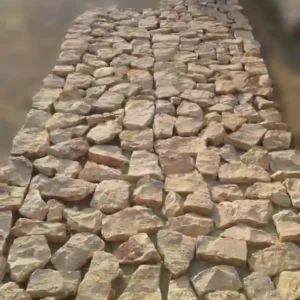
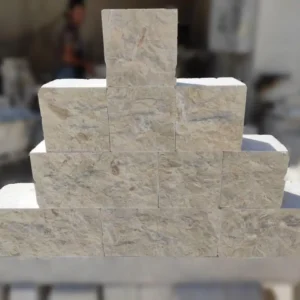
That is why a cobblestone sett follows an arc a slab cannot. It is also why the smallest unit in a range is usually right for the tightest radius on a job, even where a larger unit works everywhere else on the same site.
Fan and Radial Coursing
Radial work is the classic answer to a curve and comes in several forms. Each has its own setting-out method and its own tolerance for error, which is worth knowing before the first course goes down. Getting sett coursing around a bend right is mostly a matter of choosing the method first.
- Concentric arcs follow the curve directly, each course held a constant distance from the last.
- Fan or arc segments repeat a single motif, which absorbs small variations in the radius.
- Radial coursing struck from a center point works where a genuine center exists on site.
- Segmental fans suit long sweeping curves where a single center is too far away to reach.
- A soldier course on the outside of the arc gives the eye a clean line to read.
Bonds Where the Shape Allows
Not every curved area wants a radial pattern. A courtyard with one curved edge and three straight ones often reads better with a straightforward bond in the field and the curve resolved at the boundary. Running bond laid parallel to the dominant wall keeps the space calm and pushes the cuts to one side, where a restraint can hide them.
Herringbone earns its place where vehicles are involved, because the interlock resists movement in more than one direction at once. In a court that is walked far more than it is driven, the choice becomes largely visual, and a simpler bond reads more calmly across a small area.
Setting Out Before the First Course
Curved work is unforgiving of improvised setting out. An error of a few millimeters per course is invisible at course three and obvious at course thirty, and by then it cannot be corrected without lifting.
- Establish the center point or the spring points on the ground and mark them permanently.
- Set the outside line first and work inward, so the visible edge carries the accuracy.
- Dry-lay a sample arc of several courses before any bedding goes down.
- Decide the joint width range at that stage and write it on the drawing.
- Check the arc against the string every few courses rather than only at the end.
Cuts, Closers and Waste
Curves generate cuts, and cuts generate waste. That is not a fault in the design, it is arithmetic. The real question is whether the waste allowance in the order reflects the actual geometry or a default figure carried over from a rectangular job.
- Radial fields need a larger allowance than straight fields of the same area.
- Half units used as closers reduce waste where the range includes them.
- Cuts should land against a restraint or a soldier course, never in the open field.
- Keep offcuts on site until the last course, because small pieces resolve awkward closers.
What the Pattern Does Under Load and Water
Pattern is not only a visual decision. A bond that interlocks across the direction of travel spreads a wheel load into neighboring units, while a bond lined up with that direction hands the load to one continuous joint. On a court that takes occasional vehicles the difference shows up quickly.
Water behaves the same way. Continuous joints running downhill become channels, and channels move jointing material out of the surface. Where a court falls in one direction, turning the bond off the fall line is a small drawing change that pays for itself in maintenance.
Draw It Before You Order
Order quantity depends on the pattern, so the pattern has to be settled first. That sequence gets reversed easily, and a sett order priced before the pattern was chosen tends to come up short. If you want to compare the options side by side, our guide to sett bonds covers how each is set out.
- Draw the field, the curve and the edge treatment at a scale you can measure.
- Count the courses in the tightest radius before choosing the unit size.
- Fix the joint width, then convert area into units rather than into square feet alone.
- Add the waste allowance the geometry actually implies, not a standard figure.
Send us the layout and we will size the setts and the closers to suit the curve.