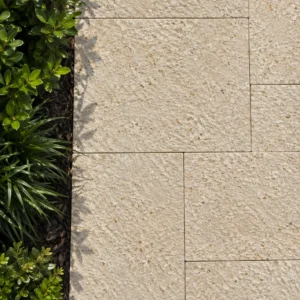
St. Barths counts its beaches in anses – the small, named bays that scallop the coastline, each with its own character and its own villa culture. Flamands runs wide and hotel-flanked; Lorient keeps a village surf rhythm; Grand Cul-de-Sac shelters lagoon watersports behind its reef; Saline and Gouverneur stay gloriously undeveloped behind their dunes. A beach villa here is really an anse villa – built to its bay’s particular temper – and the stone work follows a register that changes surprisingly little from bay to bay.
Reading the Anse
The first specification question is the bay’s own: which way it faces, what the winter swell does, how far the salt mist carries. North-facing anses take the winter’s occasional swell events and detail their sea edges accordingly; the sheltered lagoon bays let terraces run close to the water; the wild southern beaches keep architecture behind the dune line entirely, by rule and by sense. An hour with a local builder reading the bay is worth a meter of drawings – every anse has its stories, and the stone plan should have heard them.
The Sand Line
The transition from beach to built lot is the beach villa’s signature detail, and it rewards restraint:
- Paths begin where the sand firms, never reaching for the tide line – the beach stays the beach.
- Steps hold their geometry as the grade rises, with open joints and edges that let blown sand move through rather than pile.
- A rinse point near the transition keeps salt and sand at the threshold – the cheapest floor-protection device ever installed.
- Light tones continue the beach’s palette upward, so the built lot reads as the bay’s continuation rather than its interruption.
paths where sand meets stone details the bedding and edge craft of that transition zone, and it transfers to every anse on this island.
Conservation Manners
The island guards its wild beaches deliberately – Saline and Gouverneur sit behind protected dunes and salt-pond country, and the marine reserve wraps much of the coast. Building near any of it comes with manners that are partly law and wholly sense: nothing built on or through dunes, groundwork kept clear of pond margins, site runoff never allowed to carry fines toward the reef, and lighting designed low and warm where turtle-nesting beaches lie below. The properties that hold their value nearest the wild anses are precisely the ones that treat the wildness as the asset it is.
The Terrace Above the Bay
The beach villa’s main stage is the terrace with the bay view, and its register is the island’s gentlest: pale limestone laid wide and calm, shade at the inland edge, the pool where the plan allows and the view where it insists. Specification runs the standard shore logic – light tones for heat, texture for salt-misted mornings, density for the air itself – with one anse-specific addition: sand arrives on every wind, so surfaces and joints are chosen to sweep clean rather than trap grit underfoot.
Rooms the Climate Builds
Anse villas live outdoors ten months of the year, and the stone plan is really a floor plan for rooms without walls:
- The dining terrace under shade, floored in the interior’s stone carried out under cover.
- The morning coffee corner catching the early light on the bay.
- The outdoor shower – the beach villa’s true luxury – in textured stone that drains fast and dries faster.
- The evening lounge where the day’s heat leaves the pale stone last and gently.
Landing Stone for the Anses
Every crate still arrives the island’s way – through the hub, over the channel, up the lanes – and beach lots add their own last-mile note: access lanes to the anses are narrow and shared, staging happens inside the lot on dunnage clear of the sand, and delivery days respect the beach’s public life. The full route and its disciplines are walked in the island’s two-leg freight chapter, and beach projects follow it with one extra courtesy: the bay was there first.
The Salt Pond Behind the Beach
Several of the island’s anses keep a secret behind the dune line: a salt pond, the shallow basin where the valley’s water meets the sea’s leftovers. The ponds are ecological engines – wading birds, crab country, natural storm buffers – and lots that back onto them build to a particular register. Terraces sit raised and screened for the evening insect hour; pond margins stay natural and unpaved, both by rule and by self-interest, since hard edges against a pond simply relocate its moods; and drainage plans respect the pond’s role as the valley’s receiving basin rather than competing with it. Stone work near pond country leans elevated and breezy – raised walkways, ventilated terraces, steps that climb away from the wet line – and lighting stays low and warm for the birds’ sake as much as the neighbors’. The reward for the respectful register is a double frontage: beach on one side, wild water on the other, and evenings that belong to a landscape most visitors never learn exists behind the famous sand.
The Register Holds
From Flamands’ hotel shore to Gouverneur’s empty dune line, the anse register holds: read the bay, respect the sand line, build the outdoor rooms in the beach’s own palette, and land the materials like a guest. A beach villa in St. Barths succeeds when the anse would hardly notice it arrived – and pale stone, well detailed, is how that trick is done.
The Beach Kit Yard
An anse villa accumulates equipment the way a harbor accumulates boats – boards, snorkels, kayaks, umbrellas, the whole apparatus of a good shore life – and the properties that stay beautiful give all of it a home: the kit yard, a stone-floored working court at the beach path’s landward end.
- The yard floor runs textured stone laid to a center drain, hose-washed in a minute at day’s end.
- Racks and hooks mount on a stone screen wall that hides the working clutter from the terrace’s sightline.
- The rinse point serves boards and bodies both, positioned so drips never cross the finished terrace.
- A shaded shelf keeps wax, sunscreen and small kit out of the sun that ruins them.
The kit yard is the anse villa’s equivalent of the mudroom – the unglamorous stone room that keeps every glamorous room glamorous – and guests use it harder than any surface but the pool deck. Build it at working grade in the villa’s own stone family and the whole property runs cleaner for a decade.
No two anses share the same brief
The island packs many small bays into a very short coastline, and they behave nothing alike. One faces the prevailing wind and takes spray most of the year. Another sits in a sheltered pocket where the sand is fine and the air is still. A third is shallow and busy with day boats. Reading the specific bay before choosing a finish is the single most useful hour of design work on a beachfront plot, because exposure, not taste, is what determines how a surface will look in year five.
- Record which way the plot faces and where spray actually reaches
- Specify against the windward corner, then use the same stone throughout
- Expect fine sand to migrate everywhere, and detail edges for it
- Keep planting back from thresholds that will be swept daily
- Assume salt on every fixing, whatever the aspect
The season sets the maintenance calendar
Beachfront exposure peaks at the same time each year. The climatology published by the National Hurricane Center puts the Atlantic season from June through November, with most activity between mid-August and mid-October and the statistical peak on September 10. On a beach villa that governs both works and housekeeping: hard landscaping belongs in the first half of the year, and anything loose on a terrace has to be clearable in an afternoon during the second half.
- External works front-loaded into the drier, quieter months
- No unrestrained units left near the shore through the peak weeks
- Furniture and planters chosen so the terrace can be cleared quickly
- A written tie-down routine issued to the villa manager each spring
Choosing beach villa stone that works barefoot and wet
The route from house to sand is walked barefoot, wet and covered in sand, which is the least forgiving combination there is. Guidance on testing frictional properties of natural stone walking surfaces describes the ANSI A326.3 wet method and a benchmark dynamic coefficient of friction of at least 0.42 for level interior floors expected to be walked on wet. A beach path sits beyond that reference, so the sensible move is to test the delivered finish and hold a margin above the minimum.
- Wet-tested finishes on every route between house, pool and sand
- Textures that keep grip with sand on them, not only when clean
- Thresholds detailed level so nobody steps down onto a wet edge
- Rinse points drained clear of the walking line
Our St Barths stone supply guide sets out the formats, finishes and lead times that suit this island. Read the bay first, and the rest of the specification writes itself.